


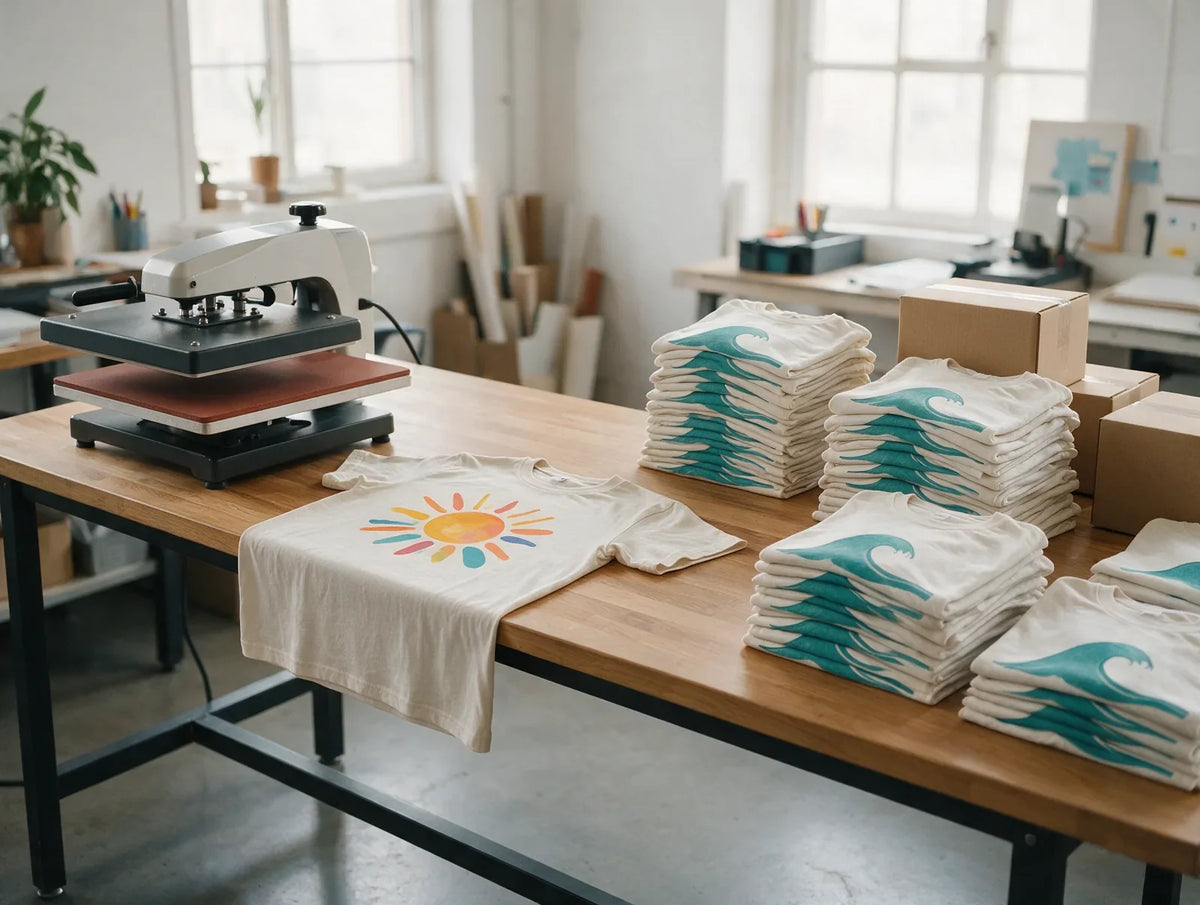
The choice between print on demand vs bulk printing comes down to one trade-off. Print on demand (POD) makes each item after someone orders it, so you hold no inventory but usually pay more per piece. Bulk printing makes the whole run up front, so each piece costs less, but you carry the risk of stock that doesn't sell.
There's also a middle path many small brands use: order DTF transfers and press shirts yourself as orders come in. This guide compares all three on inventory risk, cost per piece, speed, design variety and cash flow, then gives simple rules for choosing.
Key takeaways
- Print on demand: no stock to buy, but a higher cost per piece and thinner margins.
- Bulk printing: the lowest cost per piece on big runs of one design, paid before anything sells.
- Middle path: order DTF transfers with no setup fees or minimums and press shirts as orders come in.
- Test new designs on demand; move steady sellers to a bulk run once sizes and demand are clear.
- Our print on demand works by inquiry, with no store integrations or automatic order sync.
In this guide
- Print on demand vs bulk printing at a glance
- How does print on demand work?
- What are the disadvantages of print-on-demand?
- How does bulk printing work?
- Print on demand vs screen printing: pros and cons
- Print on demand vs bulk printing: what does it cost?
- The middle path: DTF transfers you press yourself
- How do you order t-shirts in bulk?
- Is print on demand still profitable?
- When should you switch from print on demand to bulk?
- Frequently asked questions
- Start lean and scale what sells
Print on demand vs bulk printing at a glance
Print on demand trades a higher cost per piece for zero inventory, bulk printing trades a large upfront payment for the lowest cost per piece, and DTF transfers you press yourself sit in between. Here's how the three compare on the factors that decide most orders.
| Factor | Print on demand | DTF transfers you press | Bulk screen printing |
|---|---|---|---|
| Upfront cost | Little or none | Small, frequent transfer orders plus your blanks | The whole run, paid before you sell |
| Cost per piece | Usually the highest | In between | Lowest on large runs of one design |
| Minimum order | Often none | None: no setup fees, no minimums | Built for runs; quantity sets the price |
| Inventory risk | Lowest: nothing is made until it sells | Low: you stock blanks and transfers, not finished shirts | Highest: the full run is printed up front |
| Speed to the buyer | Production time on every order | Press and ship from stock when an order comes in | Ships from stock, but the run takes planning |
| Design variety | Very high | High: many designs fit on one gang sheet | Low: each design is its own setup |
| Control over blanks and packing | Limited to the partner's catalog and options | Full: your blanks, your packing | Full, set when you order the run |
| Your time | Least hands-on | You press, pack and ship | You store, pack and ship |
Cash flow follows the same pattern: print on demand lets you pay as you sell, while a bulk run asks for the most cash before the first sale. Packing and shipping usually come with print on demand. On the other two paths you ship, and if you sell transfers rather than pressed shirts, we can blind ship orders straight to your customer in unbranded packaging, with our name and address on the shipping label.
Not sure which column describes you? The situation table near the end of this guide matches common cases to the path that usually fits.
How does print on demand work?
Print on demand means nothing is printed until someone orders it. You supply the designs, and a print partner makes each item after the sale; with most app-based services, orders flow in from your online store automatically and the partner prints, packs and ships them. You hold no stock, so there's nothing to store or mark down.
- Upload your designs and choose the products to print them on.
- List those products in your online store or on a marketplace.
- A customer places an order and pays you.
- The partner prints, packs and ships that one order.
- You keep the difference between your price and the partner's base price.
With no stock to buy, print on demand is popular for testing ideas and for shops with wide catalogs. You still own the parts that sell: the designs, listings, prices, marketing and customer service. The partner owns production, from the blank to the print and, usually, the packing.
Many app-based services print with DTG (direct to garment), a method we don't offer. Our guide on how DTF and DTG compare explains the differences.
How our print on demand works
Our print on demand service is inquiry-based, so every project starts with a conversation with our team. There are no store integrations or automatic order sync, which means it isn't a plug-in for your online shop. Start by telling us what you want to make on the print on demand page. For shirts specifically, see print on demand t-shirts.
Prefer to place each order yourself? The DTF path below works with orders you place on our site, whenever you need them.
What are the disadvantages of print-on-demand?
The main disadvantages are a higher cost per piece and thinner margins, less control over the blank, print and packaging, slower delivery because every item is made after it's ordered, and dependence on a partner's catalog and queue. You trade those for zero inventory, which is worth it while demand is unproven.
- Higher cost per piece. Each item is made one at a time, so there's no run to spread a setup across.
- Thinner margins. Platform and marketplace fees, ads and returns all come out of a smaller gap between cost and price. Our guide to pricing shirts to cover marketplace fees shows how to plan for them.
- Less control. You pick from the partner's blanks, print method and packaging, and you rarely see a piece before your customer does.
- Slower delivery. Production time is added to every order before it ships, which matters most for gifts and event dates.
- Dependence on a partner. Price changes, a blank going out of stock or a busy season at their end become your problem, and moving a catalog to a new partner takes time.
- Harder to scale. The cost per piece stays about the same as you grow, so volume doesn't widen the margin the way a bulk run does.
That's why many sellers keep print on demand for testing and move proven designs to DTF transfers or a bulk run, the two paths covered below.
How does bulk printing work?
Bulk printing means producing a full run before you sell it, most often with screen printing. Ink is pushed through a mesh screen onto the garment, and each color in the design needs its own screen. That setup happens once per design, so the cost per shirt drops as the quantity grows.
In a typical run, the artwork is split into one layer per ink color, a screen is made for each layer, and the screens are lined up on the press before the first shirt prints. After that, each shirt goes through quickly, which is where the savings come from.

- Pros: the lowest cost per piece on large runs, consistent results across the order, stock on hand to ship right away and full control of the blank and packing.
- Cons: a large payment up front, the risk of leftover sizes and colors, storage space and one design per setup.
Bulk works best when you already know what will sell: event shirts, staff uniforms, team orders, school spirit wear and restocks of a proven design. Bulk t-shirt orders also make sense when everyone gets the same design in a few solid colors.
We offer screen printing for large runs of one design. For a quote, call (678) 845-6864 or email hello@tidalcolors.com with the design, quantities, ink colors and print locations. If a run leaves extras, our guide covers what to do with leftover merch.
Print on demand vs screen printing: pros and cons
Print on demand wins on flexibility: one piece at a time, any number of designs and nothing paid up front. Screen printing wins on cost per piece and consistency once one design runs in quantity, and on bold, solid colors. The real difference is when you pay and how much risk you carry.
| Factor | Print on demand | Screen printing |
|---|---|---|
| How it's made | One item after each order, usually printed digitally | In a batch, with one screen per ink color |
| Upfront cost | Little or none | A setup for each design and color, paid before printing |
| Cost per piece | Higher, and about the same at any quantity | Falls as the run grows |
| Artwork that suits it | Full-color art, photos, many designs | Bold logos and a few solid colors |
| Consistency | Can vary between pieces and partners | Very consistent across a run |
| Inventory risk | None | Unsold sizes and colors are yours |
| Good fit for | Testing designs, wide catalogs, unpredictable demand | Events, teams, staff and proven sellers |
DTF transfers fit in between. They're printed digitally like print on demand, so full-color art and many designs are fine, but you order them in batches you control, with no setup fees or minimums. Our transfers are lab tested for 100+ washes, and you press each shirt only when it sells.
How DTF compares with screen printing on cost, durability and detail is covered in our guide to DTF vs screen printing, which also weighs screen printing against digital printing in general. Still choosing a method for t-shirts overall? Start with our guide to choosing a t-shirt printing method.
Print on demand vs bulk printing: what does it cost?
Per piece, bulk printing usually costs the least and print on demand the most; up front, it's the reverse. Compare the cost per shirt you actually sell: a bulk run spreads its setup across every shirt but leaves you paying for the ones that don't sell, while print on demand charges more per piece, but only for shirts that sell.
| Path | What you pay for | When you pay | What helps your margin |
|---|---|---|---|
| Print on demand | A per-item price covering the blank, the print and usually packing and shipping | When each order comes in | A higher retail price, or products with more room between cost and price |
| DTF transfers you press | Transfers, blanks, supplies and your own time | In small batches, before you press | Longer, well-filled gang sheets |
| Bulk screen printing | A setup per design and color, printing per piece and the blanks | For the whole run, before anything sells | Larger runs, fewer ink colors and fewer print locations |
What do unsold shirts do to your cost?
They raise the cost of every shirt you do sell. Divide what the run cost by the number of shirts sold: print 100 and sell 80, and each shirt sold carries the cost of 1.25 printed shirts; sell 50 and it carries the cost of two.
So a bulk run beats print on demand only when its cost per printed shirt, multiplied by that factor, still comes in under the print-on-demand price per shirt. Even then, the leftovers need storage space and a plan. Run the same check before every reorder, using the sell-through from your last run rather than a hopeful guess.
On the DTF path, there's no setup fee to spread. A single 12-by-12-inch transfer is $4.51 when you order by size, and the lowest per-foot prices are on long gang sheets: as low as $4.50/ft (about $0.017/in²) on the 20 ft and 40 ft sheets and the 30 ft uploaded sheet. Every size and length is on our page of DTF transfer prices by size and length.
Your blank, labor, packaging and selling fees complete the true cost per shirt; our guide to the full cost-per-shirt formula walks through each part.
For small runs, many designs or names, DTF usually costs less than screen printing because there's no setup to pay off. For a large run of one simple design, screen printing usually wins; our guide to DTF or screen printing for your run compares them by order size.

The middle path: DTF transfers you press yourself
Ordering DTF transfers and pressing them yourself sits between the two. You buy blank shirts and keep transfers on hand, then press a finished shirt only when someone orders it. Inventory risk stays low, and because you do the pressing, more of each sale stays with you.
The setup is a heat press, blank shirts in the sizes and colors you sell, and a supply of transfers. When an order comes in, you press the design onto the right blank, pack the shirt and ship it under your own brand.
- Small orders. There are no setup fees and no minimums on DTF transfers, so you can order a few transfers to test a new design.
- Many designs at once. Fit several designs on one 22-inch-wide gang sheet. Gang sheets start at $5.99 for 1 ft.
- Fast restocks. Orders placed before 3 PM EST, Monday to Friday, are printed and shipped the same day, and transfer orders of $75+ ship free with Standard shipping.
- Stock that keeps. Unpressed transfers last 6–12 months in a cool, dry place when stored flat or rolled.
- Try it first. The free sample pack lets you press real transfers on your own blanks. You pay $4.99 for shipping and get it back as $4.99 store credit, or pick it up free in Alpharetta.
The trade-off is your time: every order means pressing, packing and shipping, so this path suits sellers who own a heat press and can turn orders around themselves. A shop with a dozen designs can put them all on one gang sheet, keep blanks in its usual sizes and press only what sells.
Our guide to starting a t-shirt business with DTF walks through this setup step by step. Selling transfers instead of finished shirts? They ship without Tidal Colors branding; see DTF transfers for resellers for how it works.
How do you order t-shirts in bulk?
Lock the design, pick one shirt style and collect every size before you order. Then match the method to the quantity: screen printing for a large run of one design, DTF transfers or printed apparel with no minimum for smaller or mixed runs, and embroidery for polos, caps and jackets.
- Lock the design and print locations. Decide on front, back or sleeve, and count the ink colors if the design will be screen printed.
- Pick one style and color. Sizing differs between brands and cuts, so choose the exact shirt first. Our guide to choosing blank t-shirts for printing explains what to look for.
- Collect real sizes. Ask for each person's size, youth or adult, instead of guessing. For a group you can't survey, see how many of each size to order.
- Match the method to the run. Choose screen printing for a big run of one design, printed apparel or DTF transfers for smaller or mixed runs and per-person names, and embroidery for polos, caps and jackets.
- Get the price. Screen printing quotes depend on quantity, ink colors and print locations. Finished shirts are designed and ordered on each product page with no minimum order, and transfers are priced by size or sheet length on our DTF pricing page.
- Preview and proofread. Check the design in the online designer or the Gang Sheet Builder preview, and read every name letter by letter.
- Order and keep the records. Save the final size list and files. The Gang Sheet Builder can reopen a sheet you ordered before, which makes the next reorder quicker.
Where to buy blank t-shirts in bulk
Blank wholesalers and apparel distributors sell plain tees by the case, and big retailers and online marketplaces sell multipacks of basics. Whichever you use, check the weight, fiber and size range, and make sure every size you need is in stock in your color, because one missing size stalls the run. A low price per blank isn't a saving if the shirt twists or shrinks after a wash.
Rather not buy blanks? We print on shirts from our own catalog, from Gildan Heavy Cotton tees to heavyweight t-shirts and youth sizes, and printed apparel has no minimum order.
Is print on demand still profitable?
It can be, but margins are thinner than many new sellers expect. Every piece costs more to make than in a bulk run, so print on demand pays when the designs are original, aimed at a clear audience and priced to cover platform fees, ads and returns; generic designs in a crowded marketplace rarely earn much.
- Original designs for a clear audience. A niche you can reach beats a broad one you can't; our guide covers choosing a niche.
- Prices built from the full cost. Count fees, ads, returns and your time, not just the base price.
- Traffic you don't pay for on every sale. An audience, a following or repeat buyers keep ad costs from eating the margin.
- A plan for winners. Move steady sellers to DTF or a bulk run, as the next section explains.
Do people actually make money with print on demand?
Some do, but many earn little. The sellers who make it work treat print on demand as a brand rather than a side listing: original designs for an audience they can reach, product photos and listings that sell, prices set from the full cost, and a plan to move winners to cheaper production as volume grows.
There's no reliable average to quote, so judge it by your own numbers after a small test.
What is the most profitable print-on-demand item?
There isn't one winner: the most profitable item is the one your audience values well above what it costs to make. T-shirts usually sell in the highest numbers but compete hardest on price, while hoodies, sweatshirts and personalized gifts usually sell for more per piece, so each sale can leave a larger margin.
The same logic picks the platform. The print on demand site that earns the most is the one where your buyers already shop and your margin survives the fees, so compare base prices, product and print quality (order samples), shipping times and the store or marketplace fees on top. Selling through a marketplace shop? Our guide to selling DTF shirts on a marketplace covers listings and fees.
When should you switch from print on demand to bulk?
Move a design to a bulk run when it sells steadily, you can predict the sizes and colors people buy, and you have the cash and space to hold stock. Until then, keep it on demand or on a short gang sheet; many brands run all three paths at once, each for a different part of the catalog.
- Steady sales. The design has sold through more than one restock, not just a launch week.
- Predictable sizes and colors. Your own sales already show the split you would order.
- One design, few colors. Screen printing is priced by ink colors and print locations, so simple art gains the most.
- Cash and space. You can pay for the run up front and store it until it sells.
- Time to plan. A run takes planning, and finished shirts need production time on top of shipping.
Can you combine print on demand, DTF and screen printing?
Yes. Many brands combine them. They test new designs with POD or a short gang sheet, then move steady sellers to a bulk run once demand is clear. That way, the big up-front spend only goes to designs that have already sold.
For example, a small brand might screen print its core logo tee in its two steady colors, press new and seasonal designs from a gang sheet as orders come in, and keep low-volume products on demand. Each path covers the part of the catalog it suits.
Which path fits your business?
Match the path to where your business is today: how sure you are of demand, whether you own a heat press and how much cash you can tie up in stock. The table pairs common situations with the path that usually fits; most shops end up using more than one.
| Your situation | Path that usually fits |
|---|---|
| Testing a new design or niche, no budget for stock | Print on demand, or a short gang sheet pressed per order |
| Many designs, orders arrive unevenly, you own a heat press | DTF transfers pressed per order |
| One design for a team, school, staff or event, sizes known | Bulk screen printing for a large run; printed apparel with no minimum for a smaller group |
| A different name or number on every shirt | Printed apparel with the online designer's Add Team Name, or DTF names on a gang sheet |
| A proven design you restock often | A bulk run for the steady sizes and colors, DTF for the rest |
| You sell ready-to-press transfers to crafters or shops | White-label DTF transfers with blind shipping |
| Finished products without pressing or holding stock | Print on demand, by inquiry |
Frequently asked questions
Does print on demand use screen printing?
Rarely. Screen printing needs a screen made and lined up for each ink color before anything prints, a setup that only pays off across a run, so one-at-a-time orders are usually printed digitally instead. Screen printing comes in once a design sells in quantity, and we offer screen printing for runs of one design.
Is print on demand quality as good as screen printing?
It can be, but it varies more. Print-on-demand results depend on the method, the blank and each partner's quality control, while screen printing gives bold, very consistent solid color across a run. Order a sample of anything you'll sell and wash it a few times. For DTF, our transfers are lab tested for 100+ washes, and the free sample pack lets you test them on your own blanks.
Is print on demand the same as dropshipping?
Not quite. Dropshipping means a supplier ships ready-made stock straight to your customer; print on demand means each item is made after the order and then shipped, usually by the same partner. Both spare you from holding inventory. For DTF transfers, our blind shipping sends orders to your customer in packaging without Tidal Colors branding, and the label shows our name and Alpharetta address.
How many shirts count as a bulk order?
There's no fixed number. A bulk order is one design printed as a batch for a group or for stock, rather than one piece per sale. Screen printing is priced on the quantity, ink colors and print locations, so ask for a quote with all three. Printed apparel has no minimum order, and DTF transfers have no setup fees or minimums.
Can a bulk order mix sizes and shirt colors?
Sizes, yes: a bulk order is normally one design across every size your group needs (see size counts for group orders). Colors depend on the method. Our DTF transfers include a white underbase, so one design works on light and dark shirts alike. Screen printing on a mix of light and dark garments can need an extra setup, so list every shirt color when you ask for a quote.
Can each shirt in a bulk order have a different name?
Yes. On our custom apparel product pages, the online designer's Add Team Name tool puts a different name or number on each shirt. If you press shirts yourself, order the names as DTF transfers and fit them on a gang sheet. Teams often pair a screen printed design with DTF names; our guide to DTF vs screen printing covers that mix.
How early should you place a bulk t-shirt order?
As early as your date allows. Finished shirts need production time on top of shipping, and each custom apparel product page shows estimated standard and rush delivery dates. DTF transfer orders placed before 3 PM EST, Monday to Friday, are printed and shipped the same day; delivery then depends on the shipping option and the distance (see DTF shipping and turnaround). For holiday dates, check our holiday order deadlines.
Should you order a sample before a bulk run?
Yes. Check the blank's fit, feel and color and see the print on the real fabric before you pay for a run. For finished shirts, buy one first, since printed apparel has no minimum order. For DTF, the free sample pack lets you press and wash real transfers; you pay $4.99 for shipping and get it back as $4.99 store credit, or pick it up free in Alpharetta.
Can you turn print-on-demand designs into DTF transfers?
Usually, yes, if the files are high resolution. We prefer a PNG with a transparent background at 300 DPI and also accept AI, EPS, PDF and JPG files in RGB or CMYK, and we check and color-correct every file. Order the designs by size or on a gang sheet, then press and ship each order yourself. There's no store connection, so you place orders on our site; our DTF artwork requirements list the file rules.
Can you take pre-orders instead of printing in bulk?
Yes, and it suits clubs, teams, fundraisers and fan merch. Open orders for a set window, collect sizes and payment, then order one batch to the exact counts, so you print only what's already paid for without guessing sizes. With no minimums on DTF transfers or printed apparel, a small pre-order works as well as a large one.
Start lean and scale what sells
There's no single right answer, only the right fit for where your business is today. Keep risk low while you learn what sells, then move proven designs to the method with the lowest cost per piece. If you want finished products without holding stock, talk to our team about print on demand.


