


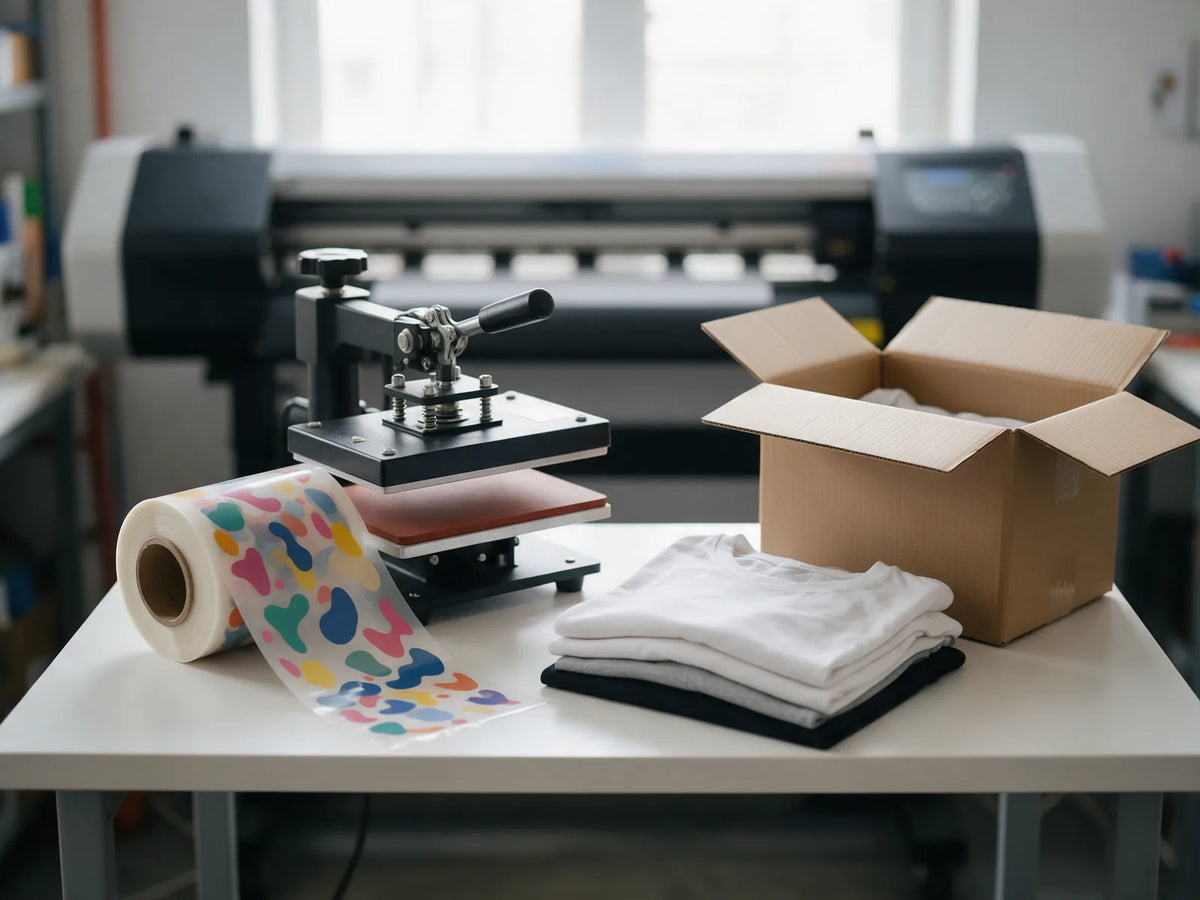
The real DTF printer cost is much more than the price of the machine. Ink, film, powder, curing, maintenance, space and the hours it takes to run everything add up, and they keep adding up in slow months too. For most small shops, outsourcing transfers costs less until volume is steady and high enough to keep a printer busy every day.
This guide compares every cost factor side by side, shows what outsourcing costs per foot, and explains when buying, outsourcing or a mix of both makes sense for your shop.
What goes into DTF printer cost
A working DTF setup is a small production line, not a single machine. Before you sell your first transfer, you will typically need:
- The printer. A DTF printer that prints CMYK plus white ink onto PET film.
- RIP software. It controls color, the white underbase and ink levels. Some printers include it, while others sell it separately.
- Consumables. CMYK and white ink, transfer film and hot-melt adhesive powder, used up on every print.
- Powder and curing equipment. A shaker or manual powder station, plus a curing oven or similar heat source to melt the powder.
- A heat press. You'll want one to apply transfers whether you print them yourself or buy them.
- Space and air. A clean area with stable temperature and humidity, and ventilation for curing fumes.
The purchase price is the cost everyone sees. The ongoing costs decide whether the printer ever pays for itself.
Cost factors: owning a printer vs outsourcing
Here is how the main cost factors compare when you print in-house versus ordering finished transfers:
| Cost factor | Own DTF printer | Outsourcing |
|---|---|---|
| Equipment | Printer, RIP software, powder and curing setup, plus a heat press | Only a heat press to apply transfers |
| Ink, film and powder | Bought in bulk and used on every print, test and cleaning cycle | Included in the sheet price, from $5.99 for 1 ft |
| Curing | A curing oven or similar heat source, plus time to cure every sheet | Done for you; transfers arrive ready to press |
| Maintenance | Daily printhead and white ink care, cleaning supplies, replacement parts and downtime | No printer to maintain |
| Labor and learning curve | Time to learn color settings, powdering and curing, then to run the printer every day | Upload a file or design in the free Gang Sheet Builder |
| Space and ventilation | A dedicated, climate-stable area with fume ventilation | Room for a heat press |
| Waste and misprints | Test prints, misprints and expired supplies come out of your margin | Print-quality or adhesion problems reported within 15 days of delivery are reprinted free |
| Turnaround | Print on your own schedule while the printer is running | Printed the same day when ordered before 3 PM EST on a business day, then shipped or picked up |
Equipment is the most visible line, but labor, maintenance and waste are the ones that surprise new owners. White ink settles when a printer sits, so even a quiet week needs daily care, and every clogged head or bad batch costs you the material and the time to print it again.
What outsourcing costs per foot
Outsourced DTF comes down to one number you can track: the price per foot. Our gang sheets are 22 inches wide and sold by length, starting at $5.99 for 1 ft. Longer sheets bring the rate down to about $4.50 per foot, such as 20 ft for $89.99 or 40 ft for $179.99, which works out to about $0.017 per square inch.
- No setup fees and no minimums on DTF transfers, so you can order exactly what you need.
- Single designs are available as DTF transfers by size, starting around $0.03 per square inch.
- Free shipping on transfer orders of $75+, or free local pickup in Alpharetta.
- Rewards: with Tidal Rewards, you can earn up to 10% back in store credit.
See every length and price on our DTF transfer pricing page. Because there is no equipment to pay off, a slow month doesn't leave you covering a machine that sits idle.
When buying a DTF printer makes sense
Owning a printer can pay off, but it works best when most of these are true:
- Your volume is steady and high. You print most days, not just in seasonal bursts, so the printer stays busy and the white ink keeps moving.
- Someone can own the machine. A person on your team has time to learn the settings and handle daily maintenance.
- You have the right space. A clean, ventilated room with stable temperature and humidity.
- Speed is your edge. Your business depends on printing within hours, at any time of day.
- You can handle downtime. You have a backup plan for a busy week when the printer needs repairs.
If that sounds like your shop, get a quote for the complete system, including supplies and curing equipment, and compare it with what you spend on transfers today.
When outsourcing DTF printing makes sense
For most new and growing shops, outsourcing is the lower-risk choice. It usually fits best when:
- You're starting out or testing designs. Small runs carry no equipment risk.
- Demand comes in waves. Holiday rushes, school seasons and events don't leave a machine idle the rest of the year.
- You sell many designs in small quantities. One gang sheet can hold dozens of different designs.
- You'd rather spend time selling. Your hours go to customers and pressing, not printer maintenance.

Selling to your own customers? Our transfers ship without Tidal Colors branding, and our DTF for resellers page covers what print shops and resellers need to know. For larger volume pricing, contact us at (678) 845-6864 or hello@tidalcolors.com.
The hybrid approach: own a press, outsource the printing
You don't have to choose all or nothing. Many shops land on a middle path that keeps costs flexible:
- Press in-house, print outside. Keep a heat press and blanks on hand, order transfers as you need them and press to order. You control quality and turnaround without owning a printer.
- Stock your top sellers. Unpressed transfers keep for 6–12 months in a cool, dry place when stored flat or rolled, so you can order ahead and press on demand.
- Own a printer, outsource the overflow. If you already print in-house, send out large runs, rush jobs and busy-season peaks so your machine isn't the bottleneck.
- Track your feet per month. Note how many feet of transfers you buy each month. Once that number is steady and high, you have real data to compare against the full cost of owning.
Test outsourcing before you decide
The simplest way to compare is to press real transfers onto your own blanks. Start with the free DTF transfer sample pack: the pack is free, you pay $4.99 for shipping, and that $4.99 comes back as store credit. Local pickup is free.
Next, lay out a short sheet of your own designs in the Gang Sheet Builder. It's free, runs in your browser, needs no account and shows a preview before you order. New customers can use code WELCOME10 for 10% off the first order.
Press at 320°F (160°C) with medium pressure for 15 seconds, let the film cool completely and peel, then press again for 5 seconds under parchment paper. Our transfers are lab tested for 100+ washes, so run a few test shirts through your own wash routine and judge for yourself. The full steps are in our DTF application guide.
Frequently asked questions
How much does a DTF printer cost?
It varies widely with size, speed and what's included, and the printer is only part of the bill. Ask for a quote on the complete system, including RIP software, powder and curing equipment and a starter supply of ink, film and powder. Then add maintenance, labor and space before you compare it with outsourcing.
Is it cheaper to make your own DTF transfers?
Only when your volume is steady and high enough to keep the printer busy. At low or seasonal volume, idle-time maintenance, wasted supplies and labor usually make outsourced transfers the cheaper option.
Do I need a heat press if I outsource?
A heat press gives the best results. Apply our transfers at 320°F (160°C) with medium pressure for 15 seconds and peel cold. A household iron works in a pinch if you press firmly.
Will my customers see Tidal Colors branding?
No. Our transfers ship without Tidal Colors branding, which suits resellers and print shops. Resellers can also read about tax exemption for resellers.
Is there a minimum order for DTF transfers?
No. There are no minimums and no setup fees on DTF transfers, so you can start with a single 1 ft sheet.
The bottom line
Buy a DTF printer when steady, high volume and a dedicated operator can keep it busy. Until then, outsourcing lets you put your money into blanks, designs and marketing while the printing is handled for you.


