


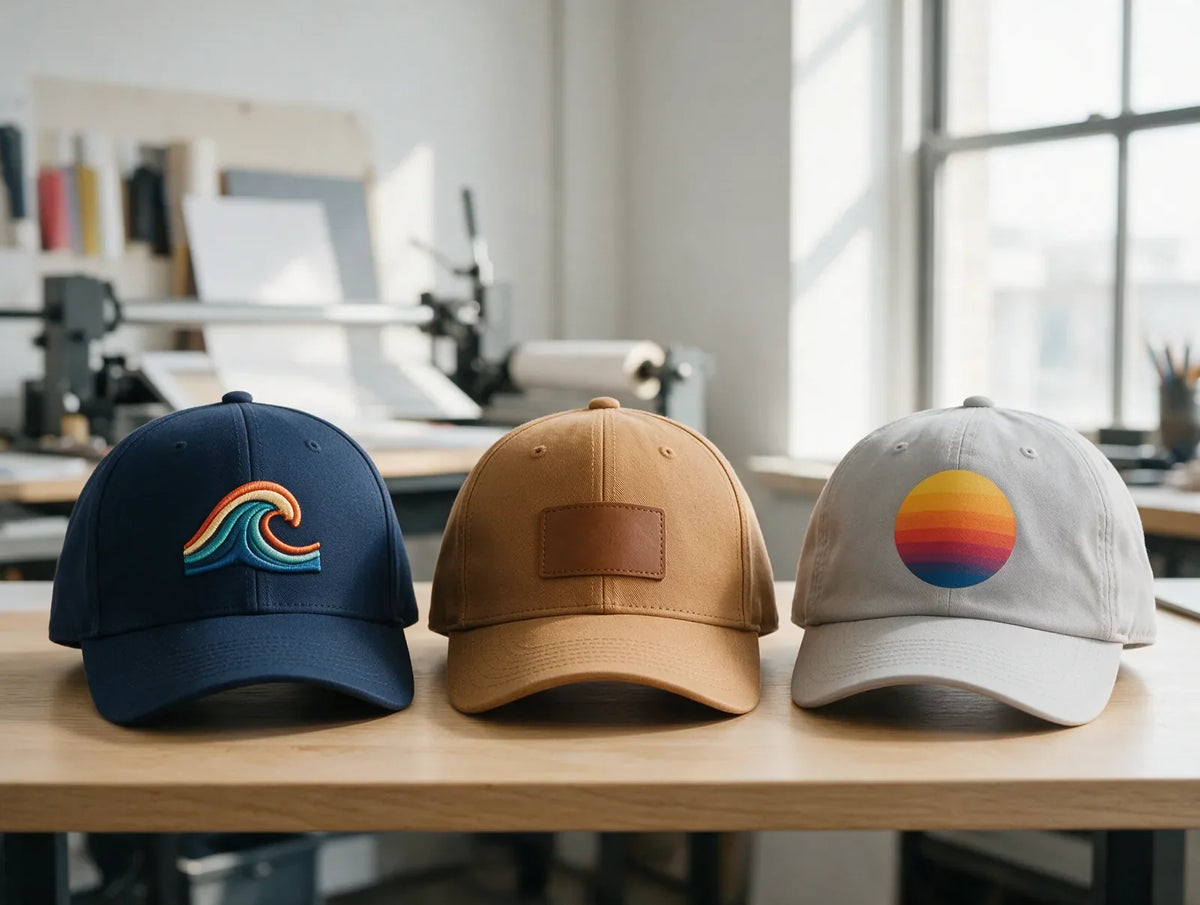
Choosing between embroidered vs printed hats comes down to your logo and your hat style. Embroidery stitches the design into the cap for a raised, classic finish that suits bold, simple logos. Printing, with screen printing or DTF, puts a smooth, flat design on the front and handles full color and fine detail.
Patches sit in between, adding texture and a finished, retail look. We offer all three: embroidery with up to 15-color stitching; woven, PVC and faux-leather patches; and screen printing and DTF on flat-front and unstructured styles. Here's how they compare on look, durability, detail, cost and hat style.
Key takeaways
- Embroider bold, simple logos; hats take up to 15 thread colors.
- Pick a woven patch for fine detail, PVC for bold raised color, faux leather for a rugged look.
- Print gradients and photos with DTF, solid-color designs with screen printing, on flat-front and unstructured caps.
- Structured six-panel caps suit embroidery and patches; the center seam gets in the way of a print.
- Embroidery is priced mostly by stitch count; DTF transfers have no setup fees or minimums.
In this guide
- Embroidered vs printed hats at a glance
- What's the difference between embroidery and a patch?
- Durability: how hat logos hold up to sweat and sun
- Design complexity: detail, gradients and colors
- Which hat styles suit embroidery, patches or print?
- How much does a custom embroidered hat cost?
- Printed hats: screen printing and DTF
- Can I print a logo on a hat?
- How to choose between embroidery, patches and print
- Frequently asked questions
- Find the right finish for your hats
Embroidered vs printed hats at a glance
Embroidery gives a hat a raised, stitched logo that suits bold, simple designs; printing gives a smooth, flat one that handles fine detail, gradients and full color; a patch adds a separate badge with its own edge. They differ on five things: look, durability, design detail, cost and the hats they suit.
| Factor | Embroidery | Patch | Print (screen or DTF) |
|---|---|---|---|
| Texture and look | Raised, textured and classic, stitched into the cap | A separate badge with its own edge: flat woven, raised PVC or tonal faux leather | Smooth and flat with crisp edges |
| Durability | Stitched in and very hard-wearing, with no ink layer to crack or peel | Holds up well; the edges take most of the wear | Our DTF transfers are lab tested for 100+ washes; keep hats out of the washer |
| Design complexity | Bold shapes, simple logos and larger text, in up to 15 thread colors | Woven: finer detail and smaller text; PVC: bold blocks of color | DTF: fine lines, small text, gradients and photos; screen printing: a few solid colors |
| Cost and setup | Priced mostly by stitch count; a new logo is digitized first | Set by patch type, size and shape; the patch is made first, then attached | DTF transfers are priced by size, with no setup fees or minimums; screen printing by colors and quantity |
| Hat styles | Structured, unstructured and trucker caps | Most caps with a firm or flat front | Flat-front and unstructured styles |
In short, embroider simple logos and print detailed, colorful ones. Patches cover the cases in between. Each row of the table gets its own section below, and our custom hats page shows the caps and finishes side by side.
The overall feel differs too. Embroidery reads as premium and traditional, a patch as rugged or retail, and a print as clean, modern and colorful. No single finish wins for every order; the right one depends on the logo in front of you and the cap it goes on. If you're weighing the same methods for shirts, polos and jackets, our guide to embroidery vs printing covers them.

What's the difference between embroidery and a patch?
Direct embroidery stitches your logo straight into the cap, so it sits flush with the fabric and has no border. A patch is a separate badge, made first and then attached, so it stands out with its own edge and can use materials thread can't: a finely woven face, PVC or faux leather.
Woven, PVC or faux-leather patch?
Pick the patch by your logo and the look you want. A woven patch holds the finest detail, a PVC patch gives bold, raised color, and a faux-leather patch gives a tonal, rugged badge. Each one adds texture and dimension that direct embroidery can't. We offer three kinds:
- Woven patches. Fine threads woven flat for crisp, detailed artwork and smaller text.
- PVC patches. Soft, flexible and raised, with bold, bright colors and a sporty look.
- Faux-leather patches. A tonal, rugged look that suits outdoor brands, workwear and trucker hats.
Choose direct embroidery for a classic stitched logo. Choose a patch when your logo has fine detail, when you want a bold, layered look or when you want the hat to feel like retail merch. Browse embroidered hats for the stitched look, or see how a logo becomes thread on our custom embroidery page.
Embroidered vs printed patches
The two names describe how the badge itself is made. An embroidered patch is stitched onto a fabric base and finished with a stitched border, so it looks like raised embroidery on a badge. A printed patch carries a printed image, so gradients and photos show. A woven patch sits between them: flat, with very fine detail.
Our patches are woven, PVC and faux leather. If your design is a full-color image, it can skip the patch and be printed straight onto a flat-front or unstructured cap instead.
Durability: how hat logos hold up to sweat and sun
Embroidery is the hardest-wearing finish on a hat, since a stitched logo has no surface layer to crack or peel. Patches hold up well, with the edges taking most of the wear, and prints last too: our DTF transfers are lab tested for 100+ washes. How the hat is worn and cleaned matters as much as the method.
Four things decide how a decorated cap ages:
- Sweat and sun. Both work on the whole front panel, not only the logo. A stitched logo or a patch has no exposed ink layer, while a print is a thin layer on the surface, so a cap that lives outdoors leans toward thread or a PVC badge.
- Folding and crushing. Stuffing a soft, unstructured cap into a back pocket bends a print along with the crown, again and again. Stitches and patches flex with the fabric.
- Washing. Most hats keep their shape best out of the washing machine. Spot clean with a damp cloth and cold water, then let the cap air dry; for DTF, skip bleach and dry cleaning.
- Patch edges. The border is where wear shows first, so check the edges after heavy use. The FAQ below covers how long patches last.
For the full story on print wash life, read how long DTF transfers last, and see our tips on caring for printed hats before you clean a pressed cap.
Design complexity: detail, gradients and colors
Thread draws bold shapes, chunky lettering and solid color well, but it can't blend gradients, reproduce a photo or hold hairline detail. Up to 15 thread colors cover most logos; for finer detail use a woven patch, and for gradients, photos or full color, print it with DTF.
| Your logo has… | Best route on a hat | Why |
|---|---|---|
| Bold shapes and chunky lettering | Embroidery | It stitches cleanly and looks raised |
| Small text or thin lines | Woven patch or DTF | Thread has width, so tiny letters fill in |
| Gradients, shadows or a photo | DTF | It prints every color in one pass |
| A few solid colors on many hats | Screen printing | One screen per color, reused across the run |
| Many flat colors | Embroidery (up to 15 thread colors) or DTF | Both handle it; pick by the look you want |
A cap front is only a few inches wide, so a logo that reads well on a shirt may need simplifying before it goes on a hat. If you're sending a print file, check our artwork requirements first.
Artwork tips for hat logos
- Design for a small space. A cap front is only a few inches wide, so drop taglines and keep text bold.
- Send a clean file. A PNG with a transparent background at 300 DPI is preferred; AI, EPS, PDF and JPG files work too.
- Mind the contrast. Pick thread, patch or ink colors that stand out against the hat color.
- Keep printed text at 8 pt or larger. Smaller text can get lost on a curved front.
- Plan for dark hats. Our DTF transfers include a white underbase, so colors stay bright on black, navy and charcoal caps.
Which hat styles suit embroidery, patches or print?
The cap's front decides the options. Structured six-panel caps take embroidery and patches best, since the center seam runs through the design area; flat-front and unstructured caps take all four routes, including screen printing and DTF; on mesh-back truckers, only the front panel is decorated.
| Hat style | Embroidery | Patch | Screen printing or DTF |
|---|---|---|---|
| Structured six-panel cap, such as the Richardson 112 | Yes, the classic choice | Yes | Not one of the styles we print |
| Flat-front cap | Yes | Yes | Yes |
| Unstructured dad hat | Yes | Yes | Yes |
| Mesh-back trucker | Front panel only | Front panel only | Only on an unstructured or flat front, such as the Richardson 111 |
| Foam-front trucker | Ask us first | Ask us first | Ask us first |
| Knit beanie | Commonly embroidered; ask us first | Ask us first | Not one of the styles we print |
On a structured six-panel cap, the seam down the middle of the front would split a print, while stitches and a patch sit over it neatly. That's why the Richardson 112, a structured six-panel trucker, gets embroidery or a patch from us. The Richardson 111 is the opposite case: an unstructured, garment-washed trucker with a 100% cotton front, so it can be printed as well as stitched.
Knit beanies are commonly embroidered rather than printed, since a knit doesn't give a print an even surface; ask us before you plan a beanie order. Unstructured dad hats take every method we offer, and our trucker hats pair a solid front with a mesh back. For a model-by-model look at truckers, see Richardson 112 vs other trucker hats.
How much does a custom embroidered hat cost?
An embroidered hat is quoted from your logo and your order: mostly the stitch count, which grows with the logo's size and how much of it is filled with thread, then the number of placements, the cap you pick and the quantity. A new logo is digitized into a stitch file before the first hat is sewn.
Patched and printed hats are priced on different drivers, so the most affordable route depends on the design. Here's what moves the price for each one:
| Route | What sets the price | Where to start |
|---|---|---|
| Direct embroidery | Stitch count, placements, the cap and the quantity | How embroidery is priced |
| Patch | Patch type (woven, PVC or faux leather), size and shape, the cap and the quantity | Request a patch quote |
| Screen printed hat | Ink colors (one screen each) and the quantity | Screen printing |
| DTF transfer | The design's size; transfers are priced by size or gang sheet length, with no setup fees and no minimums | DTF transfer prices |
We don't list hat prices here, because each quote depends on your logo, your cap and your count. How embroidery is priced, and how to request a quote, is on our custom embroidery page. To keep the cost down, use a smaller or more open logo in one spot: fewer stitches and fewer placements usually mean a lower quote.
Printed hats: screen printing and DTF
Printing gives a smooth, flat design with sharp edges, and it's the way to go when your logo has many colors or fine detail. We print on flat-front and unstructured styles, where the front gives the design an even surface.
Screen printing suits simple designs in a few solid colors, especially across larger orders. DTF prints every color in one pass, so gradients, photos and small details come through cleanly.

DTF on hats
A DTF transfer is printed on film and heat pressed onto the hat, so it can reproduce full-color art that would be impossible to stitch. Transfers adhere to cotton, polyester and nylon, and heat tape holds them in place while they're pressed.
There are two ways to get custom DTF on hats. Order finished printed hats from us on flat-front and unstructured styles, or order transfers to press yourself, either by size or as hat-size designs added to a gang sheet. The same transfer works on men's, women's and kids' caps; only the size changes to fit the front, so a DTF baseball cap for a youth team is planned the same way as an adult one.
Ordering transfers to press yourself? A structured cap front typically fits a design about 4–4.5 inches wide and 2–2.5 inches tall. Our guide to applying DTF transfers on hats walks through it step by step, and the DTF size guide covers other placements.
Online forum threads about DTF caps mostly trace problems to three things: a seam running under the design, a stiff curved front that the press can't meet evenly, and mesh, which gives the film little to grip. Will DTF work on hats in general, and on foam truckers? Our guide to DTF on hats, foam truckers included answers both.
Can I print a logo on a hat?
Yes. You can embroider it, add a woven, PVC or faux-leather patch, screen print it or press a DTF transfer, and the cap decides which of those work: we print on flat-front and unstructured styles, while structured caps are embroidered or patched. You can order finished hats or press transfers yourself.
Follow these steps from blank cap to finished logo:
- Pick the cap. Choose a structured, flat-front, unstructured or trucker style; the custom hats page lays out the options.
- Match the method to the logo. Bold and simple goes to embroidery, fine detail to a woven patch, gradients or photos to DTF, and a few solid colors on many hats to screen printing.
- Prepare the file. Send a PNG with a transparent background at 300 DPI, or an AI, EPS, PDF or JPG file, and keep printed text at 8 pt or larger.
- Ask for a quote on finished hats. Include the logo, cap style and color, method and quantity. Embroidery quotes start on the custom embroidery page; for patches and printed hats, send us your logo.
- Order transfers if you press your own. Buy them by size or add hat-size designs to a gang sheet, with no setup fees or minimums.
- Press with heat tape. Tape the transfer so it can't shift, then press with our heat press settings; the hat guide above walks through each step.
How to choose between embroidery, patches and print
Run through these questions about your logo and your hats:
- How detailed is the logo? Simple and bold points to embroidery. Fine detail or small text points to a woven patch or DTF.
- How many colors? Up to 15 thread colors covers most logos. Gradients and photos call for DTF.
- Which hat style? Structured caps favor embroidery and patches. Flat-front and unstructured styles open up printing.
- What look do you want? Embroidery feels classic and premium, patches feel rugged or retail and prints feel clean and modern.
- Where will the hats be worn? For job sites and outdoor work, a stitched logo or a PVC or faux-leather patch has a tough, rugged look.
Quick picks for common hat orders
- Company and staff caps: embroidery on a structured cap, or a faux-leather patch for a modern, upscale look.
- Sports teams and clubs: embroidered caps in team colors for a classic look on the sidelines.
- Brand merch and drops: a woven or PVC patch, or a full-color DTF design on an unstructured dad hat.
- Events, reunions and giveaways: a printed design on flat-front or unstructured caps when the artwork is colorful.
- Outdoor and work crews: a PVC or faux-leather patch on a trucker hat.
So is printed or embroidered better? On a hat, the answer comes from the checklist above: the logo's detail, its colors and the cap's front. For shirts, polos and jackets, the embroidery vs printing guide weighs the same choice.
Frequently asked questions
Can you embroider a hat?
Yes, caps are one of the items we embroider, in up to 15 thread colors, on structured, unstructured and trucker fronts. On a trucker, only the solid front is stitched, never the mesh. Bold shapes and larger lettering stitch best, while fine detail or small text suits a woven patch better. Our custom embroidery page explains how a logo becomes a stitch file and a quote.
How many colors can you embroider on a hat?
We offer up to 15-color stitching on hats. Each thread color counts once, however many places it appears in the logo, and colors that contrast with the cap read best from a distance. If your logo has gradients or photo detail, consider a woven patch or a printed design instead, since thread can't blend one color into the next.
What types of embroidery are used on hats?
Flat embroidery is the standard stitched logo, sewn straight into the front panel, while 3D puff embroidery stitches over a layer of foam for raised, bold lettering, a look you'll see on some caps. Patches are the other route. On our hats, that means stitched logos in up to 15 thread colors, plus woven, PVC and faux-leather patches. Our embroidery vs printing guide covers embroidery types in more depth.
Do embroidered hats cost more than printed hats?
Often, for detailed or larger logos, because embroidery is priced mostly by stitch count and every hat takes machine time. A small, simple stitched logo can come out close to a print. DTF transfers are priced by size with no setup fees or minimums, and screen printing usually gets cheaper per hat as the quantity grows. Compare quotes for your actual logo and hat count before you decide.
Is a patch cheaper than direct embroidery?
Usually not. A patch is made as its own piece and then attached, which adds a step, while direct embroidery is stitched once into the cap. A patch earns its cost when the logo needs detail thread can't hold, which suits a woven patch, or when you want a bold, raised PVC badge or a tonal faux-leather look. Ask for both options in your quote.
Why are custom embroidered patches so expensive?
Each patch is produced on its own before it goes on the hat, and every new design needs its own setup, such as a stitch or weave file, or a mold for PVC. Materials like PVC and faux leather cost more than thread, and small runs spread that setup across fewer pieces. For a quote on woven, PVC or faux-leather patches, send us the design, size and quantity.
How long do embroidery patches last?
There's no fixed lifespan: it depends on the material, how well the patch is attached and how hard the hat is worn. Edges usually show wear first. Woven threads can fuzz with rubbing, faux leather can scuff, and PVC shrugs off water and sweat. Spot clean decorated hats and keep them out of the washer and dryer to help any patch last longer.
What if I'm not sure which finish will look best?
Send us your logo, the hat style and color, and how many you need, and we'll recommend embroidery, a patch or a print. A quick test helps too: print the logo about 4 inches wide on paper, since a structured cap front is typically about 4–4.5 inches wide, and check whether the small text still reads. If it doesn't, simplify the logo or consider a woven patch.
Find the right finish for your hats
Go with embroidery for a classic, raised logo, a patch for texture and detail, and screen printing or DTF for full color on flat-front and unstructured styles. Still deciding? Compare every option on our custom hats page, or read our broader guide to embroidery vs printing.

