


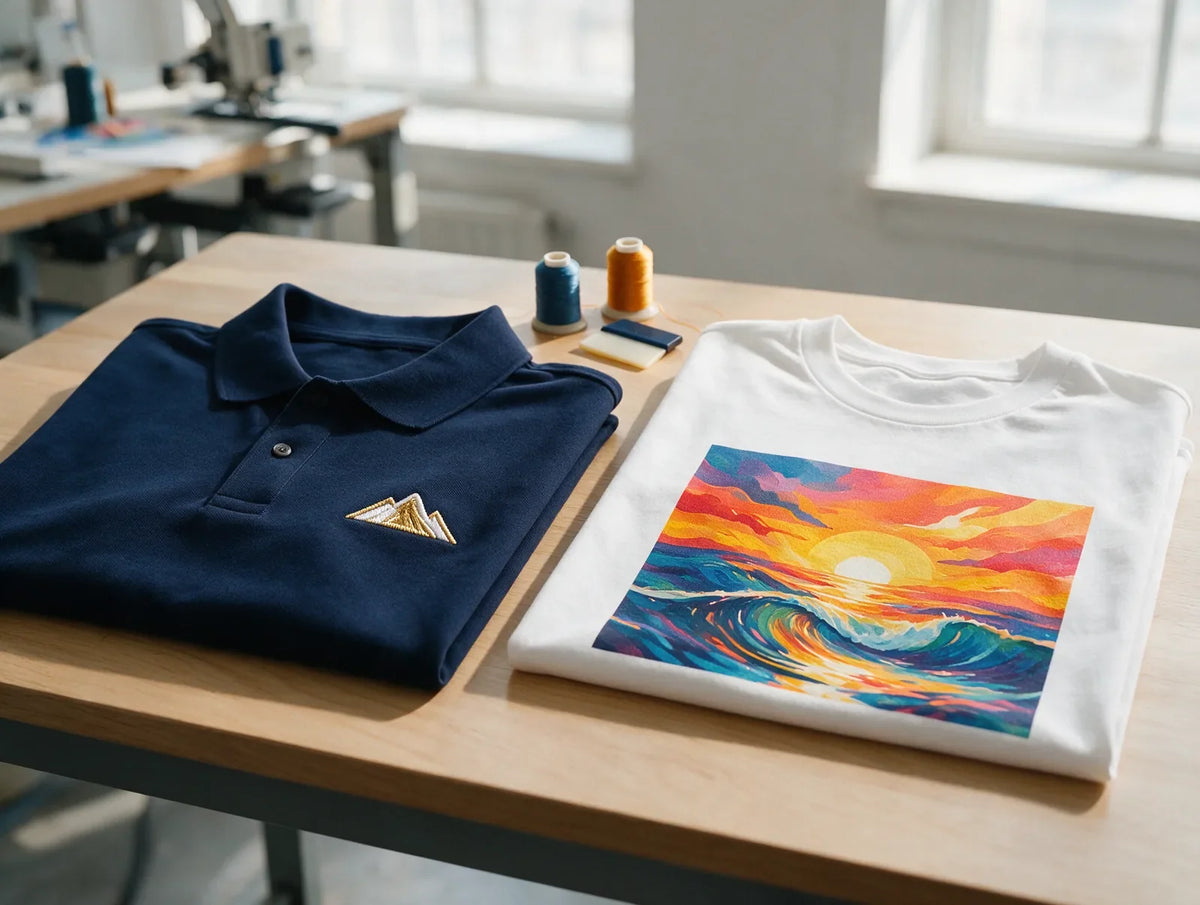
Embroidery vs printing comes down to the look you want and the item you're decorating. Embroidery stitches your logo into the fabric with thread, for a raised, premium finish that suits caps, polos, jackets and workwear. Printing puts ink or a transfer on the surface, which handles full color, fine detail and large designs on t-shirts and much more.
We offer embroidery, screen printing, DTF transfers and dye sublimation, so we can help you pick whichever fits. This guide compares them on look, detail, cost and durability, garment by garment.
Key takeaways
- Embroider simple, bold logos on sturdy garments: polos, caps, jackets, hoodies and workwear.
- Print gradients, photos, fine detail and large designs, and almost anything on lightweight t-shirts.
- Embroidery is usually priced by stitch count, screen printing by colors and quantity, DTF by design size.
- Thread won't crack or peel the way ink can; our DTF transfers are lab tested for 100+ washes.
- Many orders mix both: embroidered polos and caps for staff, printed tees for events.
In this guide
- Embroidery vs screen printing vs DTF at a glance
- How do embroidery and printing work?
- Is embroidered or printed better for your logo?
- Which garments suit embroidery, and which suit printing?
- Is it cheaper to embroider or print?
- What are the disadvantages of embroidery?
- Is DTF better than embroidery?
- Which lasts longer, embroidery or printing?
- Can you use embroidery and printing together?
- Embroidered vs printed logo: design tips
- Frequently asked questions
- Choose the right finish for your logo
Embroidery vs screen printing vs DTF at a glance
Embroidery sews your logo into the fabric with thread; screen printing pushes ink through a screen, one color at a time; DTF prints on film that's heat pressed on. So embroidery looks raised and suits bold, simple logos, screen printing suits big runs in a few colors, and DTF handles full color at any quantity.
| Factor | Embroidery | Screen printing | DTF transfers |
|---|---|---|---|
| Look and feel | Raised, textured and premium | Smooth and bold; the ink sits in and on the fibers | Smooth, with a thin, flexible layer on the surface |
| Detail | Bold shapes and simple logos | Solid shapes; very fine lines can fill in | Fine lines, small text, gradients and photos |
| Colors | Thread colors, up to 15 on hats | A few solid spot colors, one screen each | Full color in one pass |
| Design size | Small to medium: chest, cap front, sleeve | Up to a full back | From a small logo up to 22" wide |
| Setup | The logo is digitized into a stitch file | A screen for every color | None: no setup fees or minimums |
| Suits | Polos, caps, jackets, hoodies, workwear and cotton towels | Tees and sweatshirts in bulk | Tees, performance wear, nylon and mixed fabrics |
| Durability | Stitched in; won't crack or peel | Very durable when fully cured | Lab tested for 100+ washes |
The setup row is where DTF is most often misjudged. It gets grouped with screen printing as a method with high setup costs, but it needs no screens, so our DTF transfers have no setup fees and no minimums, and even a single transfer is priced only by its size.
The quick rule: embroider simple logos on sturdy garments, and print detailed or large designs. The sections below explain why. For the two printing methods in depth, see our guide to DTF vs screen printing.
How do embroidery and printing work?
Both start from your artwork, then part ways. For embroidery, the logo is digitized into a stitch file and a computerized embroidery machine sews it into the garment with thread. For printing, the design goes down as ink: pushed through a screen one color at a time, or printed digitally on film and heat pressed, which is DTF.
How embroidery works
Before anything is stitched, your logo is digitized: converted into a stitch file that tells the machine where each stitch goes, in which direction and in which thread color. The machine then sews the design into the garment, layer by layer.
The result is a raised, textured logo that looks polished and holds up to heavy wear. We embroider hats, polos, jackets, sweatshirts and hoodies, workwear and cotton towels. On hats, we offer up to 15-color stitching, plus woven, PVC and faux-leather patches.
Text and outlines are usually sewn as satin stitches, and wide areas are filled with rows of fill stitches. Every stitch adds to the stitch count, which usually sets the price of custom embroidery.

How printing works
Printing covers several methods. These are the three we offer:
- Screen printing. Ink is pushed through a fine mesh screen, one color at a time. Setup happens once per design, so the cost per piece drops as the quantity grows. Learn more about screen printing.
- DTF transfers. Your design is printed onto film, coated with adhesive powder and heat pressed onto the garment. Every color prints in one pass, and the transfer adheres to cotton, polyester, blends, nylon, canvas and more. Explore custom DTF transfers.
- Dye sublimation. Heat turns the dye into a gas that bonds with white or light polyester, so the print becomes part of the fabric and has no feel at all. We use it for custom blankets, towels and sublimated team uniforms.
Is embroidered or printed better for your logo?
Neither is better across the board; your logo decides. A bold, simple logo with a few flat colors stitches cleanly and looks premium on a polo or cap. A logo with gradients, fine lines, small text or many colors, or one that needs to be large, should be printed.
The logos that stitch best have bold icons, initials or monograms, chunky lettering and solid areas of color. Check yours against these points:
| If your logo… | Embroidery | Printing |
|---|---|---|
| Has gradients, shadows or a photo | Needs a flat, simplified version | Prints as designed with DTF |
| Has small text or thin lines | Enlarge the text or drop the tagline | DTF holds text down to 8 pt |
| Has many colors | Thread colors, up to 15 on hats | Full color with DTF; one screen per color in screen printing |
| Needs to be large | Gets heavy and stiff past chest-logo size | Any size, up to a full back |
| Should look raised and textured | Yes, that's the stitched look | No: prints are flat and smooth |
A quick test: shrink your logo on screen to the size of a chest logo. If the tagline turns unreadable or the design depends on shading, it needs a simplified version for stitching, or it should be printed.
Think about the feel, too. Embroidery reads as polished and professional, which is why it's the usual choice for company polos, caps and jackets. Printing reads as bold and casual, right for event shirts, graphic tees and merch.
Which garments suit embroidery, and which suit printing?
Embroidery needs fabric with some body to hold the stitches, so it's at its strongest on polos, caps, jackets, sweatshirts, hoodies and workwear. Lightweight t-shirts, stretchy performance wear and large designs are better printed, since dense stitching can pucker thin fabric and feels stiff across a big area.
| Garment | Usually the right method | Why |
|---|---|---|
| Polos | Embroidery | A stitched chest logo is the classic business look |
| Caps and hats | Embroidery or a patch; screen printing or DTF on flat-front and unstructured styles | Firm fronts hold stitches well |
| Jackets | Embroidery on the chest; print large back designs | Heavy fabric carries stitches, but a big stitched back gets stiff |
| Sweatshirts and hoodies | Embroidery for a small chest logo; print big front or back designs | Fleece holds stitches, and large art stays lighter printed |
| Workwear | Embroidery | Stands up to hard wear and frequent washing |
| T-shirts | Screen printing for big runs of one design; DTF for full color, small runs and names | Thin jersey puckers under dense stitching |
| Performance wear and nylon | DTF | Our transfers adhere to polyester and nylon, while stretchy knits pull stitches out of shape |
| Cotton towels | Embroidery | Monograms and logos stitch well on cotton |
| Blankets | Dye sublimation | Full-color, edge-to-edge prints |
| Bags and totes | DTF | Presses well on canvas |
Fabric matters as much as the garment type: piqué, twill, canvas and fleece hold stitches flat, while thin or loose knits can pull and pucker around them. Browse polo shirts, custom jackets, custom sweatshirts and workwear to embroider, and check what DTF transfers work on before printing bags, nylon or performance wear.
Hats get a guide of their own, since patches and cap styles add more choices. See custom hats for the styles we decorate, our comparison of embroidered vs printed hats for every cap style and patch, and DTF transfers on hats if you press your own.

Is it cheaper to embroider or print?
Printing is usually cheaper: DTF for small runs and full-color art, screen printing for big runs of a simple design. Embroidery usually costs more per piece because its price follows the stitch count, but it can beat screen printing on small orders of multi-color logos, since thread colors don't each need their own screen.
Each method prices a job its own way, so compare them on your actual order: the item, the logo's size and colors, the number of placements and how many pieces you need.
| Method | What sets the price | As the quantity grows | Usually the better value for |
|---|---|---|---|
| Embroidery | Stitch count (logo size and how much of it is filled) and the number of placements; a new logo is digitized first | The price per piece usually changes less than with screen printing, since every piece takes the same stitching time | Small logos on polos, caps, jackets and workwear |
| Screen printing | Number of ink colors (a screen each), print locations and quantity | Drops as the setup is spread over more pieces | Large runs of one design in a few colors |
| DTF transfers | Design size only: by transfer size or gang sheet length, with no setup fees and no minimums | Little changes, since there's no setup to spread; longer gang sheets go as low as $4.50/ft | Full color, small runs, names and mixed designs |
For a real number: a full-color 12" × 12" DTF transfer is $4.51, even if you order just one, and it costs the same whether the design has two colors or twenty. See every size and sheet length in our DTF transfer prices.
Three common orders show the pattern. Staff polos with a small left-chest logo suit embroidery, because a small logo keeps the stitch count low. A big run of event tees with a one-color design suits screen printing, since one screen serves every shirt. Tees with full-color art, or a different name on each, suit DTF.
When is embroidery worth the extra cost?
Embroidery is worth paying more for on pieces people keep and wear often, like staff polos, jackets and caps, on workwear that's washed hard and often, and when a raised, premium logo is part of your brand. For one-time event tees, large or full-color designs and tight budgets, printing is the better value.
Think in cost per wear: a stitched polo that staff wear every week spreads its price over many more wears than a shirt made for one event. Comparing the two printing methods instead? Here's when DTF costs less than screen printing.
For an embroidery price, send us your logo, the items and the quantities, and we'll quote your order.
What are the disadvantages of embroidery?
Embroidery can't show gradients, photos or very fine detail, it gets heavy and stiff over large areas, and it can pucker thin or stretchy fabric. It also needs a stitch file before the first piece, matches brand colors only as closely as thread allows, and costs more as the stitch count grows.
The limits come from the thread itself. Tiny text, hairline strokes and smooth gradients don't translate into stitches, so bold, simple logos give the cleanest result. See every option on our custom embroidery page.
- No gradients or photos. Thread is one solid color at a time, so shading has to be simplified into flat areas.
- Small text blurs. Thread has width, so tiny letters and hairlines fill in.
- Large designs get stiff. A big stitched area is heavy, and every extra stitch adds to the price.
- Thin or stretchy fabric puckers. Lightweight tees and performance knits can pull around dense stitching.
- Needle holes and backing. Every stitch pierces the fabric, a concern on waterproof shells, and a stabilizer backing stays on the inside.
- Brand colors are approximate. Thread comes in set colors, matched to yours as closely as possible.
- A setup step for every new logo. Digitizing comes first, and every piece then takes machine time.
Printing has trade-offs too. Screen printing needs a screen for every color, so small runs of colorful designs get expensive; see the disadvantages of screen printing. A DTF print is a thin layer on the surface that you can feel on large solid areas; see the disadvantages of DTF.
Is DTF better than embroidery?
For full-color logos, large designs, small runs and synthetic or stretchy fabrics, yes: DTF prints every color in one pass, and our transfers have no setup fees and no minimums. For a raised, premium logo on polos, caps, jackets and workwear that gets washed hard, embroidery is usually the better choice.
| Factor | DTF transfer | Embroidery |
|---|---|---|
| Look | Flat and smooth, in full color | Raised and textured, in thread colors |
| Detail | Gradients, photos, fine lines and text down to 8 pt | Bold shapes, simple logos and larger text |
| Size | From a small logo up to 22" wide | Small to medium: chest, cap front, sleeve |
| Setup and minimums | None on our transfers | A stitch file first; ask us for a quote |
| Fabrics | Cotton, polyester, blends, tri-blends, canvas, denim, leather and nylon | Sturdy fabrics that hold stitches |
| Who applies it | You press it, or order finished apparel | Stitched onto finished garments |
| Care | Inside out, cold water, no bleach, no dry cleaning, air dry | Stands up to regular, frequent washing |
DTF's edge is flexibility. One gang sheet can hold a different name, number or design for every piece, and a full-color logo costs the same as a one-color one. Embroidery's edge is the finish: the depth and texture of thread can't be printed, and it reads as premium on the clothes people wear to work.
On hats, DTF suits flat-front and unstructured styles, while structured caps are usually embroidered or finished with a patch. See pressing DTF on caps or how each cap style is decorated.
Which lasts longer, embroidery or printing?
Both last when they're made and cared for well, but they wear differently. A stitched logo has no ink to crack or peel, which is why embroidery is the usual pick for uniforms and workwear washed hard and often. Prints last too: our DTF transfers are lab tested for 100+ washes.
- Embroidery. Thread doesn't crack or peel. With rough use it can fray or snag, and thin fabric around it can pucker after washing.
- DTF transfers. Lab tested for 100+ washes when pressed at the recommended settings. Wash inside out in cold water, skip bleach and dry cleaning, and air dry. More in how long DTF transfers last.
- Screen printing. Very durable when the ink is fully cured. For a head-to-head on wear, see screen printing vs DTF durability.
The laundry decides a lot. Uniforms sent to an industrial laundry service go through hotter, harsher washes than home care, so embroidery is the safer pick there, while our DTF care calls for cold water and air drying. For shirts washed at home, either method holds up when you follow its care steps.
They also age differently. Thread colors can fade with bleach, and a loose stitch can catch on rough surfaces or hook-and-loop fasteners. A DTF print keeps its color best with the cold washes and air drying above. To check for yourself, press a few prints from our free DTF transfer sample pack on your own garments and wash them with those care steps.
Can you use embroidery and printing together?
Yes, and many orders do: embroider the pieces that should look polished and stand up to daily wear, and print the ones that need full color, large designs or a lower price per piece. Most often that means stitched polos, caps and jackets alongside printed tees.
- Businesses: embroidered polos, jackets and caps for staff, plus printed tees for events and giveaways.
- Sports teams: sublimated or printed jerseys with names and numbers, plus embroidered caps and coach polos.
- Apparel brands: printed graphic tees for the main line, with embroidered hats and hoodies as premium add-ons.
To keep your brand consistent across both, match thread colors to your brand colors as closely as possible and use a simplified version of the logo for stitching.
Send the logo once with your full item list, and we'll suggest which pieces to stitch and which to print. Outfitting a whole crew or club? See custom company apparel and our guide to ordering team uniforms.
Embroidered vs printed logo: design tips
The same logo can look great stitched or printed if you prepare a version for each method.
For an embroidered logo
- Simplify. Remove gradients, shadows and hairline details.
- Go bold with text. Small lettering fills in, so enlarge it or drop the tagline.
- Limit colors. Choose thread colors that contrast with the garment. Hats take up to 15.
- Send a sharp file. Digitizing starts from your artwork, so a clean, high-resolution logo stitches best. Our custom embroidery page lists the file types to send.
For a printed logo
- Use the right format. A PNG with a transparent background at 300 DPI is preferred. We also accept AI, EPS, PDF and JPG files. We check and color-correct every DTF file, and the full rules are in our DTF artwork requirements.
- Keep text readable. Make every line of text 8 pt or larger.
- Size it for the spot. A left-chest logo is typically 3–4 inches wide, and an adult full-front design is typically 10–12 inches wide. Other placements are in the DTF size guide.
- Match the method. Design around a few solid colors for screen printing; gradients and photos are fine with DTF.
- Plan for dark garments. Our DTF transfers include a white underbase, so colors stay bright.
Decorating caps? Read embroidered vs printed hats. For every method side by side, see our guide to custom printing techniques.
Frequently asked questions
Is embroidery the same as printing?
No. Embroidery sews thread through the fabric with a needle, so the logo is raised and textured; printing puts ink or a transfer on the surface, flat and smooth. The two are often searched together as "embroidery printing", but a stitched logo uses no ink at all. We offer both: embroidery, plus screen printing, DTF transfers and dye sublimation.
How much does an embroidered logo cost?
It depends mostly on the stitch count: a larger logo, or one filled solid with thread, takes more stitches and machine time than a small, open design. The number of placements and the quantity matter too, and a new logo is digitized into a stitch file before the first piece. Send your logo and item list through our custom embroidery page for a quote.
Can you embroider a t-shirt?
It can be done, but most t-shirts are better printed. Thin jersey can pucker around dense stitching, and a large stitched design feels stiff and heavy on a light tee; a stitched look works best as a small chest logo on a heavyweight tee. We embroider hats, polos, jackets, sweatshirts and hoodies, workwear and cotton towels; for t-shirts we recommend DTF or screen printing.
Which is better, DTG or embroidery?
They do different jobs. DTG prints full-color art straight into cotton, so it suits detailed designs on t-shirts; embroidery stitches a raised logo that suits polos, caps and jackets. We don't offer DTG: for full color we print DTF transfers, which also work on polyester and nylon. Our guide to DTF vs DTG compares the two digital methods.
Is embroidery in style in 2026?
Yes. A stitched logo on a polo, cap or jacket reads as polished, so it stays a standard for company apparel, uniforms and teams rather than following trends. For a current look, many brands pair a small embroidered chest logo with a bold printed design on the back or on matching tees.
What are the three types of embroidery?
In custom apparel, the three you'll hear about most are flat embroidery, the standard stitched logo; 3D puff, stitched over foam for raised letters, mostly on caps; and appliqué, where fabric pieces are stitched down, as on varsity letters. Patches are another route: on hats we offer woven, PVC and faux-leather patches, compared in our hat decoration guide.
Which is faster, embroidery or printing?
Printing, when it's DTF: transfer orders placed before 3 PM EST on a business day are printed and shipped the same day. Embroidery starts with digitizing your logo, and every piece then takes machine time, so embroidered items, like other finished apparel, need production time on top of shipping. For an event date, contact us early.
Can you embroider polyester or performance polos?
Yes. Polyester and performance polos take embroidery well with the right backing, which is why stitched logos are common on golf and staff polos. Very thin or stretchy knits can pucker under dense stitching, so keep the logo small and simple. For full color or a larger logo on performance wear, DTF is the lighter option: our transfers adhere to polyester, blends and nylon.
How do you wash embroidered shirts?
Turn the garment inside out, wash it on a gentle cycle in cold or warm water with a mild detergent, and skip bleach, which can fade thread colors. Air dry or tumble dry low. If it needs ironing, iron from the back with the design face down on a towel, so the stitches stay raised. Printed DTF garments have their own rules: see how to wash DTF shirts.
Can you embroider a large design?
Yes, on sturdy garments such as a jacket back, but a large stitched area gets heavy and stiff, and the price climbs with every stitch. For big artwork, printing is usually lighter and costs less: DTF prints a full-color back with no setup fees. If you want both, keep the stitched logo small on the chest and print the large design.
Choose the right finish for your logo
Pick embroidery for a raised, premium logo on caps, polos, jackets and workwear. Pick printing for full color, fine detail, big designs and t-shirts. Still unsure? Send us your logo and the items you have in mind, and we'll recommend a method.


