


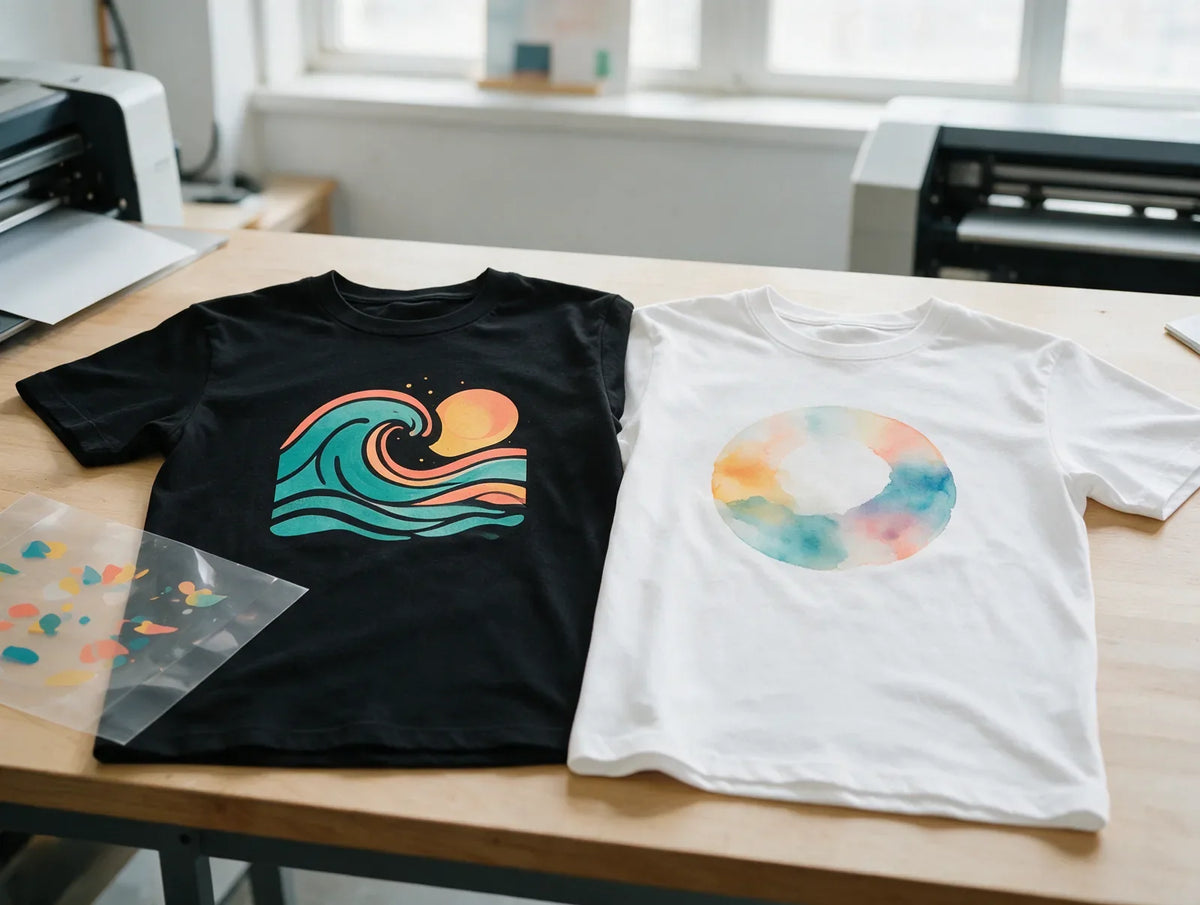
DTF vs DTG is a choice between two digital printing methods that both handle full-color artwork. DTG (direct-to-garment) prints ink straight onto the shirt, where it soaks into the fibers for a very soft feel on cotton. DTF (direct-to-film) prints your design onto film first and heat presses it onto the garment, so it works on far more fabrics and can be printed now and pressed later.
One thing to know up front: Tidal Colors prints DTF transfers, and we don't offer DTG. This guide covers DTG as general background, compares the two methods side by side and explains when DTF is the better fit for your project.
DTF vs DTG at a glance
| Factor | DTF (direct-to-film) | DTG (direct-to-garment) |
|---|---|---|
| How it prints | Design is printed on film, then heat pressed onto the garment | Ink is printed directly onto the garment |
| Fabrics | Cotton, polyester, blends, tri-blends, canvas, denim, leather, nylon | Best on 100% cotton and cotton-rich blends |
| Dark garments | White underbase is printed on the film, no pretreatment needed | Garment is pretreated, then printed with a white underbase |
| Feel | Thin, flexible layer on top of the fabric | Ink soaks into the fibers for a very soft feel |
| Print ahead | Yes, transfers can be stored and pressed later | No, each garment is printed directly |
| Best for | Mixed fabrics, dark garments, names and numbers, pressing it yourself | Soft prints on light-colored cotton |
Both methods print photos, gradients and fine detail digitally, with no screens to set up. The real differences come down to fabric, feel and how the work gets done.
How DTG printing works
Direct-to-garment printing works much like an inkjet printer for clothing. The garment is smoothed onto a flat platen, the printer applies water-based ink directly to the fabric, and heat then cures the ink so it holds up in the wash.
Dark garments need an extra step. The print area is first coated with a pretreatment solution and dried, which helps the white ink stay on the surface instead of sinking in. The printer then lays down a white underbase and prints the colors on top.
Because the ink becomes part of the fabric, DTG gives a very soft print on cotton. Polyester and other synthetics are harder for DTG, and results depend heavily on the garment, the pretreatment and the printer.
How DTF printing works
With DTF, the printing happens on film instead of on the shirt. Your design is printed in full color onto a clear film with a layer of white ink behind it, then coated with an adhesive powder and cured into a finished transfer. Heat and pressure bond it to the garment.
- White underbase built in. Colors stay bright on black, navy and other dark garments without any pretreatment.
- Adhesive does the bonding. That is why DTF sticks to polyester, nylon, denim and leather as well as cotton.
- Print now, press later. Unpressed transfers keep for 6–12 months, stored flat or rolled in a cool, dry place.

Our transfers press at 320°F (160°C) with medium pressure for 15 seconds, then peel cold once the film has cooled. For the full process from file to finished shirt, read what DTF printing is and how it works.
Direct to film vs direct to garment: key differences
Fabric choice
This is the biggest difference. DTG ink needs natural fibers to soak into, so it does its best work on 100% cotton and cotton-rich blends. DTF relies on an adhesive instead, and our transfers adhere to cotton, polyester, blends, tri-blends, canvas, denim, leather and nylon.
If your order includes polyester jerseys, performance tees, nylon jackets or canvas totes, DTF is the practical choice.
Dark garments and color
Both methods print full color on dark garments, but they get there differently. DTG needs a pretreatment on dark fabric before the white ink goes down. DTF prints the white underbase on the film itself, so the garment only needs a quick pre-press to remove moisture and wrinkles.
Feel and breathability
DTG wins on softness. The ink sits in the fibers, so even a large design stays light and breathable. DTF adds a thin, flexible layer on the surface that feels smooth on most designs, while very large solid areas feel heavier and breathe less.
On black, charcoal and deep heather garments, black knockout DTF can lighten a big design. No black ink is printed, so the garment shows through wherever your artwork is black.
Durability and care
Both methods last when they are done right. DTG ink sits in the fibers, so wear usually shows as gradual fading rather than cracking or peeling. Our DTF transfers are lab tested for 100+ washes when pressed at the recommended settings.
DTF care is simple: wash inside out in cold water, skip bleach and dry cleaning, and air dry. Our guide on how to wash DTF shirts explains each step.
Workflow and who does the pressing
DTG is a finished-garment process. The shirt has to be at the printer, and each one is printed on its own. DTF splits the job in two: the transfers are printed first, and the pressing can happen anywhere there is a heat press, today or months later.
That is why DTF suits print shops, resellers, Etsy sellers and teams that keep blank stock and press to order.
Cost and order size
Neither method needs screens, so both handle small runs. With DTG, every garment takes its own machine time and ink, plus pretreatment on dark shirts. With DTF, one 22-inch-wide gang sheet can hold many designs, names and sizes at once, and we charge no setup fees and no minimums on DTF transfers.
When DTF is the better fit
Choose DTF when your project includes any of these:
- Polyester, nylon or mixed fabrics. Jerseys, performance wear, windbreakers, bags and canvas totes.
- Dark garments. The white underbase is part of the transfer, so there is no pretreatment step.
- Names, numbers and many designs. Every jersey in a team order can be different, and all of them fit on one gang sheet.
- Garments you press yourself. Order transfers, keep your own blanks and press only what sells.
- Small runs with full-color art. You pay for the size of the design, not the number of colors, so a photo costs no more than a one-color logo of the same size.
When DTG might suit you better
DTG is a good method with real strengths. It may be the better pick when:
- You want the softest possible print on 100% cotton.
- The design is very large, and breathability matters more than fabric range.
- You are printing on white or light cotton, where DTG can often skip the pretreatment step.
If DTG is a must for your project, you will need a shop that offers it. For everything DTF does well, we can help.
What we offer instead of DTG
We print DTF transfers for print shops, resellers, small brands, teams and anyone who presses their own garments. There are four ways to order: transfers by size, the free Gang Sheet Builder, an uploaded gang sheet or Black Knockout. See every option on our custom DTF transfers page.
- Fast turnaround. Orders placed before 3 PM EST, Monday to Friday, are printed the same day.
- Free shipping. Transfer orders of $75+ ship free, and we ship to all 50 states with tracking.
- Finished apparel. Prefer printed shirts to transfers? Browse custom t-shirts and we will help you pick the right print method.
Weighing DTF against screen printing for a big run of one design? Our DTF vs screen printing guide compares cost, detail and turnaround. To see and feel DTF before you decide, order our free DTF transfer sample pack.
Frequently asked questions
Is DTF better than DTG?
Neither is better for every job. DTF is more versatile: it works on more fabrics, handles dark garments without pretreatment and can be printed ahead and pressed later. DTG gives a softer feel on 100% cotton, especially on large designs.
Does Tidal Colors offer DTG printing?
No. We don't offer DTG. For full-color designs, we print DTF transfers, which press onto cotton, polyester, blends, nylon, denim and more.
Which lasts longer, DTF or DTG?
Both hold up well when they are produced and cared for properly. DTG prints tend to fade gradually as the ink wears in the fibers. Our DTF transfers are lab tested for 100+ washes when pressed at the recommended settings and washed inside out in cold water.
Can DTG print on polyester?
Some DTG setups can, but DTG works best on cotton, and results on polyester are less consistent. DTF transfers adhere to polyester, poly blends and nylon, which makes them a more reliable choice for jerseys and performance wear.
Which feels softer, DTF or DTG?
DTG, on cotton. The ink soaks into the fibers, so there is almost nothing to feel. DTF leaves a thin, flexible layer on top, which feels smooth on most designs but heavier on very large solid areas.
Choosing between DTF and DTG
Choose DTG for the softest feel on light cotton. Choose DTF for polyester and mixed fabrics, dark garments, names and numbers, or transfers you press yourself. Comparing DTF with other methods too? Read DTF vs sublimation.


