


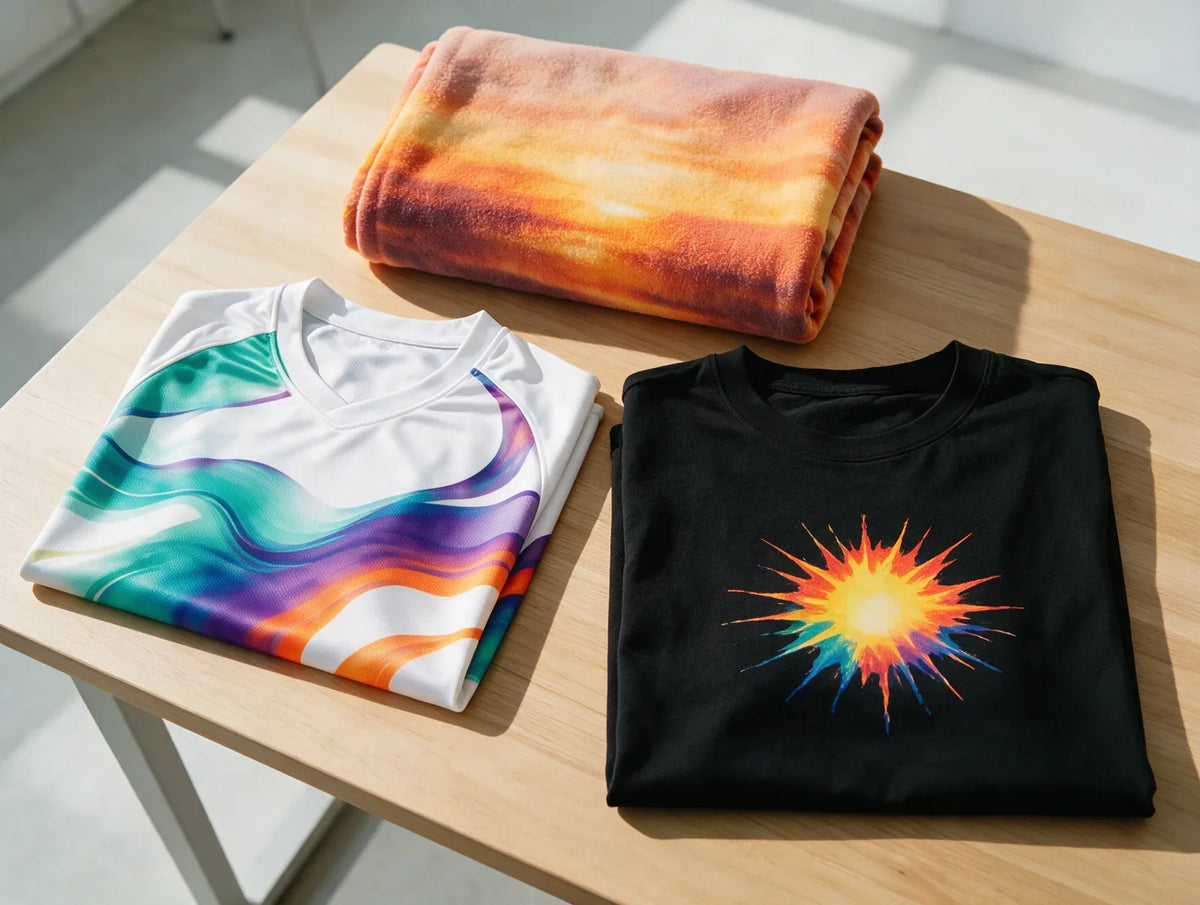
DTF vs sublimation mostly comes down to fabric and color. Dye sublimation turns ink into a gas that bonds with polyester, so the design becomes part of the fabric, but it only works on white or light-colored polyester and polyester-coated items. DTF prints your design onto film and bonds it with an adhesive, so it works on cotton, polyester and blends, on light and dark garments alike.
We offer both. We print DTF transfers for apparel, and we use dye sublimation for custom blankets, towels and team uniforms.
Key takeaways
- Sublimation dyes white or light polyester; DTF bonds a printed layer to cotton, polyester and blends in any color.
- Sublimation has no feel and covers items edge to edge; DTF is a thin layer for placed designs.
- On polyester, color and coverage decide: light and all-over points to sublimation, dark or placed points to DTF.
- Our DTF transfers are lab tested for 100+ washes; a sublimated print has no surface layer to crack or peel.
- We offer both: DTF transfers, plus sublimated blankets, towels and team uniforms.
In this guide
- DTF vs sublimation at a glance
- What is sublimation printing and how does it work?
- How DTF transfers work
- Key differences between DTF and sublimation
- Sublimation vs DTF for polyester
- What holds up better, DTF or sublimation?
- Which is better, DTF or sublimation?
- Which is cheaper, DTF or sublimation?
- What are the disadvantages of sublimation?
- Can you do DTF with a sublimation printer?
- Where do mugs, tumblers and vinyl fit?
- What we make with each method
- Frequently asked questions
- Match the method to the fabric
DTF vs sublimation at a glance
| Factor | DTF transfers | Dye sublimation |
|---|---|---|
| How it works | Design is printed on film, then bonded to the fabric with an adhesive | Heat turns the dye into a gas that bonds with polyester fibers |
| Fabrics | Cotton, polyester, blends, tri-blends, canvas, denim, leather, nylon | Polyester or polyester-coated surfaces |
| Garment color | Any color, thanks to a white underbase | White or light colors only |
| Feel | Thin, flexible layer on the surface | No feel, because the design is part of the fabric |
| Coverage | Placed designs up to 22 inches wide | Edge-to-edge and all-over prints |
| Durability | Lab tested for 100+ washes (our transfers) | Dyed into the fibers, so nothing can crack or peel |
| Hard surfaces | Made for fabric; mugs and glass need UV DTF, which we don't offer | Mugs, tumblers and panels with a polyester coating |
| Best for | Cotton tees, dark garments, mixed fabrics, names and numbers | Blankets, towels, jerseys and other light polyester items |
The quick rule: white or light polyester with color edge to edge points to sublimation. For cotton, dark garments, mixed fabrics and placed designs, DTF is the better choice.
So DTF and sublimation aren't the same thing, even though both are pressed on with heat. Sublimation dyes the fibers themselves, while DTF adds a thin printed layer on top of them, and that one difference explains most of the table.
What is sublimation printing and how does it work?
Sublimation starts with special dye-based ink printed onto transfer paper. Under heat and pressure, the dye turns from a solid into a gas and moves into the polyester fibers. As it cools, it locks in as part of the fabric, so nothing sits on top.
That chemistry sets the rules. The dye only bonds with polyester or a polyester coating, so it fades or washes out of cotton. The ink is also transparent and there is no white ink, so the fabric color shows through the whole design. That is why sublimation is used on white and light-colored items.
You'll see it on performance tees and jerseys, polyester-faced blankets and towels, and coated gifts such as mugs. We use it for three things: blankets, towels and team uniforms.
Sublimation also isn't the same as DTG, a method we don't offer, which prints ink straight onto a garment, mostly cotton. How DTF, DTG and sublimation compare side by side is in our DTF vs DTG guide.
How DTF transfers work
DTF prints your design onto a clear film, adds a layer of white ink behind the colors, then coats it with an adhesive powder and cures it. Heat and pressure melt the adhesive into the fabric, and the film peels away to leave the design behind.
- Works on most fabrics. Our transfers adhere to cotton, polyester, blends, tri-blends, canvas, denim, leather and nylon.
- Any garment color. The white underbase keeps colors bright on black, navy and other dark fabrics.
- Press it yourself. Our transfers apply at 320°F (160°C) with medium pressure for 15 seconds, then peel cold.
For the full process, from artwork to finished shirt, read what DTF printing is and how it works.
Key differences between DTF and sublimation
Fabric
Sublimation needs polyester. High-polyester fabrics give the brightest, sharpest prints, while blends with more cotton look lighter and more faded because the dye has fewer fibers to bond with. DTF does not depend on fiber content in the same way, since the adhesive does the bonding.
Garment color
DTF prints a white underbase behind your colors, so a design looks just as bright on a black hoodie as on a white tee. Sublimation has no white ink. On a dark garment the design barely shows, and any white in your artwork comes out as the color of the fabric.
Feel and breathability
Sublimation has no hand feel at all. The fabric stays as soft and breathable as it was, which is a big plus on athletic wear and large prints. DTF adds a thin, flexible layer that feels smooth on most designs, while very large solid areas feel heavier.
Print size and coverage
Sublimation can cover an item edge to edge, which is why it suits photo blankets, beach towels and all-over jersey designs. DTF is made for placed designs, such as a chest logo, a full front, a sleeve print or a name and number on the back, up to 22 inches wide.
Detail and fine lines
Both start as a digital print, so gradients and fine detail come through either way. Sublimation leaves no edge where the print stops, which suits soft fades on white polyester. DTF keeps crisp edges and small details on any garment color; keep text at 8 pt or larger and send artwork at 300 DPI. Our DTF artwork requirements cover file types and sizing.
Sublimation vs DTF for polyester
Polyester is the one fabric where both methods work well, so the choice comes down to color and coverage:
- White or light polyester, all-over color: sublimation. The print adds no weight and keeps performance fabric breathable.
- Dark or bold-colored polyester: DTF. The white underbase lets your design show on any color.
- A logo or name on a colored team shirt: DTF, which presses a placed design onto a finished garment in any color.
- Mixed fabrics in one order: DTF, since the same transfers work on cotton tees, poly jerseys and canvas bags.

Thin polyester can be sensitive to heat. When you press DTF on performance wear, use a cover sheet and test on an inside seam or a spare piece first; a quick pre-press is optional. Our DTF heat press settings guide has more fabric tips.
Can you sublimate on 100% polyester?
Yes. 100% polyester is the fabric sublimation is made for, as long as it's white or light in color. The dye bonds with the polyester fibers, so the print stays bright and soft, and polyester-coated items work the same way. On blends, the more polyester, the brighter the print.
Performance fabric also stays as breathable as it was, which is why sublimated jerseys and running shirts feel so light. For dark polyester, or a placed design you press yourself, DTF is the route, and the settings guide above covers pressing it on polyester.
What holds up better, DTF or sublimation?
Both last, in different ways. A sublimated design is dyed into the fibers, so there is no surface layer to crack or peel. Our DTF transfers are lab tested for 100+ washes when pressed at the recommended settings, washed inside out in cold water and air dried.
| Factor | DTF transfers | Dye sublimation |
|---|---|---|
| How wear shows | The print stays one flexible layer; trouble usually starts at the press or in a hot dryer | Nothing on the surface to wear; colors can slowly fade, especially in strong sun |
| What it depends on | A full press at our settings, then gentle care | The polyester content and a full, even press |
| Care | Inside out, cold water, no bleach, no dry cleaning, air dry | Follow the care label on the item |
| Tested figure | Ours: lab tested for 100+ washes | We don't quote a wash count |
For DTF, most of the wear story is decided on the day you press. A full press at the right heat, pressure and time melts the adhesive into the fabric, and the cold peel and a short second press finish the bond; after that, gentle washing keeps the print flexible.
For sublimation, the fabric matters most: the more polyester, the more dye the fibers hold, and long hours in strong sun can slowly fade it.
A sublimated print on a cotton-rich blend looks lighter from day one: that's the fabric, not wear. If a DTF print lifts or cracks, the usual causes and fixes are in our guide to why DTF prints lift or crack. For washing steps and the full picture of wash life, see how to wash DTF shirts and how long DTF transfers last.
Which is better, DTF or sublimation?
Neither is better across the board. Sublimation wins on white or light polyester when you want all-over color you can't feel. DTF wins on cotton, dark garments, mixed fabrics and placed designs such as logos, names and numbers, and it's the one to choose when an order mixes fabrics.
Here is how the choice usually plays out for common items:
| Project | Better fit | Why |
|---|---|---|
| Cotton t-shirts and hoodies | DTF | Sublimation doesn't bond with cotton |
| Black or dark apparel | DTF | The white underbase keeps colors bright |
| Photo blankets | Sublimation | Smooth, edge-to-edge photos with no feel |
| Beach towels | Sublimation | The polyester face carries the print; the cotton back dries |
| Team jerseys | Sublimation for all-over designs; DTF for names, numbers and logos | Sublimation colors the whole jersey; DTF presses onto jerseys in any color |
| Canvas, denim and leather | DTF | The adhesive bonds where the dye can't |
| Hats | DTF | Flat-front and unstructured styles; see DTF transfers on hats |
| Small runs of many designs | DTF | No setup fees and no minimums on our transfers |
Ordering for a whole team? Our uniform guide compares sublimated or printed uniforms and walks through sizes, names and numbers.
Which is better for t-shirts, DTF or sublimation?
For most t-shirts, DTF. Most tees are cotton or cotton blends, which sublimation can't dye well, and they come in every color. Sublimation is the pick for white or light polyester tees printed edge to edge, such as performance shirts for a race or a team.
Still choosing the shirt itself? Our guide to choosing blank t-shirts for printing compares popular blanks, from everyday basics to heavyweight tees.
Which is better for a small business?
It depends on what you sell. If your products are cotton tees, hoodies, hats or dark garments, DTF covers them all, and you can order ready-to-press transfers instead of buying a printer. If you sell polyester items printed edge to edge, sublimation is the better fit.
Weighing a printer of your own? Our guide to DTF printer vs outsourcing compares the two routes. For the first steps of a shirt brand, see starting a t-shirt business with DTF.
The quickest test is on your own blanks. Our sample pack lets you press DTF on the shirts, hoodies or bags you plan to use; shipping is $4.99 and comes back as $4.99 store credit, or you can pick it up free in Alpharetta.
Which is cheaper, DTF or sublimation?
It depends on what you're making. For placed designs on shirts, DTF is often the lower-cost route: our transfers are priced by size or by sheet length, with no setup fees or minimums. For edge-to-edge color on polyester blankets, towels and uniforms, sublimation covers the whole surface in one print, which a placed transfer can't do.
Neither one is simply more expensive, because the two are priced in different ways. Our DTF prices follow the size of the print: single transfers are priced by size, gang sheets by length. The number of colors doesn't change the price, so a full-color design costs the same as a one-color design of the same size, and several designs on one gang sheet share the cost of that sheet.
Sublimation is usually bought as a finished item. The dye goes into a polyester blank, such as a blanket, a towel or a jersey, so the blank, its size and the quantity shape the price.
| Cost question | DTF transfers | Dye sublimation |
|---|---|---|
| How it's priced with us | Single transfers by size, gang sheets by length | Blankets and towels: quoted per order |
| Setup fees and minimums | None on DTF transfers | Blankets and towels: no minimums, volume pricing on larger orders |
| Coverage | Placed designs, not edge-to-edge coverage | Edge to edge, in one print |
| Printing it yourself | A dedicated DTF printer, film, powder and a way to cure | Usually a lower-cost start, but only for polyester and coated items |
Our DTF prices are listed on the DTF transfer prices page, and blanket and towel quotes come back within one business day.
Are sublimation printers worth it? That depends on how much polyester you'll print. For DTF, our guide to buying a DTF printer or outsourcing works through the same decision; with ready-to-press transfers, there's no printer to buy: you apply them with a heat press, or an iron in a pinch.
What are the disadvantages of sublimation?
Sublimation's limits all come from how it works. The dye only bonds with polyester or a polyester coating, there's no white ink, and the dye is see-through, so it needs white or light items, and fabrics with more cotton come out paler.
- Polyester or coated items only. Cotton tees, hoodies and most everyday basics are out, and so are mugs, glass and metal without a polyester coating.
- White or light colors only. The dye is see-through, so it disappears on black, navy and other dark fabrics.
- No white in the print. White areas of the artwork show the color of the fabric, so a white design on a light blue shirt comes out light blue.
- More heat. It generally needs a hotter, longer press than DTF, which rules out heat-sensitive items and can leave press marks on some fabrics.
These limits matter most on mixed orders. A team that wants one design on cotton hoodies, dark tees and white jerseys can't sublimate all of them, while DTF transfers from one gang sheet can go on every piece.
Can you sublimate on cotton?
Not well. Sublimation dye bonds with polyester, so on 100% cotton the design fades or washes out, and cotton-rich blends hold some color but look lighter. For cotton shirts and hoodies, DTF is the better choice, since its adhesive bonds to cotton in any color.
DTF has trade-offs too, such as a layer you can feel on large solid areas; see the pros and cons of DTF printing.
Can you do DTF with a sublimation printer?
Not real DTF. A sublimation printer has no white ink and runs dye-based sublimation ink, while DTF needs pigment inks with a white layer, PET film, adhesive powder and curing. Printing sublimation ink onto DTF film with powder can work on light garments, but without white it won't show on dark ones and looks duller than true DTF.
It doesn't work the other way around either: DTF's pigment inks don't turn into a gas, so a DTF printer can't make sublimation prints.
Are DTF and sublimation inks the same?
No. Sublimation ink is a dye made to turn into a gas and bond with polyester. DTF ink is a pigment ink with a white layer, printed onto film and backed with adhesive powder, so it stays on top of the fabric and works on cotton too. A printer is set up for one or the other.
Is a DTF transfer the same as a sublimation transfer?
No. A sublimation transfer is paper that gives up its dye under heat and is then thrown away; only the dye stays, inside the fabric. A DTF transfer carries the printed ink, the white layer and the adhesive on clear film, and the print stays on top of the fabric when the film peels off.
That's why sublimation paper only works on polyester or coated items, while a DTF transfer presses onto cotton too. Ours peel cold, once the film has cooled completely.
Can a regular printer make DTF transfers, and is a cutting machine a DTF printer? Both are answered in our guide to DTF printing.
Where do mugs, tumblers and vinyl fit?
Mugs and tumblers are a sublimation job, on blanks made with a polyester coating; standard DTF is made for fabric, and hard goods use UV DTF decals instead, which we don't offer. Vinyl is a third heat method for shirts: it's cut from solid colors, so it suits simple names and numbers more than full-color art.
Sublimation vs DTF on tumblers and mugs
Sublimation, on sublimation-ready blanks: mugs and tumblers made with a polyester coating take the dye, while plain ceramic, glass or steel won't. Standard DTF is made for fabric and has nothing to grip on a smooth cup, so drinkware that can't be sublimated usually gets UV DTF, a cold-applied decal. We don't offer UV DTF.
- Coated mugs and tumblers. Sublimation, on blanks sold as sublimation-ready. Curved cups usually go in a mug press or a wrap, not a flat shirt press.
- Uncoated glass, metal and plastic. UV DTF decals, not standard DTF.
- Wood. Sublimation needs a coated, sublimation-ready board; standard DTF isn't made for wood.
Our own sublimation work covers blankets, towels and team uniforms. For item-by-item answers on hard goods, see whether DTF can go on mugs, tumblers, glass or metal.
Sublimation vs DTF vs vinyl
Heat transfer vinyl is cut from sheets of solid color, so it suits simple names, numbers and one-color shapes on almost any fabric color. Sublimation dyes full-color designs into light polyester, and DTF prints full color onto film for cotton, polyester and blends in any color.
- Vinyl (HTV). A one-color name or number on a few pieces; each color is cut, weeded and layered separately.
- Sublimation. Full color you can't feel on white or light polyester.
- DTF. Full color and fine detail on most fabrics, dark ones included.
That layering is why multi-color art and photos usually go to DTF or sublimation instead of vinyl. We don't offer HTV. For DTF vs HTV durability and price, and for heat transfer vs sublimation, see our guide to DTF vs HTV and other heat transfers.

What we make with each method
Because we offer both, you can pick the method that suits each item. Here is where each one fits in our lineup:
- DTF transfers. Order by size, design a gang sheet in your browser, upload your own sheet or choose Black Knockout for black, charcoal and deep heather garments. See every option on our custom DTF transfers page.
- Custom blankets. Our dye-sublimated custom blankets come in 9 fabric types from 220 to 850 GSM, with production in 1–3 business days. Sizes run from 30 × 40 to 60 × 80 inches, plus 96 × 120 in select fabrics.
- Beach towels. Our custom beach towels have a polyester face that carries the print and a cotton back for drying. Personalized beach towels come in 22 × 42 and 30 × 60 inches, Standard (360 GSM) or Premium (450 GSM), with a name in 30 fonts and 10 text colors.
- Team uniforms. We make sublimated custom team uniforms for sports such as baseball, basketball, soccer and volleyball. Our guide to ordering custom team uniforms goes step by step.
Blankets and towels have no minimum order, larger orders get volume pricing, and we reply to quote requests within one business day.
Not sure which method your project needs? Contact us with the item, quantity and design, and we will help you choose.
Frequently asked questions
Can DTF go on 100% polyester?
Yes. Polyester is on our fabric list, pure polyester included, and our transfers press at the same 320°F (160°C), 15-second setting as on cotton. Use a cover sheet, and test dyed or coated polyester on a spare first, since heat can draw garment dye into light inks. Item-by-item tips are in our guide to what DTF transfers can go on.
Is DTF or sublimation better for polyester shirts?
Both work. Choose sublimation for white or light polyester when you want an all-over print with no feel. Choose DTF for dark or bold-colored polyester, or when you need a placed logo, name or number. On performance shirts, sublimation also keeps the fabric fully breathable.
Can you sublimate on a black shirt?
Not with standard sublimation. The dye is transparent and there is no white ink, so the design will not show on dark fabric. DTF transfers include a white underbase, so they print bright colors on black. On black, charcoal and deep heather shirts, Black Knockout DTF goes a step further and prints no black ink at all.
Is sublimation or DTF better for tote bags?
For most totes, DTF. Cotton and canvas totes don't hold sublimation dye, and DTF works on canvas, polyester and nylon bags in any color, with a test press first on nylon. Sublimation is the pick for a white or light polyester tote printed edge to edge. Tote pressing tips are in our guide to DTF on bags, hats and other items.
What blanks work for sublimation and for DTF?
For sublimation: white or light polyester, or blanks made with a polyester coating; the higher the polyester content, the brighter the print. For DTF: cotton, polyester, blends, tri-blends, canvas, denim, leather and nylon, in any color. Choosing tees for DTF? Our guide to blank t-shirts for printing compares the usual picks.
Can you put DTF on a sublimated jersey?
Yes, but test one first. A sublimated jersey is full of dye, and the heat of a press can draw some of it into the white of a DTF print and tint it. Press a spare or an inside seam with a cover sheet, check the white, then do the whole roster; lay the names out on a names-and-numbers gang sheet.
Can you use the same heat press for DTF and sublimation?
Yes. For fabric, one flat heat press can handle both, but the settings differ. Our DTF transfers press at 320°F (160°C), medium pressure, for 15 seconds, then peel cold and finish with a 5-second press under a cover sheet. Sublimation generally needs a hotter, longer press, so follow the settings for your paper and blanks, and use protective paper so dye doesn't transfer to the press.
Does artwork need to change for sublimation or DTF?
A little. For DTF, send a PNG with a transparent background at 300 DPI: anything white in the file prints as white ink, as our guide to transparent PNG artwork for DTF explains. For sublimation, white areas print as the color of the fabric, and an edge-to-edge design is usually made at the item's full size.
Which is better for photos, DTF or sublimation?
For a photo on white or light polyester, such as a blanket or a jersey, sublimation gives a smooth print you can't feel, edge to edge. For a photo on cotton or a dark shirt, DTF, since its white underbase keeps the colors true. Either way, start from the largest, sharpest original you have; photo blanket ideas are in our blanket and towel gift guide.
Can you sublimate on nylon, canvas or denim?
Not reliably. Sublimation needs polyester to bond with, so cotton canvas and denim don't hold the dye, and nylon doesn't take it the way polyester does. All three are on our DTF fabric list; nylon gets a test press first, and canvas and denim need firm, even pressure.
Match the method to the fabric
Think fabric first, then color. White or light polyester with all-over color points to sublimation, while cotton, dark garments, mixed fabrics and placed designs point to DTF. From DTF transfers to sublimated blankets, towels and team uniforms, we can help with both.


