


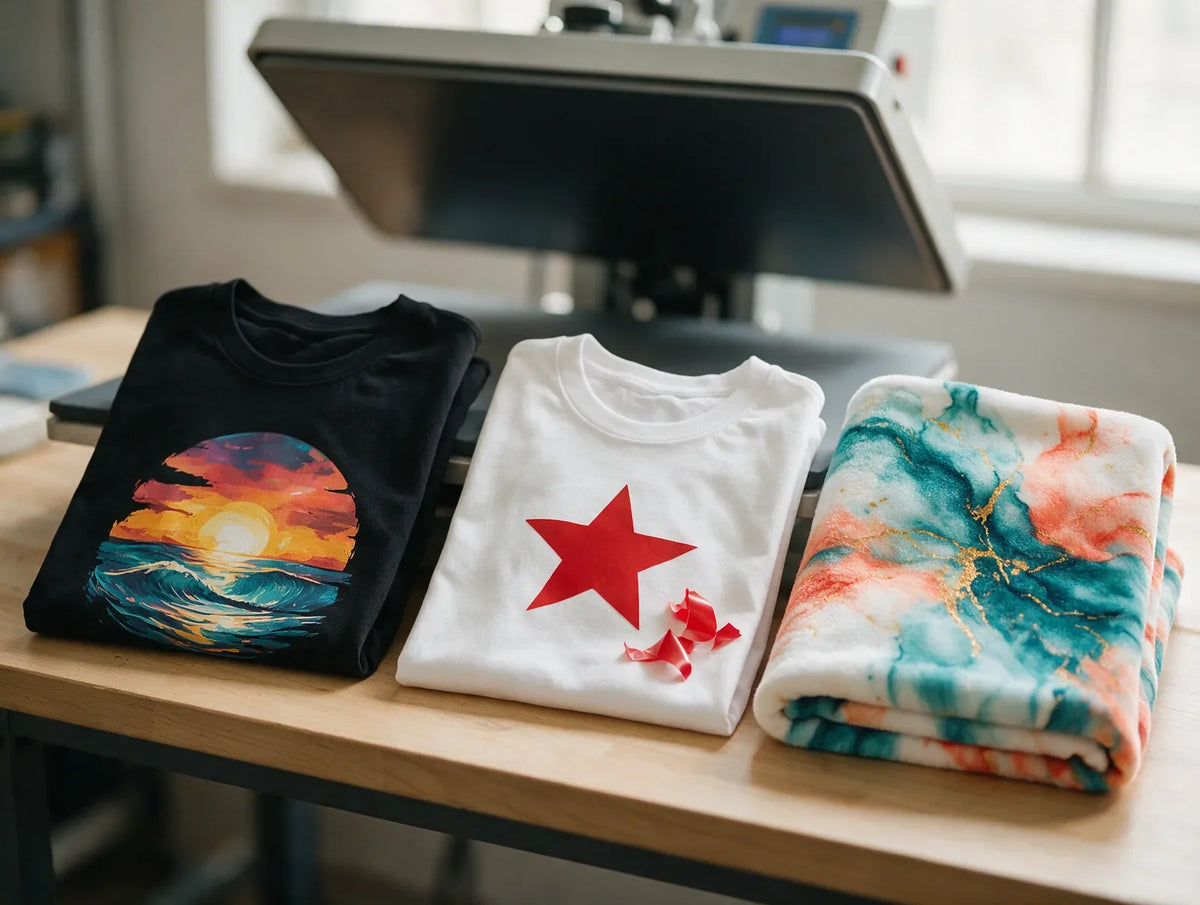
Heat transfer printing covers any method where a design is made first, on film, vinyl or paper, and then bonded to fabric with a heat press. The three types you will hear about most are DTF (direct-to-film), HTV (heat transfer vinyl) and dye sublimation. All three rely on heat and pressure, but they handle color, fabric and feel in very different ways.
The short answer: choose DTF for full-color designs on most fabrics, HTV for simple one-color names and shapes, and sublimation for vivid prints you cannot feel on white or light polyester. Below, we explain how each type of heat transfer works, compare them side by side and help you pick the right one for your project.
How heat transfer printing works
Every heat transfer follows the same basic path:
- Make the design on a carrier. It is printed onto film or paper, or cut from a sheet of vinyl.
- Press it. A heat press applies heat, pressure and time so the design bonds to the fabric.
- Remove the carrier. The film, carrier sheet or paper comes away, and the design stays on the garment.
The big difference is how the design bonds. DTF uses an adhesive powder melted onto the back of the print, HTV has a heat-activated adhesive built into the vinyl, and sublimation ink turns into a gas that bonds with polyester fibers. That one difference explains most of what each method can and cannot do.
Types of heat transfer at a glance
| Factor | DTF transfers | HTV | Dye sublimation |
|---|---|---|---|
| How it is made | Printed on film with a white underbase and adhesive powder | Cut from colored vinyl, then weeded by hand | Printed on transfer paper with sublimation ink |
| Colors | Unlimited colors, gradients and photos | One solid color per layer | Unlimited colors, gradients and photos |
| Fabrics | Cotton, polyester, blends, canvas, denim, leather, nylon | Cotton, polyester and blends, with special vinyls for other materials | Polyester or polyester-coated items |
| Garment colors | Light and dark | Light and dark | White and light colors |
| Feel | Thin, flexible layer on the surface | Smooth layer that gets thicker with each color | No feel; the ink becomes part of the fabric |
| Best for | Full-color art, small runs, many designs or names | Simple names, numbers and shapes | All-over prints, blankets and polyester jerseys |
You may also come across screen-printed transfers and printable transfer papers. They have their uses, but DTF, HTV and sublimation are the three most people compare when choosing a heat transfer method.
DTF transfers: full color on most fabrics
DTF printing puts your design onto a clear film, adds a white underbase behind the colors and coats the back with an adhesive powder that is cured into a ready-to-press transfer. There is no cutting or weeding, and every color prints in one pass, so a full-color illustration takes no more work than a one-color logo.
- Fabrics: our transfers adhere to cotton, polyester, blends, tri-blends, canvas, denim, leather and nylon.
- Light or dark garments: the white underbase keeps colors bright on black and navy.
- Detail: gradients, photos and fine lines print cleanly; keep text at 8 pt or larger.
- Durability: our transfers are lab tested for 100+ washes.
Our transfers press at 320°F (160°C) with medium pressure for 15 seconds, peel cold and finish with a 5-second second press under parchment paper. There are no setup fees and no minimums on DTF transfers. Read what DTF printing is and how it works for the full process, or see every ordering option on our custom DTF transfers page.
HTV: cut vinyl for simple names and shapes
Heat transfer vinyl is a thin sheet of colored vinyl with a heat-activated adhesive on the back, held on a clear carrier sheet. A cutting machine cuts the design in reverse, the extra vinyl is picked away by hand in a step called weeding, and the design is pressed onto the garment.
HTV is popular with crafters and small shops because a single name or number can be cut and pressed quickly. It also comes in specialty finishes such as glitter, metallic and reflective. The limits show up as designs get more complex:
- One color per layer. A three-color design means three cuts, three rounds of weeding and careful alignment.
- Weeding takes time. Small text, thin lines and detailed shapes are slow to weed and easy to tear.
- Layers add up. Each extra layer adds stiffness, so large multi-color designs can feel heavy.
- Solid colors only. Standard vinyl is not built for photos or smooth gradients.
Dye sublimation: vivid prints you cannot feel
Sublimation starts with special ink printed onto transfer paper. Under the heat press, the ink turns into a gas and bonds with polyester fibers, so the print becomes part of the fabric. There is nothing on the surface to feel or peel, and the design can run edge to edge.
The trade-off is material. Sublimation needs polyester or a polyester-coated surface, so it is not a fit for all-cotton shirts. The ink is also transparent and cannot print white, so it shows best on white or light colors and does not work on dark garments.

We use dye sublimation for custom blankets in 9 fabric types, from 220 to 850 GSM, with production in 1–3 business days. For a closer look at DTF and sublimation, both of which we offer, read our guide to DTF vs sublimation.
DTF vs HTV: which is better for shirts?
For most shirt projects, the choice between DTF and HTV comes down to colors, detail and how many pieces you are making.
- Choose HTV for a single name, number or simple shape in one color on a few pieces, especially if you already own a cutter, or when you want a glitter or metallic finish.
- Choose DTF for designs with several colors, gradients, photos, small text or fine lines, and for orders with many designs, names or sizes.
Time is the hidden cost. With HTV, every extra color and every detailed letter adds cutting, weeding and layering. A DTF transfer arrives ready to press, so a full-color design takes the same pressing time as a one-color one. Names and numbers for a whole team can share one 22-inch gang sheet, which you can lay out in the free Gang Sheet Builder.
How to choose the right heat transfer method
Answer these questions about your project, and the right method usually becomes clear:
- What is the fabric? Polyester opens the door to sublimation. Cotton, blends, denim, canvas and nylon point to DTF.
- What color is the garment? Dark garments rule out sublimation. DTF and HTV work on light and dark.
- How many colors? One solid color suits HTV. Photos, gradients and multi-color art suit DTF or sublimation.
- How many pieces and designs? A few one-color pieces suit HTV. Many designs, names or sizes suit a DTF gang sheet.
- What should it feel like? Sublimation has no feel, DTF is a thin, flexible layer, and HTV feels smooth but stiffer as layers stack up.
Quick picks
- Full-color logo on cotton tees: DTF.
- Bright artwork on black hoodies: DTF, thanks to the white underbase.
- One name on a single shirt: HTV, or a DTF transfer ordered by size.
- Photo blanket: dye sublimation.
- All-over print on a white polyester jersey: dye sublimation.
Weighing screen printing or embroidery too? Our guide to custom printing techniques compares DTF, screen printing, embroidery and sublimation.
Pressing tips for every heat transfer
- Follow the maker's settings. Each type has its own temperature, time and peel. Sublimation generally needs a hotter, longer press than DTF, and vinyl settings vary by brand.
- Pre-press the garment. A quick press removes moisture and wrinkles that can block the bond.
- Check the real temperature. Many presses run hotter or cooler than their display, so test with heat strips or a temperature gun.
- Respect the peel. Hot-peel and cold-peel products behave differently. Our DTF transfers are cold peel, so let the film cool completely.
- Care for the finished piece. Wash inside out in cold water, skip bleach and dry cleaning, and air dry.
Our DTF application guide walks through every step for our transfers. A household iron works in a pinch, but a heat press gives the most even heat and pressure.
Frequently asked questions
Is DTF better than HTV?
For multi-color designs, photos and fine detail, yes. DTF prints every color in one transfer with no cutting or weeding. HTV still makes sense for simple one-color names and shapes, or when you want a specialty finish like glitter.
Can you sublimate on cotton?
Not well. Sublimation ink bonds with polyester, so on cotton the print looks faded and washes out. For cotton shirts, DTF is the better heat transfer option.
Which heat transfer lasts the longest?
All three last when they are pressed and cared for correctly. Sublimation becomes part of the polyester, and our DTF transfers are lab tested for 100+ washes. Washing inside out in cold water and air drying helps any print last longer.
Do I need a heat press for heat transfer printing?
A heat press gives the even heat and pressure every type of transfer needs, and sublimation in particular relies on one. For our DTF transfers, a household iron works in a pinch if you press firmly, but a heat press gives the best results.
Do DTF transfers work on dark shirts?
Yes. Our transfers include a white underbase, so colors stay bright on black, navy and other dark garments. Sublimation cannot do this, because its ink is transparent.
Pick the right heat transfer for your project
If your design has more than one color, needs fine detail or is going on dark or mixed fabrics, DTF is the most flexible choice. Keep HTV in mind for simple one-color jobs and sublimation for polyester and all-over prints. Want to feel the difference first? Order a free DTF transfer sample pack.


