


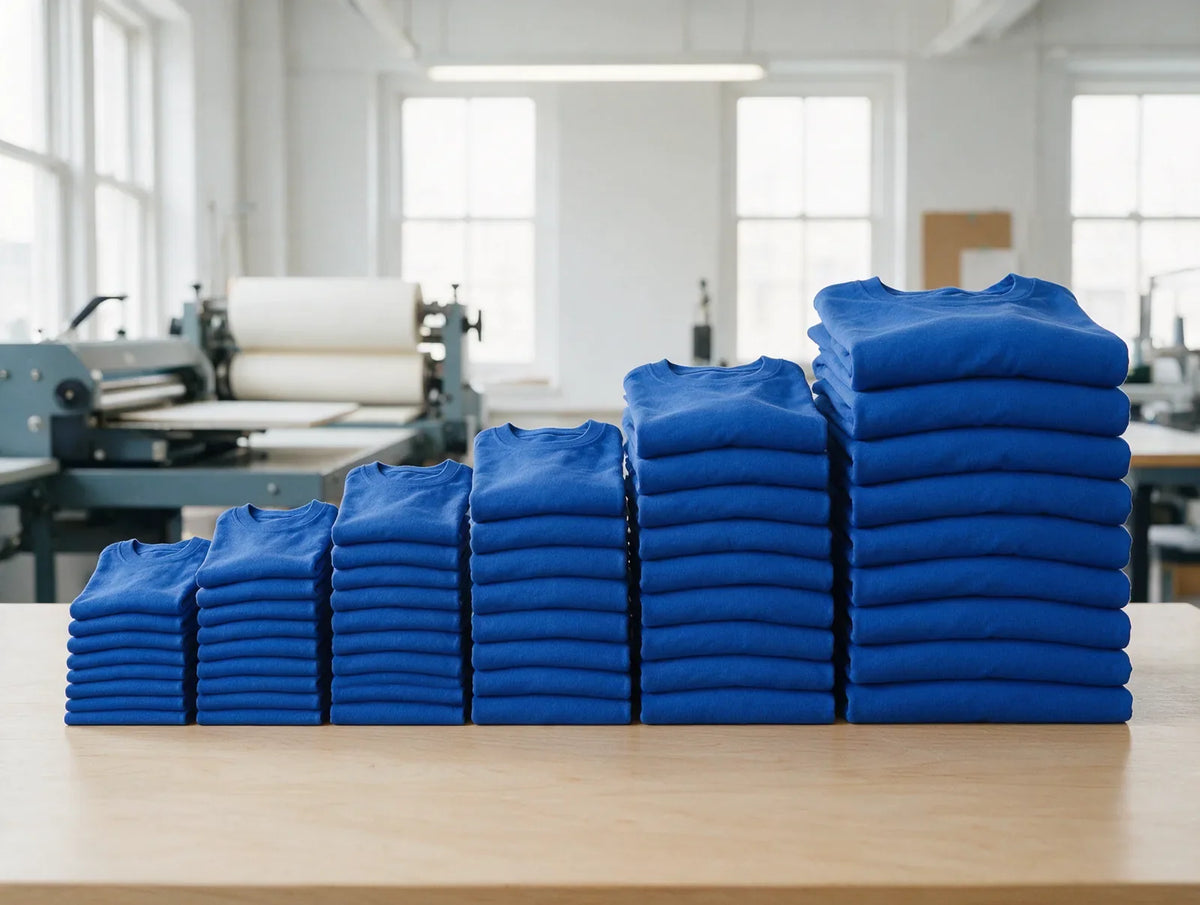
The most accurate t-shirt size breakdown for group orders is the one your group gives you: real sizes from real people. When you can't collect every size in time, a common starting split helps you estimate, and a few extra shirts cover the gaps.
This guide gives that split with worked counts for 50, 100 and 250 shirts, shows how to adjust it for your crowd and collect sizes, and covers youth and adult sizes, women's fits, extras and print sizes. It works for teams, schools, churches, clubs, family reunions and company events.
Key takeaways
- Collect real sizes first; estimate only for the people you can't reach.
- A common starting split: S 10%, M 25%, L 30%, XL 20%, 2XL 10%, 3XL and up 5%.
- Shift it for your crowd: younger groups smaller, trades crews larger, fitted women's styles a size up.
- Keep youth, adult and women's sizes on separate lists, each checked against its own size chart.
- Put a few extras in M, L and XL, and print youth shirts at a smaller size.
In this guide
- How many of each shirt size to order
- Size breakdowns for 50, 100 and 250 shirts
- Adjust the split for your group
- Collect real sizes for group orders first
- Youth and adult shirt sizes in one order
- Women's fits vs unisex shirts
- Plan a few extra shirts
- Size the print for every shirt
- Ordering custom shirts for your group
- Frequently asked questions
- Get your group's sizes right
How many of each shirt size to order
If you can't collect real sizes, a common starting split for adult unisex shirts is about 10% S, 25% M, 30% L, 20% XL, 10% 2XL and 5% 3XL and up. It peaks at L because most adult groups cluster around the middle sizes, and it's a starting point to adjust, not a rule.
Sometimes you have to estimate, for example for a giveaway, a walk-in event or a group that won't fill out a form. In that case, start from a typical split and adjust it for your crowd. The split below is a common starting point for adult unisex shirts, not a fixed rule.
| Adult size | Common starting share | Example: 40 shirts |
|---|---|---|
| S | 10% | 4 |
| M | 25% | 10 |
| L | 30% | 12 |
| XL | 20% | 8 |
| 2XL | 10% | 4 |
| 3XL and up | 5% | 2 |
As a ratio, the split works out to about 2 : 5 : 6 : 4 : 2 : 1. For every 20 shirts, that's 2 S, 5 M, 6 L, 4 XL, 2 in 2XL and 1 in 3XL and up, so an order of 60 is three times that: 6, 15, 18, 12, 6 and 3. The 40-shirt column above is the same ratio doubled.
The split describes adult unisex tees only. Youth, toddler and women's-cut shirts run on their own size charts, so keep them out of this math and plan them as separate lists, as covered further down.
Any estimate is a guess, so use real sizes wherever you have them and apply the split only to the people you couldn't reach.
Size breakdowns for 50, 100 and 250 shirts
For 50 adult shirts, the common split works out to about 5 S, 12 M, 15 L, 10 XL, 5 2XL and 3 in 3XL and up. For 100 it's 10, 25, 30, 20, 10 and 5, and for 250 it's 25, 62, 75, 50, 25 and 13. Each column below adds up to its headcount.
| Size | 50 shirts | 100 shirts | 250 shirts |
|---|---|---|---|
| S | 5 | 10 | 25 |
| M | 12 (12.5 rounded down) | 25 | 62 (62.5 rounded down) |
| L | 15 | 30 | 75 |
| XL | 10 | 20 | 50 |
| 2XL | 5 | 10 | 25 |
| 3XL and up | 3 (2.5 rounded up) | 5 | 13 (12.5 rounded up) |
| Total | 50 | 100 | 250 |
Multiply the headcount by each share and round to whole shirts. When two sizes land on a half, as M and 3XL and up do at 50 and 250, round the larger size up and the smaller one down, so nobody who needs the biggest shirt goes without and the total still matches.
The 100-shirt column is the easiest to remember, because each count is the same number as its share. If your headcount falls between two columns, don't stretch the nearest one; run the quick method below on your real number instead.
For a mixed crowd, apply the counts to the adults only. A school event with 100 people, 40 of them kids, has 60 adult shirts to split: 6 S, 15 M, 18 L, 12 XL, 6 in 2XL and 3 in 3XL and up. The 40 youth shirts go on their own list.
How to work out the split for any headcount
Here's the quick math for any group: take the people whose sizes you already know out of the count, apply the split to everyone else, round, and check the total. The five steps below cover it, followed by a worked example.
- Count the sizes you already have. Tally every confirmed size from your form, by size.
- Subtract them from the headcount. What's left is the number of people you're guessing for.
- Multiply by each share. Use S 0.10, M 0.25, L 0.30, XL 0.20, 2XL 0.10 and 3XL and up 0.05.
- Round to whole shirts. Use the half rule above when two sizes land on .5.
- Add the rounded numbers and check the total. Fix any gap in L, the largest share, and plan extras separately (see below).
Here's how it plays out. A club of 60 has 38 sizes back and 22 people who never replied. For those 22: S 2.2 becomes 2, M 5.5 becomes 6, L 6.6 becomes 7, XL 4.4 becomes 4, 2XL 2.2 becomes 2 and 3XL and up 1.1 becomes 1, which adds up to 22.
Add those six numbers to the 38 real sizes, and that's your order. The more replies you collect, the fewer shirts ride on the guess, so a single rounding choice matters less.
Size breakdowns for small groups
Under about 20 shirts, a percentage split stops being useful because the counts turn into fractions of a shirt, so ask everyone for a size instead. Take 12 shirts: S 1.2 becomes 1, M is 3, L 3.6 becomes 4, XL 2.4 becomes 2, 2XL 1.2 becomes 1 and 3XL and up 0.6 becomes 1, a total of 12.
That math looks tidy, but in a group of 12 one guessed 3XL may never get worn while someone else squeezes into an L. A quick message to each person beats the split for a small team, office or family.
Adjust the split for your group
Shift the split toward the people you're ordering for: younger crowds run smaller, trades and field crews run larger, and fitted women's styles usually need a size up. Move the whole curve one step rather than guessing size by size, and when you can't decide, lean a size larger, since a roomy shirt gets worn and a tight one doesn't.
Then adjust it for the people in your group:
- Students and young adults often skew toward S and M.
- Adult staff and work crews often skew toward L, XL and 2XL.
- Mostly women in a unisex style: shift the whole split down about one size.
- Mixed groups of kids and adults: estimate the youth and adult headcounts separately, then split each one.
- Adult XS: add it only if you know someone needs it.
| Group | How to shift the split |
|---|---|
| Office and corporate teams | Stay close to the common split; offer a women's style as a second list |
| Trades and field crews | One step larger: fewer S, more XL, 2XL and 3XL and up |
| Schools and youth groups | A separate youth list, then the split only for the adults |
| College students and young adults | One step smaller; skip 3XL and up unless someone asks |
| Mostly men in a unisex style | The common split as it is |
| Mostly women in a unisex style | One step smaller, or offer a women's cut |
Moving the split one step means each size takes the share of its neighbor. To go one step larger, give M the share S had, L the share M had, and so on up the list; the share that falls off the end stays in the last size, so the total doesn't change. Going smaller works the same way in the other direction. If that leaves the smallest size empty and you know someone needs it, move one shirt back.
When one event mixes crowds, such as office staff and a field crew at a company picnic, split the headcount by group first. Shift each part on its own, then add the counts together for the order.
Running and fitness groups often prefer fitted styles, so add a fit preference to the form instead of guessing. Crews with plenty of larger sizes can look at our big and tall t-shirts, and our page on company and staff apparel covers uniforms and shirts for teams at work.

Collect real sizes for group orders first
Estimating is the fallback, not the plan. Asking everyone for their size takes a little effort, but it saves you from leftover shirts and people stuck in a size that doesn't fit. A short form, a firm date and a default for no-replies are all you need.
- Pick the exact shirt style first. Sizes vary between brands and cuts, so share the size chart for the style you plan to order.
- Use one form. An online form or a sign-up sheet works. Ask for name, fit (adult, youth or women's) and size, and offer sizes as a fixed list so nobody writes "medium-ish".
- Add a fit note. One line saying whether the shirt runs relaxed or fitted helps people pick the right size the first time.
- Spell out youth and adult. A youth M and an adult M are very different shirts, so never accept a plain "M".
- Set a reply-by date. Choose a date well before you need to order, and send one reminder a few days ahead.
- Announce a default size. Tell people up front what they'll get if they don't answer, such as a middle-to-large size in the group's main fit. A clear default tends to bring the last replies in.
- Decide what happens to late replies. For anyone who doesn't answer, fall back on the starting split above.
- Save the final list. It makes reorders and next year's shirts much easier.
Keep the form short, and put a photo of the shirt in its color at the top so people know what they're signing up for. Five fields cover nearly every group order:
| Field | Why it matters |
|---|---|
| Name | Matches each shirt to a person at hand-out |
| Fit: adult unisex, women's or youth | Splits answers into three separate lists |
| Size, from a fixed list | No "medium-ish" or "whatever fits" answers |
| Name or number to print (optional) | Needed only for personalized shirts |
| Paid or not | Tracks who has paid on a pre-order |
If people are buying their own shirts, a pre-order with payment up front gives you exact sizes and covers the cost before anything is printed. Our guide on print on demand vs bulk orders goes deeper into taking pre-orders. For shirts with a different name or number on each one, see our guide to names and numbers for team shirts.
How do I know what size shirt to order?
Compare the size chart for the exact style with a shirt you already own that fits the way you like. Lay that shirt flat, measure across the chest and down the length, and pick the size on the chart closest to it. If you're between two sizes, go by the fit you prefer.
Charts differ between brands and even between styles from the same brand, so always use the chart for the style you're ordering. If you'd like help comparing two styles, ask us by phone or live chat.
Youth and adult shirt sizes in one order
Family reunions, schools and youth teams usually need both youth and adult shirt sizes. Treat them as two separate lists, because youth sizes are cut on their own scale, and how a youth XL compares with an adult S varies by brand.
- Ask for age and current size. For kids, ask parents for the size their child wears now plus their age, so you can sanity-check each answer.
- Size up for growth. If shirts will be worn all season or all year, many families choose one size up.
- Teens may need adult sizes. Older and taller kids often fit an adult S or M better than a youth XL.
- Toddlers are a third list. Toddler sizes run separately from youth sizes, so collect them on their own.
Browse our youth t-shirts and pick a color that the adult shirts come in too, so kids and adults match.
For sports teams, rosters, growth room and spare jerseys are covered in our guide on how to order custom team uniforms, and our custom team uniforms page covers every sport we make uniforms for.
What is the difference between youth and adult sizes?
Youth shirts are cut for children's proportions: shorter in the body and sleeves, and sized by age ranges rather than chest size alone. Adult shirts run longer and wider, so even where a youth XL and an adult S look close on a chart, the youth shirt is usually shorter.
That length difference is why older kids often move to adult sizes before a youth XL feels tight across the chest. A shirt that fits the shoulders but stops above the waistband is the usual sign it's time to switch.
What size is an adult medium in youth?
Usually there isn't one. In most tee brands even a youth XL sits closer to an adult small, so anyone who wears an adult medium should stay in adult sizes. For an adult small, a youth XL can work for a shorter fit; check both charts for the same style.
To keep kids and adults matching, pick a style that comes in both youth and adult cuts. For example, the Gildan Heavy Cotton T-Shirt (5000), a 5.3 oz pre-shrunk 100% cotton tee in most colors, has a youth version (5000B). Check the size chart for each version, since youth and adult charts are separate. For the smallest members of the group, browse our toddler t-shirts.
Women's fits vs unisex shirts
Most group orders default to unisex tees, which are cut like classic men's shirts. Women's styles are shaped and usually run smaller, so many women order one size up in a women's cut.
- Offer a choice when you can. Add unisex and women's options to your form, each with its own size chart.
- Keep the look consistent. Choose a women's style in a matching or close color so the group still looks like a group. See our women's t-shirts.
- Plan for tall sizes. Some styles, like the Hanes Beefy-T tall tee, come in tall sizes for longer torsos.
- Keep it simple when time is short. For a large order on a tight timeline, one unisex style is the easiest to manage.
Treat women's-cut sizes as their own list and collect them rather than estimate them, because fitted cuts differ more from brand to brand than unisex tees do. If you must estimate a women's list, apply the common split to the women's chart and expect many people to pick one size up from their unisex size. A note on the form that the style runs fitted helps people choose.
Tall sizes work the same way. Collect them by name, never by estimate, since a tall shirt only helps the person who asked for one and fits everyone else too long.
Plan a few extra shirts
Even with a perfect sign-up list, someone joins late, swaps sizes or spills on a shirt at the event. A small cushion saves you a rushed reorder. How many extras depends on your group, not a fixed share: count the late sign-ups and swaps you had last time and plan for about that many.
- Put extras in the middle sizes. M, L and XL are the safest spares because they fit the most people.
- Add one at the ends only if your group has a lot of S or 2XL and up.
- Give leftovers a job. Extras make good volunteer thank-yous, raffle prizes or shirts for next year's newcomers.
Hold the extras back until hand-out day. Use them to fix size swaps first, and give them to latecomers only once every swap is settled.
For a giveaway with no sign-up at all, order a little more than your expected headcount and lean on the starting split.
Teams have their own version of this: plain spares without a name or number cover a new player or a torn jersey. Our team guide explains how to plan spare jerseys for teams.
Size the print for every shirt
The shirt size changes how big the print should be. A design that looks right on an adult XL can swallow the front of a youth small. These typical widths are a good guide:
- Adult full front: 10–12" wide
- Youth full front: 6–8" wide
- Toddler full front: 5–6" wide
- Left chest: 3–4" wide
- Full back: 12–14" wide

Most group orders with kids need at least two versions of the design: one for adults and one for youth. If you press shirts yourself with DTF transfers, place every version on one gang sheet. Our DTF size guide covers placement and common widths in more detail.
Count the versions from your size list, not the headcount. A reunion of 60 with 18 youth and 42 adult shirts needs 18 transfers at the youth width and 42 at the adult width. Groups with many 2XL and larger shirts sometimes add a third, wider version, since adult 2XL–4XL full fronts commonly run 12–14" wide. Our guide on how to put every version on one gang sheet shows how to lay them out side by side.
Smaller placements are more forgiving. A left-chest design or a small back print can often stay the same size across youth and adult shirts, so if you'd rather have one version for everyone, a small placement is the simplest route. Our transfers include a white underbase, so the same version also works if the group mixes light and dark shirt colors.
Ordering custom shirts for your group
Once your size list is final, ordering is the easy part. Browse styles and colors on our custom t-shirts page, add your design and order the sizes on your final list. We print with DTF and screen printing, and we're happy to help you choose the right shirt and method.
On each custom apparel product page, you pick the color and decoration method, then select Start designing. Sizes are chosen in the designer, and Add Team Name puts a different name or number on each shirt. Because printed apparel has no minimum order, a small group can order exactly its list.
Each product page also shows estimated standard and rush delivery dates, so check them against your event date before you set the reply-by date. For larger runs, our guide to ordering t-shirts in bulk covers the trade-offs.
Groups in metro Atlanta can choose free local pickup in Alpharetta, and we ship to all 50 states with tracking. Learn more about custom t-shirt printing in Atlanta, or call us at (678) 845-6864 with questions about your group order.
Still working on the design? Browse our family reunion shirt ideas and church shirt ideas for inspiration.
Frequently asked questions
What is a typical size breakdown for 100 shirts?
A common starting point for adult unisex shirts is about 10 S, 25 M, 30 L, 20 XL, 10 2XL and 5 in 3XL and up. Adjust it for your group, and use real sizes wherever you can collect them. The same split gives about 5, 12, 15, 10, 5 and 3 for 50 shirts, and the counts for 250 are in the table above.
Should teenagers order youth or adult sizes?
It depends on the teen. Many older kids fit an adult S or M better than a youth XL. Share the size chart and ask families to compare it with a shirt that fits now. The same goes for a 12-year-old and an adult small: some fit it and some don't, so let the shirt the child wears today decide.
How many extra shirts should I order?
A few, mostly in M, L and XL, since those sizes fit the most people. If your group often has late sign-ups, add a couple more. Base the number on how many late sign-ups and swaps your group had last time, and give any leftovers a job, such as volunteer thank-yous or prizes.
Do women's t-shirts run small?
Women's styles are usually more fitted and run smaller than unisex shirts, so many women order one size up. Share the size chart for the exact style you plan to order. If the group can't settle on a women's style, one unisex style for everyone keeps the order simple and the look consistent.
Can one print size work on every shirt?
Not usually. Typical full-front prints are 10–12" wide on adult shirts and 6–8" wide on youth shirts, so groups with kids and adults normally need two versions of the design. When you order DTF transfers, put both versions on one sheet; our guide on how to make a DTF gang sheet shows the layout.
Can a youth XL fit an adult?
Sometimes. A youth XL is often close to an adult XS or S across the chest but shorter in the body, so it can suit a petite adult who wants a shorter, closer fit. It can feel snug in the chest and arms, though, so compare the youth chart with a shirt that fits before you switch.
How do shirt sizes go in order?
Adult sizes run XS, S, M, L, XL, then 2XL, 3XL and up. Youth sizes run on their own scale from youth XS to youth XL, and toddler sizes come before youth. On a form, list them in that order as a fixed menu so people pick rather than type. The sizes a style comes in show up when you pick it in the designer.
Is youth 14-16 the same as adult small?
Not exactly. In many brands a youth 14–16 is labeled youth L or XL and sits close to an adult XS or S in width, but it's shorter. Against women's sizes it may be close to a fitted women's XS or S, depending on the cut. Compare the charts for the exact styles before you swap one for the other.
Is a youth large a size 10 or 12?
It depends on the brand. Many tee brands put 10–12 at youth medium and 14–16 at youth large, while others shift by one size, so read the size range printed on that style's chart. When a child falls between labels, go by a shirt that fits now rather than the number alone.
What does a shirt size 16-32/33 mean?
That's dress-shirt sizing, not t-shirt sizing. The first number is the neck size in inches and the second is the sleeve length range. Group t-shirts use letter sizes instead, so ask for S, M, L, XL, 2XL and up on your form, not neck and sleeve numbers, and keep youth and adult letters apart.
Should you size up in case cotton shirts shrink?
Usually not by a full size. Pre-shrunk cotton tees such as the Gildan Heavy Cotton T-Shirt change less in the wash, and blends and polyester usually hold their shape. Hot washes and the dryer cause most shrinking, so wash cold, inside out, and air dry (see how to wash DTF shirts). Heavyweight cotton is covered in our heavyweight t-shirt guide.
What if someone is between two sizes?
Go one size up for a relaxed or unisex fit, and stay with the smaller size only if the person likes a close fit or the style runs large. For kids who are still growing, the larger size usually wins. A note on the form about how the shirt fits helps, and our guide to blank t-shirts compares fabric and fit.
Get your group's sizes right
Collect real sizes first, estimate only where you must, add a few extras and size the print for every shirt. With a clean size list in hand, the order itself is quick.


