


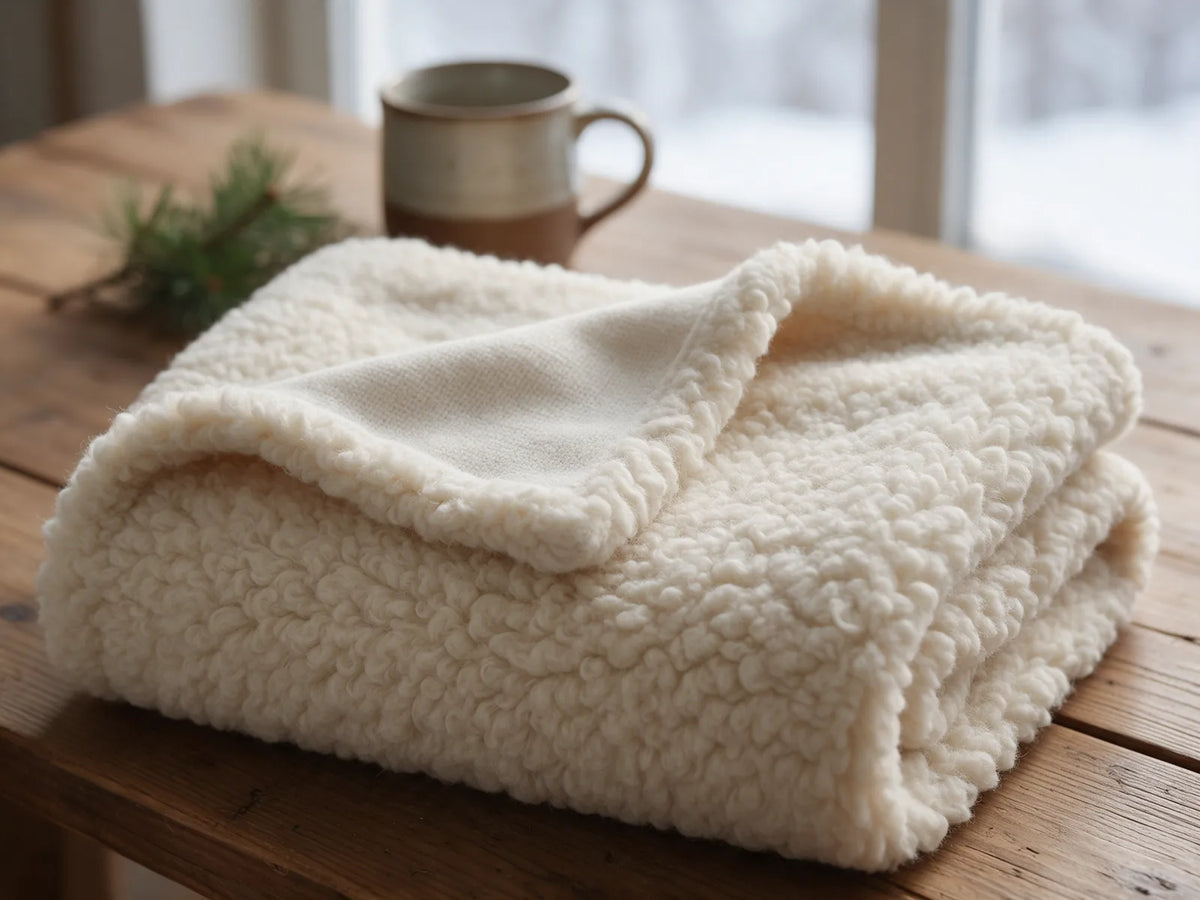
What is sherpa fabric? Sherpa is a knit fabric, usually polyester or acrylic, with a thick, curly pile on one side that imitates sheepskin and a flat knit on the other. It's a synthetic, animal-free stand-in for shearling, used for jacket linings, slippers and the fluffy back of warm throw blankets.
Key takeaways
- Sherpa is a knit, usually polyester or acrylic, brushed into curls that look like sheepskin.
- It's warm because the curls trap air, but on its own it isn't windproof.
- Sherpa blankets pair a smooth face with a sherpa back, and the design prints on the smooth side.
- Heat and friction mat the curls, so keep sherpa away from irons and high heat.
- Our Sherpa blanket is 480 GSM: a silky printed face, a fluffy sherpa back and a whip-stitched edge.
In this guide
- What is sherpa fabric made of?
- Why is it called sherpa?
- What does sherpa fabric feel like?
- Is sherpa fabric warm?
- What is sherpa fabric used for?
- Sherpa blanket material: what's on each side
- Does sherpa pill, shed or shrink?
- Is sherpa the same as wool?
- Is sherpa a good fabric?
- Sherpa fabric, in short
- Frequently asked questions
What is sherpa fabric made of?
Most sherpa is made of polyester, and some of acrylic, knit into a fabric with a thick, curly pile on one side and a flat knit on the other. Cotton and cotton-blend sherpa exist too, mostly sold by the yard for sewing, but most sherpa blankets and jacket linings you'll find in stores are synthetic.
Sherpa by fiber:
- Polyester: the most common choice; light, quick-drying and good at holding its curl.
- Acrylic: a softer, more wool-like hand; many early sherpa linings used an acrylic pile.
- Recycled polyester: spun from recycled plastic and handled just like regular polyester sherpa.
- Cotton or organic cotton: yes, sherpa can be 100% cotton. It breathes better but is heavier, less curly and costs more, so it's mostly sold as a sewing fabric.
How is sherpa fabric made?
Sherpa starts as a knit: yarn is knitted into a base with loops on one face, and those loops are brushed and crimped with wire brushes until they twist into the small, nubby curls that look like sheepskin. The back stays a flat knit, so it can be sewn or bonded to other fabrics.
- Spin polyester, acrylic or cotton fibers into yarn.
- Knit a base fabric with loops standing up on one side.
- Brush the loops with wire brushes to open up the fibers.
- Crimp the brushed fibers until they twist into tight curls.
- Bond or sew the sherpa to another layer: denim or suede for a jacket, a smooth face fabric for a blanket.
Why is it called sherpa?
The name started as a trademark: the American textile maker Collins & Aikman developed the fabric and sold it as Sherpa, a nod to the Sherpa people of the Himalayas and their wool-lined cold-weather clothing. Over time the word became the everyday name for any curly, sheepskin-style pile fabric.
Sherpa-lined coats were already in stores by the early 1960s, and the fabric has kept the name ever since. Other names you'll see on labels and listings:
- Faux shearling, because it imitates sheepskin with the wool still on.
- Faux lambswool, for the soft, curly look of a young sheep's coat.
- Berber fleece, usually for a tighter, nubbier curl.
- Sherpa fleece, a common name in blanket and jacket listings.
"Sherpa fleece" is a common listing name because sherpa belongs to the same family of brushed polyester knits as fleece. For warmth, softness and weight side by side, see our comparison of sherpa, fleece and minky.
What does sherpa fabric feel like?
Sherpa feels soft, lofty and slightly nubby, like the inside of a sheepskin boot: your fingers sink into small, springy curls instead of gliding over a flat surface. The other side is a thin, smooth knit, and on a blanket that side is usually covered by a silkier face fabric.
- Look: clusters of small curls, most often in cream, ivory or oatmeal, so it reads like lamb's wool from across the room.
- Plush sherpa: a longer, denser, softer pile than the tight, nubby berber curl; it feels fluffier but mats more easily.
- Weight: thick but airy, so a sherpa throw looks heavier than it is.
Press a hand into new sherpa and the curls bounce back up when you lift it. Where they stay flat, the pile has started to mat, which the pill and shed section below explains.
Is sherpa fabric warm?
Yes. Sherpa is warm because its curly pile traps a layer of still air next to your body, much as wool does, so it holds heat without much weight. On its own it isn't windproof, which is why jackets bond it to a denim or canvas shell and blankets pair it with a face fabric.
What makes one sherpa warmer than another:
- Deeper, denser curls, which hold more still air.
- A second layer, such as a face fabric on a blanket or a bonded shell on a jacket, which blocks drafts.
- Overall weight, shown as GSM (grams per square meter), which tells you how much fabric is there.
Warmth has a flip side: a synthetic pile doesn't breathe like wool, so a sherpa throw can feel too warm for hot sleepers or a summer night.
Our Sherpa blanket is 480 GSM, the heaviest of our shop fabrics after Chenille (570 GSM), and it's made for cold nights and holiday gifts.
Whether sherpa beats fleece or minky for warmth is a separate question. Our guide to which blanket fabric is warmest answers it with all three side by side.
What is sherpa fabric used for?
Sherpa is used wherever warmth and a cozy look matter: jacket, vest and hoodie linings, collars and cuffs, slipper and boot linings, hats and gloves, throw blankets, pillow covers and pet beds. Because its flat back bonds easily to other fabrics, it's one of the most common linings in winter clothing.
- Clothing: denim and canvas jacket linings, vests, hoodies and collars.
- Footwear and accessories: slipper and boot linings, hats and mittens.
- Home: throws, blanket backs, pillow covers and upholstery accents.
- Pets: bed linings, mats and winter dog coats.
Making something yourself? Sherpa yardage is easy to find at fabric stores. If you'd rather have a finished blanket with a printed name, read on.

Sherpa blanket material: what's on each side
Most sherpa blankets are two layers sewn together: a curly sherpa back for warmth and a smooth face, such as microfleece, plush or printed polyester, that feels silky and carries the color or design. The layers are joined at a stitched edge, so you can use the blanket either side up.
Signs of a well-made sherpa blanket:
- Curls: dense and even, springing back when pressed, with no flat or thin patches.
- Face: tight and smooth, with no loose fibers rubbing off on dark clothes.
- Edge: a strong whip stitch or binding that holds both layers flat.
- Weight: a heavier GSM for cold nights, a lighter one for layering.
- Label: the fiber content of both sides, printed on the care label.
For size, a 30 × 40 works for a baby or a lap, 50 × 60 for the couch and 60 × 80 for the bed; see the blanket size chart for standard bed and throw dimensions.
Our Sherpa blanket is built this way: a silky printed face, a fluffy sherpa back and a whip-stitched edge. You can order any of our personalized name blankets in Sherpa, Patchwork Daisy for example, in 30 × 40, 50 × 60 or 60 × 80 inches.
Type the name or short text you want, choose a font and text color, and look over the preview before you add it to the cart. The name and design print on the smooth face, where fine lines stay sharp.
For a photo, ask for a quote on a custom photo blanket in premium sherpa: names need to be at least 14 pt on deep-pile fabrics like sherpa, and you get a free proof before anything prints. For a company logo, see our custom logo blankets.
Does sherpa pill, shed or shrink?
Sherpa doesn't usually pill the way a worn sweater does; its more common problem is matting, when the curls tangle and flatten where the blanket rubs or meets high heat. A new piece sheds a little loose fiber at first, and polyester sherpa shrinks very little unless it gets hot.
| Question | Short answer | Why |
|---|---|---|
| Pill | Rarely; it mats instead | Friction tangles the curls, and heat sets those tangles in place. |
| Shed | A little, when new | Brushing leaves loose fibers in the pile, and cut edges release more. |
| Shrink | Very little as a fiber | Without high heat the fibers barely change size. Even so, our blankets can come out 2–8% smaller after their first wash, and sizes carry a ±1" tolerance. |
| Fray | No | Knit loops don't unravel, and a stitched edge (ours is whip-stitched) keeps both layers neat. |
For our printed blankets the rule is a cold, gentle machine wash with mild detergent and a low tumble dry, with no bleach and no high heat. To keep the curls fluffy for years, follow our guide on how to wash and fluff a sherpa blanket.
Is sherpa the same as wool?
No. Wool is a natural fiber shorn from sheep, and shearling is a sheepskin with the wool still attached; sherpa is a knit, usually synthetic, made to look and feel like them. It's lighter, cheaper, animal-free and machine washable, while wool breathes better, handles moisture better and stands up longer to hard use.
| Trait | Sherpa | Wool or shearling |
|---|---|---|
| What it is | A knit pile, usually polyester or acrylic | A natural animal fiber; shearling keeps the skin |
| Feel | Soft, springy curls | Springy or itchy, depending on the wool |
| Breathing and moisture | Warm, but breathes less | Breathes and regulates temperature well |
| Care | Machine washable | Often hand wash or professional cleaning |
| Cost and origin | Affordable and animal-free | Costs more; animal-derived |
A simple rule: if you want a shearling coat to wear for decades, the real thing earns its price. For a throw that gets dragged around the house and goes through the wash, sherpa is the easier fabric to live with.
Is sherpa a good fabric?
Yes, for warmth and comfort at home or in winter clothing: sherpa is soft, warm for its weight, easy to care for and far cheaper than real shearling. It's a weaker pick for hot sleepers or sweaty outdoor activity, since a synthetic pile doesn't breathe like wool, and high heat can mat it.
Where sherpa shines:
- Cozy throws and blanket backs: the curls feel warm the moment you sit down, and the blanket stays light enough to carry from the couch to the bed.
- Jacket, boot and slipper linings: a sherpa lining adds warmth without much bulk, while the shell outside stops the wind.
- A shearling look without the animal: you get the sheepskin style at a fraction of the price, in a fabric that goes in the washing machine.
Where it falls short:
- Hot sleepers and summer nights: the pile holds heat, and a synthetic lets it out more slowly than wool.
- High-sweat outdoor activity: for hiking or running, a thin technical layer moves moisture better.
- Heat: an iron, a radiator or a heater can mat or melt the curls for good.
- Heavy rubbing: spots that get constant friction, such as the seat of a chair, slowly flatten.
Put simply, sherpa is a good choice for anything you'll wrap around yourself on a cold evening and a poor one for anything you'll work up a sweat in.
Sherpa fabric, in short
Sherpa is a curly, sheepskin-style knit, usually polyester: warm without much weight, animal-free, easy to live with, and prone to matting when it meets high heat. On a blanket, look for dense curls, a smooth face and a strong stitched edge. The smooth, velvety fabric often used on the other side is explained in what minky fabric is, and sherpa throws as presents are in our Christmas blanket gift ideas.
For a photo or a larger order on sherpa, ask for a free quote: there are no setup fees and no minimum.
Frequently asked questions
Is sherpa 100% polyester?
Often, but not always. Most sherpa in blankets and jacket linings is polyester; some is acrylic, a polyester blend, recycled polyester or cotton. The care label is the only sure way to know for a given piece. Polyester sherpa is the easiest to live with: it's light, holds its curl and handles regular washing well.
Is sherpa fabric knit or woven?
Knit. Sherpa is a knitted pile fabric, which gives it a little stretch and keeps the curly side soft and lofty. When you see sherpa inside a denim jacket or a canvas coat, the sherpa knit has been bonded or sewn to that woven shell, so the garment combines both.
What are the types of sherpa fabric?
Sherpa is usually sorted by fiber and by build. By fiber: polyester, acrylic, recycled polyester, and cotton or organic cotton. By build: single-layer sherpa sold by the yard, bonded sherpa laminated to denim, suede or microfiber, and two-layer blankets with a smooth face. The pile ranges from a tight, nubby curl to long, plush teddy.
What is teddy sherpa fabric?
Teddy is the name sellers use for a fluffier style of sherpa: a polyester pile with longer, looser curls that looks like a teddy bear's coat. It's popular for coats, pajamas, slippers and plush toys. The fibers and care are the same as regular sherpa; the difference is mostly the length and softness of the pile.
Can you print on sherpa fabric?
Not crisply on the curly side: the pile breaks up fine lines, and heat-pressing it crushes the curls. That's why printed sherpa blankets carry the design on a smooth face sewn to the sherpa back. Ours is printed on its silky face by dye sublimation, and for custom layouts we ask for names of at least 14 pt on deep-pile fabrics like sherpa.
Can you iron sherpa fabric?
Not on the curly side. Direct heat flattens the curls and can melt polyester into a stiff, glossy patch that won't fluff back up. Sherpa rarely needs pressing anyway; if a seam must be pressed, work on the flat knit side with the iron on its coolest setting and a cotton cloth in between.
Why is sherpa expensive?
Plain sherpa fabric isn't expensive; prices climb with a denser pile, a better backing, recycled or natural fibers, and a second layer sewn on as a face. Branded jackets add design and brand costs on top. A printed sherpa blanket from our shop is $21.85 in 30 × 40, $36.85 in 50 × 60 and $46.85 in 60 × 80, name included.


