


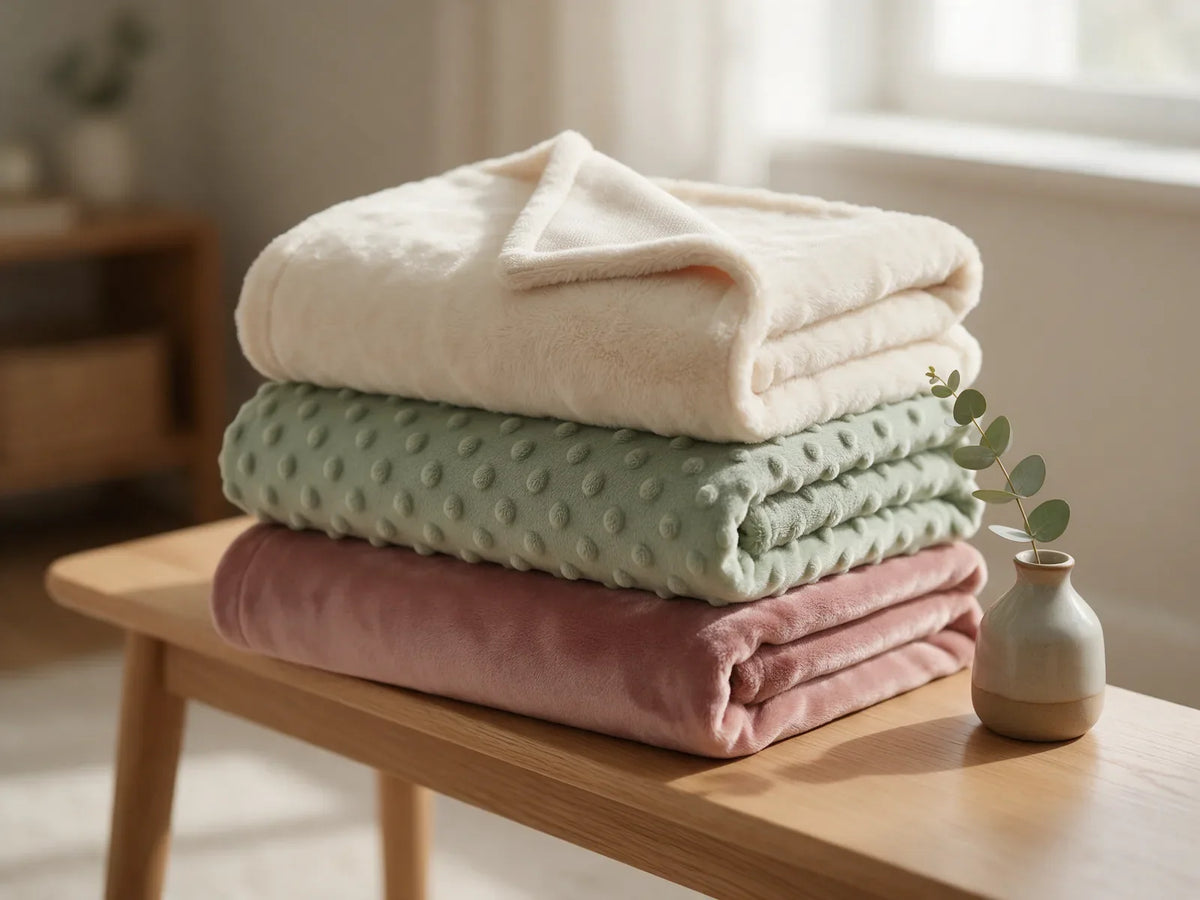
What is minky fabric? Minky is a soft, plush knit made of 100% polyester microfiber, with a short, velvety pile on one side and a smooth knit back. It's named for the feel of mink fur but contains no animal fiber, and it's a favorite for baby blankets, throws, quilt backs and plush toys.
Key takeaways
- Minky is 100% polyester microfiber: velvety pile on one side, smooth knit back, a little stretch.
- You'll also see it sold as minkee, plush mink or, in the UK, cuddle fleece.
- Polyester is heat-sensitive: never iron the pile, since high heat flattens or melts it.
- With babies, minky blankets are for supervised awake time, never for the crib or bassinet.
- Our Minky Plush is 300 GSM, and the printed name is dyed in, so it won't crack or peel.
In this guide
- What is minky fabric made of?
- What does minky fabric feel like?
- What is minky fabric called?
- What is minky fabric used for?
- Minky blanket material: what to look for
- Minky fabric pros and cons
- Does minky fabric bleed, fray or shrink?
- Can you iron minky fabric?
- Are minky blankets safe for babies?
- Minky fabric, in short
- Frequently asked questions
What is minky fabric made of?
Minky is made of 100% polyester, spun into very fine microfiber yarn and knit into a fabric with a dense, short pile on the face and a smooth knit back. There's no cotton and no animal fiber in it, though a few stretch versions blend in a little spandex.
Minky at a glance:
- Fiber: polyester microfiber, which keeps the fabric light and quick to dry.
- Build: a knit, with the pile usually on one side only; double-sided minky, plush on both faces, also exists.
- Face: a short, dense, velvety pile with a nap, meaning the fibers lean in one direction.
- Back: a smooth, flat knit that feels thin next to the pile.
- Stretch: some give, mostly across the width, which matters more to sewists than to blanket owners.
How is minky fabric made?
Minky is made by knitting fine polyester yarn into a pile fabric, then cutting and shearing the pile to an even, short height and brushing it soft. Solid colors are dyed, patterns are printed, and textured styles such as dimple dot are pressed into the pile with heat.
- Spin polyester into very fine microfiber yarn.
- Knit a base fabric with extra loops on one face.
- Cut, shear and brush the loops into an even, velvety pile.
- Dye the fabric a solid color, or print a pattern onto it.
- Heat-press dots, swirls or ridges into the pile for the textured styles.
The polyester is also why minky takes dye-sublimation printing so well: the dye bonds with polyester fibers, so a printed name ends up inside the fibers instead of sitting on the surface. Our guide to how dye sublimation works explains the process.
What does minky fabric feel like?
Minky feels silky, velvety and a little springy, much like a good stuffed animal: the pile is short and dense, so your hand glides over it instead of sinking in. It feels warm without being heavy, and it has a nap, so stroking it one way looks lighter than the other.
- Look: a soft, low sheen in solid colors or prints; dimple dot has raised dots, and embossed styles show swirls or ridges.
- Nap: the pile leans one way, so sewists cut every piece in the same direction to keep the shade even.
- Thickness: smooth minky has a short pile and faux-fur styles a long one. Weight in grams per square meter (GSM) is the fairer way to compare two blankets; our Minky Plush is 300 GSM.
- Warmth: it holds body heat well, but as a synthetic it breathes less than cotton, which matters with babies (see the baby section below).
That pairing of a fur-like touch with a light weight is most of what makes a minky blanket feel special the first time you hold one.
What is minky fabric called?
Minky goes by several names: minkee or minkie, plush, micro mink, mink or minky plush, and in UK fabric shops usually cuddle fleece, or dimple fleece for the dotted kind. The name comes from mink fur, which it's meant to feel like, but minky contains no fur or other animal fiber.
| Name | Where you'll see it |
|---|---|
| Minky, minkee, minkie | US fabric and craft stores, sewing patterns |
| Mink, plush mink, micro mink | Blanket listings; our custom blanket page calls it plush mink velveteen |
| Minky plush, minky fleece | Blanket and fabric listings; our shop fabric is Minky Plush |
| Cuddle fleece, dimple fleece | UK fabric shops |
Minky is sometimes listed as "minky fleece" because both are polyester knits, but it isn't the same as the fleece in a classic throw. Our sherpa vs fleece vs minky comparison sets them side by side on warmth, softness and weight.
What is minky fabric used for?
Minky is used wherever softness matters most: baby blankets and loveys, throw blankets, quilt backs, plush toys, pillows, robes and pet beds. Its short, even pile also shows color and printed detail clearly, so it's one of the most common fabrics for personalized name and photo blankets.
- Babies and kids: blankets, loveys, bibs and stroller blankets.
- Home: throws, pillow covers and bed throws.
- Sewing and quilting: quilt backs and plush toys; quilting tips are in the FAQ below.
- Apparel: robes, loungewear, jacket linings and scarves.
- Pets: bed covers and crate pads.
Sewing your own? Fabric and craft stores sell minky by the yard. For a finished blanket with a name already on it, the next section covers what to check.
Minky blanket material: what to look for
A good minky blanket feels dense and even, keeps its pile after washing, and has a finished edge with no loose threads. Before you buy, check the fiber content, the weight, whether it's minky on one side or both, and how the name or design is applied.
- Density: press the pile with a fingertip; it should spring back, with no thin or bare patches.
- Weight: compare GSM between blankets of the same fabric; more grams usually means a thicker blanket.
- One side or two: single-layer minky shows a smooth knit back, while double-sided minky or a second layer adds weight and warmth.
- Edges: a hem, binding or stitched edge keeps the cut pile from shedding.
- The name: a printed name is dyed into the fibers and stays flat and soft; embroidery is raised stitching on top. Either way, check a preview before you order.

Pick 30 × 40 inches for a baby or a lap, 50 × 60 for a throw and 60 × 80 to cover more of a bed; our blanket size chart has every standard size.
Our Minky Plush is a 300 GSM, 100% polyester plush with a smooth face that shows names and colors in crisp detail. Every design in our personalized name blankets comes in it, in 30 × 40, 50 × 60 and 60 × 80 inches, Hexagon Patchwork included. Type the name or short text you want, pick a font and text color, then check the preview; we print the name exactly as you type it.
A photo, a logo or a bulk order goes through a custom photo or logo blanket quote in plush mink velveteen. On deep-pile fabrics such as mink, keep names at least 14 pt; there are no setup fees, and we send a free proof before printing.
Minky fabric pros and cons
Minky's strengths are its softness, its warmth for the weight and the way it holds bright color and printed detail. Its weak spots come from the same polyester: it doesn't breathe like cotton, high heat can flatten or melt the pile, and it's slippery, stretchy and messy to sew.
| Pros | Cons |
|---|---|
| Very soft, velvety feel | Synthetic: breathes less than cotton and can feel warm |
| Warm without much weight | Heat-sensitive: high heat flattens or melts the pile |
| Holds bright color and printed detail | Slippery and stretchy to sew |
| Machine washable and generally resists pilling | Cut edges shed fluff until they're finished |
| Many textures, from smooth to faux fur | Usually costs more than basic fleece |
Those trade-offs make minky a strong fit for some people and a poor one for others:
- A good fit: anyone who runs cold on the couch, kids who drag a soft blanket from room to room, and gifts where a bright printed name is the point.
- A weaker fit: hot sleepers, warm rooms in summer and anyone who prefers natural fibers against the skin.
- A tricky first sewing project: the stretch and shedding reward patience, so beginners often start with cotton or fleece.
Picking between minky, sherpa and fleece for a gift, a baby or the couch is a comparison question of its own. Our side-by-side guide helps you compare minky, sherpa and fleece on warmth, softness and price.
Why is minky so expensive?
Minky costs more than basic fleece because its dense microfiber pile takes more fiber and finishing, textured styles need an extra heat-pressing step, and the fabric is slow to sew, which adds labor to handmade pieces. Boutique brands then add a premium for the name on the label.
A printed minky blanket doesn't have to be pricey: ours is $19.85 in 30 × 40, $27.85 in 50 × 60 and $37.85 in 60 × 80, with the name included. The price is the same for every design, and if budget comes first, Economy Fleece is our most affordable fabric.
Does minky fabric bleed, fray or shrink?
Minky doesn't fray like a woven fabric, because a knit doesn't unravel, but freshly cut edges shed a lot of loose fluff. Deep colors can give up a little loose dye when the fabric is new, and polyester itself shrinks very little unless it meets high heat.
| Question | Short answer | Why |
|---|---|---|
| Bleed | Deep or bright colors can lose a little loose dye at first | Surplus dye can sit on the fibers after dyeing. A design printed by sublimation is dyed into the fibers, so ours won't crack or peel. |
| Fray | No | Knit loops lock together instead of unraveling; a hem, binding or serged edge simply makes it neat. |
| Shed | Yes, at cut edges and when new | Cutting slices through the pile and frees short fibers, the "minky mess" sewists know; finished, hemmed blankets shed far less. |
| Shrink | Very little as a fiber | Polyester barely shrinks below high heat, but a sewn blanket can: ours by 2–8% after the first wash, with ±1" sizing. |
Our printed blankets go in the washer on cold, on a gentle cycle with a mild detergent, then into the dryer on low, with no bleach and no high heat. The full routine, from the first wash to keeping the pile soft, is in our guide on how to wash and dry a minky blanket.
Can you iron minky fabric?
Don't iron the pile side of minky: a hot iron can crush the plush flat or melt the polyester, and the shine it leaves doesn't brush out. If you must press a seam, use a low synthetic setting on the knit back with a pressing cloth, or hold a steamer just above the surface.
The same goes for heat in general. Polyester softens long before cotton does, so anything hot, from an iron's soleplate to a radiator or a fireplace screen, can leave a flattened, shiny patch, and once the pile has melted it stays that way.
Minky doesn't belong in the microwave either, since polyester can scorch or melt there. Heat a heat pack in its own inner bag, and use a minky cover only if the pack's instructions allow it.
Are minky blankets safe for babies?
The fabric isn't the problem; the setting is. The American Academy of Pediatrics says to keep blankets, quilts and other soft bedding out of a baby's sleep area until the first birthday, whatever they're made of. Save a minky blanket for awake time, with an adult right there.
Good uses while someone is watching:
- Across your lap while you feed or rock the baby.
- A soft layer for floor play and tummy time.
- Tucked around the legs on a stroller walk, with the face uncovered.
Watch the warmth. Minky is a warm synthetic, and the AAP notes that overheating raises the risk of SIDS, with sweating, a hot chest and flushed skin as warning signs. Its advice is to dress a baby in no more than one layer more than you'd wear yourself, and for sleep to use layers of clothing or a wearable blanket instead of a loose one.
For sizes and wording ideas for a newborn gift, see our personalized baby blanket gift guide.
Minky fabric, in short
Minky is a soft, one-sided polyester plush: warm for its weight, great at showing color and names, sensitive to heat, and meant for awake, supervised time with babies. Choose a dense pile and a finished edge, and keep it away from high heat. Curious about the curly fabric on the back of a sherpa blanket? Here's what sherpa fabric is.
Planning a photo, logo or bulk order in minky? Tell us the size and quantity, and we'll send pricing and timing within one business day.
Frequently asked questions
Is minky fabric 100% cotton?
No. Minky is 100% polyester microfiber, and a few stretch versions add a little spandex. Its softness comes from the dense synthetic pile, not from cotton. If you want a natural fiber, look at cotton flannel, muslin or a knit cotton blanket instead, and read the care label, which lists the exact fiber content of any blanket.
Are there different types of minky fabric?
Yes. The main types are smooth minky with a short, even pile; dimple dot, with raised dots pressed in by heat; embossed styles such as rosettes, swirls and ridges; long-pile faux-fur minky; printed minky; and double-sided minky, plush on both faces. Blankets usually use smooth or printed minky because it shows a name or design most clearly.
What is the safest material for a baby blanket?
For sleep, the material matters less than leaving loose blankets out of the crib or bassinet altogether in a baby's first year, as the AAP advises; a wearable blanket or layers of clothing keep a sleeping baby warm. For awake time, choose by temperature: breathable cotton or muslin for a warm room, plush minky for a cool day, always with an adult watching.
Does minky fabric stretch?
Yes, a little, mostly across the width and less along the length. That give makes a minky blanket drape softly, but it also makes the fabric shift under a sewing machine. Sewists use plenty of pins or clips, a walking foot and a slightly longer stitch, and they avoid pulling the fabric as it feeds.
Can minky fabric be used for tie blankets?
It can, since knit edges don't unravel when you cut the fringe, but minky sheds at every cut and its knit back can curl, so the strips look less tidy than fleece. A common workaround is a sewn edge instead of ties, or a minky top with a fleece back if you want the no-sew look.
Can minky fabric be quilted?
Yes. Minky is a popular quilt back, and many quilters skip the batting on throws and baby quilts because the pile adds loft and warmth. Use a walking foot or a long-arm with light pressure, a longer stitch and a less dense quilting pattern, so the pile doesn't pucker or get crushed.
Is minky fabric waterproof?
No. Polyester doesn't soak up water the way cotton does, so minky dries quickly, but the knit lets water straight through. For a changing pad, a picnic or a stroller in the rain, pair it with a waterproof layer, and wipe up spills on a blanket before they soak in.


