


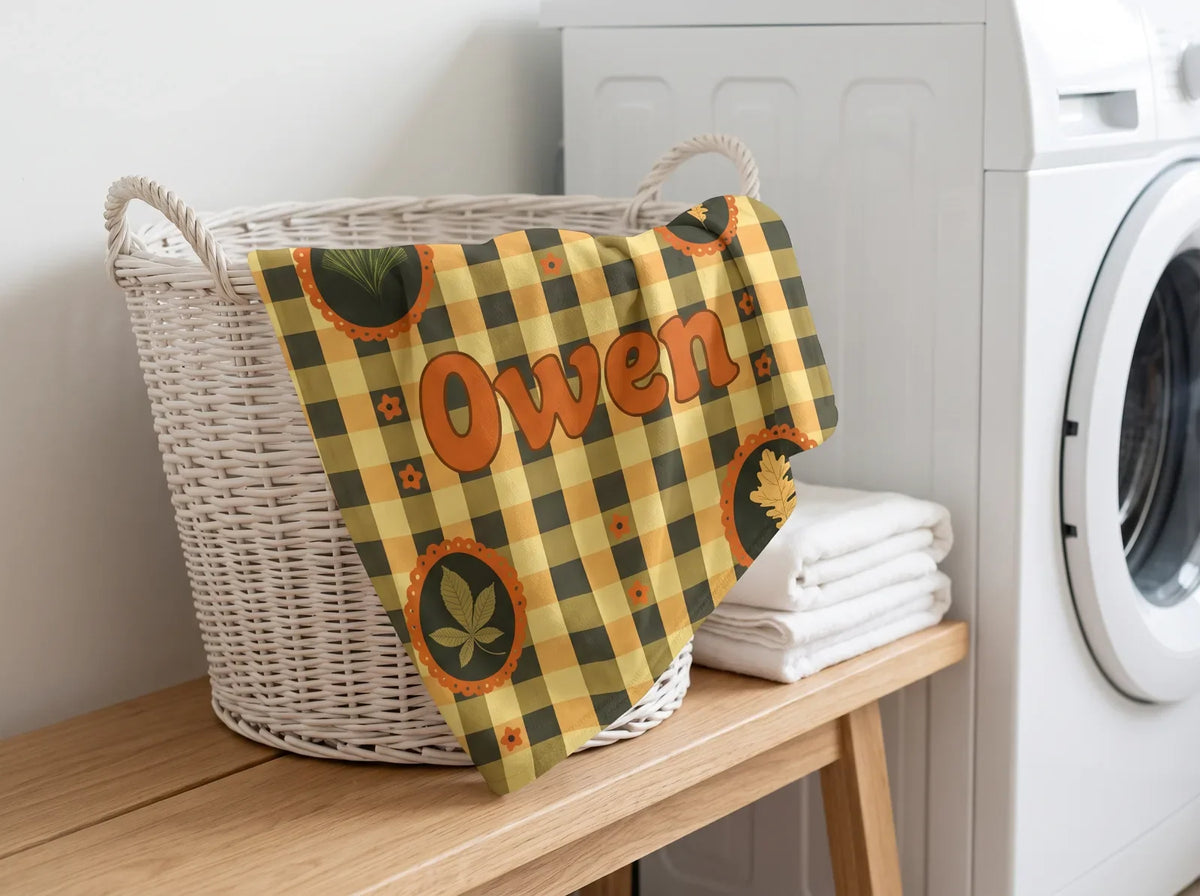
Here's how to wash a minky blanket and keep it soft: machine wash it cold, up to 30°C / 86°F, on a gentle cycle with a mild detergent, then tumble dry low, with no bleach and no high heat. That's the care rule we give for every printed blanket we make. Sherpa, fleece and chenille get their own tips below.
Key takeaways
- Wash minky cold, up to 30°C / 86°F, on a gentle cycle with a mild detergent, and skip bleach.
- Tumble dry low; high heat is the one thing that can flatten the pile for good.
- Stiff, flat minky usually means softener residue or heat; residue washes out, heat damage usually doesn't.
- Printed chenille goes in the machine; chunky chenille-yarn knits usually do better hand washed and dried flat.
- Ours can shrink 2–8% after the first wash; faux fur and picnic blankets are spot clean only.
In this guide
- How to wash a minky blanket, step by step
- How to dry a minky blanket
- Why is my minky not soft anymore?
- What detergent is best for minky blankets?
- Does minky shrink when washed?
- How to wash a sherpa blanket without ruining it
- How to wash a fleece blanket without pilling
- How to wash a chenille blanket
- Faux fur and picnic blankets: spot clean only
- Care cheat sheet for our five blanket fabrics
- Frequently asked questions
How to wash a minky blanket, step by step
Yes, you can machine wash a minky blanket at home, and it doesn't need a special program: cold water and the gentle setting do the work. The five steps below are the care rule we give for our printed blankets, in the order you'd follow them at the machine.
- Check what you're washing. Our printed minky, sherpa, fleece, chenille and twin velvet blankets all go in the machine, while our faux fur and picnic blankets are spot clean only (more on those below). For a blanket from another maker, its care label comes first.
- Set the water to cold. Keep it at up to 30°C / 86°F.
- Choose the gentle cycle. Some machines call it delicate.
- Add a mild detergent. Leave bleach out of the load.
- Tumble dry low. Keep high heat away from it; the next section covers drying in detail.
Many care guides add a few habits on top of that rule. They aren't part of our instructions, but they suit any plush blanket:
- Wash it alone or with other soft things. Towels, jeans and other lint shedders rub against the pile and leave fuzz in it.
- Leave room in the drum. A blanket that can move freely rinses cleaner and comes out less creased.
- Blot spots before the wash. Dab a mark with cold water and a drop of mild detergent instead of scrubbing it.
- Skip fabric softener and dryer sheets. The detergent section below explains why.
Why the fuss? Our Minky Plush is a 300 GSM, 100% polyester plush, soft and velvety. What makes minky special is that fine, dense pile, and it is also the part that heat and residue flatten first. For what minky fabric is and how it's made, see our guide to minky blanket fabric.
The design on our blankets is dyed into the fabric, so it won't crack or peel; the gentle routine is there to keep the plush soft, not to protect the print. Sewing with minky yardage rather than washing a finished blanket? Follow the care on the bolt.
Every design in our personalized name blanket collection comes in Minky Plush, along with Economy Fleece, Sherpa, Chenille and Twin Velvet.
How to dry a minky blanket
Yes, minky can go in the dryer. Tumble dry it on low; that's the setting our care rule gives. Take it out as soon as it's dry, because high heat and long tumbling are what flatten or harden the fine pile. Air drying over a rack is gentler still, though the plush can feel a little stiff until you shake it out.
- Add a couple of wool dryer balls. They bounce between the folds, so the blanket dries evenly instead of in a damp knot.
- Check it early. A light polyester blanket dries fast, and tumbling it after it's dry only adds heat.
- Shake it out right away. Spread it flat or fold it loosely while it's still warm, so it doesn't set in creases.

Look up minky care and you'll find two camps. Many minky care guides tell owners to skip heat entirely and fluff the blanket on an air-only cycle, while others are fine with a low setting. For our blankets, the rule is low heat, never high. For a blanket from another maker, follow its label.
An iron counts as high heat too, so keep it off the pile. Whether minky fabric can be ironed at all, even on the back, is answered in our minky fabric guide.
Why is my minky not soft anymore?
A minky blanket usually loses its softness for one of three reasons: heat from a hot wash or a high dryer setting, residue from fabric softener, dryer sheets or too much detergent, or friction and lint from a mixed load. Residue and lint wash out; heat damage usually doesn't.
Match what you notice to the likely cause. The fixes are general guidance for any minky blanket:
| What you notice | Likely cause | What helps |
|---|---|---|
| A stiff, crunchy or "crusty" feel | Softener, dryer sheets or extra detergent left in the pile | Rewash cold with less detergent and an extra rinse |
| Flat, shiny or hard patches | High heat in the wash or the dryer | Brush gently and dry low from now on; heat-set pile rarely comes back fully |
| Fuzz and lint stuck in the pile | A load with towels or other lint shedders | A lint roller or soft brush, then wash it on its own |
| Clumped, uneven pile after drying | A crowded dryer, or a blanket left to sit damp | Shake it out, then give it a short low tumble with dryer balls |
How to bring a minky blanket back to life
When residue or lint is the problem, a careful rewash usually brings the softness back. This is the order most care guides suggest:
- Rewash it cold on a gentle cycle with a small amount of mild detergent and no softener.
- Add an extra rinse to carry away whatever is left in the pile.
- If you like, pour a splash of white vinegar into the rinse instead of softener, but never in a load with bleach.
- Tumble it on low with dryer balls, or air dry it and finish with a short low tumble.
- Brush the pile gently in one direction with a soft brush.
Does minky stay soft after washing? Usually, yes, as long as it's washed cold and dried low, so the routine matters more than the brand name. On our blankets, the print is dyed into the fabric, so it won't crack or peel along the way.
What detergent is best for minky blankets?
The best detergent for a minky blanket is a mild one, used sparingly. Our care rule asks for a mild detergent and no bleach. Beyond that, a gentle liquid without added bleach or heavy fragrance rinses out easily in a cold wash, and no particular brand is needed.
Leave these out of the load:
- Bleach, including detergents with bleach in them. Our care rule says no bleach.
- Fabric softener, dryer sheets and scent beads. Many plush makers say they coat the fibers and leave the pile stiff.
- Pods on a cold, gentle cycle. Many care guides warn that a pod may not dissolve fully in cold water, which leaves residue behind.
- Extra detergent "for good measure". More soap means more residue to rinse out of the pile.
White vinegar is the usual stand-in for softener; it goes in the rinse, as in the steps above. For baby blankets, many parents pick a fragrance-free, dye-free mild detergent. Our baby and kids name blankets follow the same care rule as every other design.
Does minky shrink when washed?
A little. Our blankets, minky included, can shrink 2–8% after the first wash, and every size also has a ±1" manufacturing tolerance. Most care guides name heat as the usual cause of extra shrinking, one more reason to wash cold and dry low.
So when you choose a size, leave a little room: a blanket that only just covers a bed or a sofa before its first wash may come up short after it. Our blanket size chart shows what each size covers.
- Does sherpa shrink when washed? Ours stays in the same range after the first wash. How sherpa fabric itself reacts to heat and wear is covered in our guide to sherpa fabric.
- Does chenille shrink when washed? Our printed Chenille follows the same range. A chenille-yarn knit from another maker can behave differently, so follow its label.
How to wash a sherpa blanket without ruining it
Wash a sherpa blanket the way you wash minky: cold, up to 30°C / 86°F, on a gentle cycle with a mild detergent, then tumble dry low, with no bleach or high heat. That's the rule for ours. Most care guides add one habit: shake out the fluffy side as soon as it leaves the washer, so the pile doesn't dry matted.
Our Sherpa is 480 GSM, with a silky printed face, a fluffy sherpa back and a whip-stitched edge. The design sits on the smooth side, so the care is really about the fluffy back. For what sherpa is made of and whether it sheds or pills, read what sherpa blanket fabric is. For how it stacks up against the other two plush favorites, see sherpa vs fleece vs minky.
To keep the pile from matting, most care guides suggest three things:
- Wash it alone or with another sherpa. Less to rub against means fewer tangled curls.
- Give it room. A bulky blanket packed into a small drum comes out creased and clumped.
- Skip fabric softener. It weighs the fibers down and helps them stick together.
How to wash a sherpa blanket by hand
Our care rule is a machine wash, so hand washing is optional for ours. If you'd rather do it by hand, or a sherpa blanket's label asks for it, these general steps work:
- Fill a tub or large basin with cold water and a little mild detergent.
- Push the blanket under and swish it gently.
- Let it soak briefly.
- Drain, then rinse in cold water until no suds are left.
- Press the water out without wringing, then roll it in dry towels.
- Dry it over a rack, turning it now and then, or finish it in the dryer on low.
Can sherpa go in the dryer?
Yes. Ours tumble dry low like every blanket we print, and high heat stays off the list. Low heat is enough, because the pile only needs warm air moving through it, while a hot setting can mat and stiffen the curls in a way that rarely brushes out.
How you dry it matters as much as the setting. A thick pile holds water longer than a smooth face, so feel the fluffy side partway through and take the blanket out while the curls are still soft. To air dry instead, drape it over a rack with the fluffy side out and flip it once the top feels dry.
How to fix a matted sherpa blanket
Most matted sherpa can be fluffed back up if heat hasn't set it. Work through these general steps:
- Shake the blanket out to loosen the worst tangles.
- Mist stubborn patches lightly with water.
- Brush them in small sections with a soft-bristle or slicker brush, gently, from the base of the fibers outward.
- Tumble it on low with a few dryer balls.
- Repeat on the worst spots.
Pile flattened by high heat rarely recovers fully, so prevention beats repair. Sherpa-lined denim and other jackets follow their own garment label, and leather goes to a leather specialist.
How to wash a fleece blanket without pilling
Pilling comes from friction, so washing a fleece blanket without pilling means less rubbing: wash it alone or with other fleece, cold on a gentle cycle with a mild detergent, then tumble dry low. Our Economy Fleece is a 100% anti-pill polyester fleece, and it follows the same care rule as the rest of our blankets.
Nearly every fleece tip comes back to friction. Five ways to cut it:
- Keep lint shedders out. Towels, jeans and sweatshirts belong in another load.
- Don't pack the drum. The blanket should be able to move freely.
- Use the gentle cycle. Even a blanket that looks sturdy pills less with less agitation.
- Bag a small throw. A baby-size fleece fits in a large mesh laundry bag, which takes the rubbing instead.
- Dry on low and take it out promptly. Extra tumbling is extra friction.
Already pilled? A fabric shaver or a sweater comb, used lightly with the blanket flat on a table, lifts pills off the surface. Try it on a corner first and let the tool do the work rather than pressing down.
Anti-pill fleece is made to resist pilling, though heavy friction can still raise some fuzz over time. The same low-friction habits help any fuzzy or fluffy blanket keep a soft surface.
How to wash a chenille blanket
It depends on the chenille. A printed chenille throw like ours goes in the machine with the rest of our blankets: cold, gentle cycle, mild detergent, tumble dry low. A chunky hand-knit made from chenille yarn is different; most makers suggest a hand wash or a mesh bag on a cold, gentle cycle, then drying flat.
Printed and woven chenille blankets
Our Chenille is our heaviest fabric at 570 GSM, a dense, textured 100% polyester that comes in 50 × 60 only, and it washes with the same rule as our other blankets. For a printed or woven chenille throw from another maker, the label comes first.
Two general tips help with any heavy chenille throw:
- Wash it on its own. A heavy, wet blanket needs room to move and rinse.
- Dry it all the way through. Damp spots hide in the thickest folds, and a blanket put away damp can come out of the closet smelling musty.
Chunky chenille yarn blankets
Can you wash chenille yarn? Yes, gently. For a chunky knit, crocheted or finger-knit chenille blanket, most yarn makers suggest:
- Check the yarn label for its own care symbols.
- Put the blanket in a large mesh bag or a pillowcase and wash it cold on a gentle cycle, or soak it by hand in cold water with a little mild detergent.
- Rinse it in cold water.
- Press the water out; never wring or twist it.
- Roll it in a dry towel to take up the rest.
- Dry it flat on a towel or rack, since hanging a heavy, wet knit stretches it.
Is chenille yarn good for blankets? It makes a soft, warm blanket that knits up quickly, but it's heavy and its loops can work loose over time, which is why it gets the gentlest care. Chenille sofa covers and upholstery are another matter: follow the cleaning code on the furniture tag.
Faux fur and picnic blankets: spot clean only
Our faux fur and picnic blankets are spot clean only: treat a mark where it is instead of washing the whole blanket. The faux fur ones carry a laser-engraved patch on one corner instead of an edge-to-edge print, in brown, gray, hazelnut or ash fur. The picnic blanket pairs a poly twill top with a waterproof back and carry straps.
For any blanket that says spot clean, these steps are the usual approach:
- Blot a fresh spill with a dry cloth; don't rub it in.
- Mix cold water with a drop of mild detergent.
- Dab the mark with a white cloth, working from the outside in.
- Dab again with plain water to lift the soap out.
- Let the spot air dry.
- Once it's dry, comb faux fur gently so the fibers lie the right way.
Shaggy blankets from other makers vary a lot, so follow the label, and when it says spot clean, take it at its word. Both of our spot-clean types are made to order by quote, along with our other custom photo, logo and faux fur blankets.
Care cheat sheet for our five blanket fabrics
All five fabrics in our shop share the one care rule above: cold water, a gentle cycle, a mild detergent and a low dryer, with no bleach or high heat. What changes from fabric to fabric is the thing to watch for, summed up below.
| Fabric | What it is | Watch for |
|---|---|---|
| Minky Plush, 300 GSM | 100% polyester plush, soft and velvety | Softener residue and high heat flatten the pile |
| Economy Fleece, 300 GSM | 100% anti-pill polyester fleece, our most affordable | Friction from mixed loads |
| Sherpa, 480 GSM | Silky printed face, fluffy sherpa back, whip-stitched edge | Shake out the sherpa side so it doesn't dry matted |
| Chenille, 570 GSM (50 × 60 only) | Our heaviest: dense, textured 100% polyester | Heavy when wet; give it room and dry it all the way through |
| Twin Velvet, 300 GSM (50 × 60 only) | 95% polyester, 5% spandex, with a soft sheen | Stretch fibers dislike high heat, so keep the dryer low |
| Faux fur and picnic (by quote) | Faux fur with an engraved corner patch; picnic with a waterproof back | Spot clean only |
Not sure about a blanket from us, such as a stain you can't place or a quote-made type you haven't washed before? Ask us before it goes in the machine, or call (678) 845-6864 or email hello@tidalcolors.com.
Frequently asked questions
Can you wash a minky blanket in hot water?
No. Ours wash cold, up to 30°C / 86°F, and never with high heat. Most care guides agree that hot water and a hot dryer are what leave minky flat, stiff or shiny, and that kind of damage rarely comes back, so cold is the safe choice for any minky blanket.
Can you wash minky blankets together?
Yes, as long as the drum isn't packed. Minky with minky, or with other soft, lint-free blankets, gives the pile the least to rub against, while towels, jeans and anything else that sheds lint belong in another load. Ours follow the same cold, gentle routine whether they go in alone or together.
How often should I wash my minky blanket?
When it looks, feels or smells like it needs it. For a couch throw in daily use, most care guides suggest every few weeks, and sooner after spills, pets or a cold going around the house. Spot clean small marks in between, since fewer washes mean less wear on the pile.
Can mink blankets go in the dryer?
Usually, yes, on low. Sellers often use "mink" for the same kind of soft polyester plush as minky. Ours, both our Minky Plush and the plush mink velveteen we make by quote, tumble dry low. A thick, heavy mink blanket from another maker may ask for low heat or air drying on its label, and its weight calls for a large dryer.
Can I put a sherpa blanket in the washer?
Yes. Ours machine wash cold on a gentle cycle, like every blanket we print. The thing to watch is size: a 60 × 80 sherpa is bulky, so use the largest machine you have, or a large-capacity washer at a laundromat, and let it move freely. Many care guides find front-loaders gentler on the pile.
Can chenille go in the dryer?
Yes, if it's a printed chenille blanket like ours, which tumble dries low. Give the thick folds a feel before you put it away, since damp spots hide there. A chunky chenille-yarn knit is better dried flat, because tumbling and heat can stretch the stitches and loosen the loops.
What are the downsides of chenille fabric?
It's heavy and slow to dry, and its soft loops can snag on jewelry, pet claws or hook-and-loop fasteners. Crushed pile can show wear marks, and yarn chenille can work loose over time. Our Chenille is our heaviest fabric at 570 GSM and comes in 50 × 60 only, and that weight is also what makes it feel substantial.
What is the best cleaner for chenille fabric?
For a whole chenille blanket, a mild detergent in cold water is enough. For ours, that's all the care rule asks. For a single spot, blot it with a drop of mild detergent in cold water, then with plain water, and skip bleach and harsh solvents. Test any cleaner on a hidden corner first, and leave chenille upholstery to the cleaning code on its furniture tag.
Should you wash a new minky baby blanket before using it?
Many parents wash a new baby blanket once before first use, with a mild, fragrance-free detergent. Our baby and kids designs, such as Outer Space, Sleepy Bunny and Teddy Bear Polka Dot, follow the same care rule as every blanket we print. Whether minky suits a baby, and the safe-sleep guidance that applies to any blanket, is covered in our minky fabric guide.


