


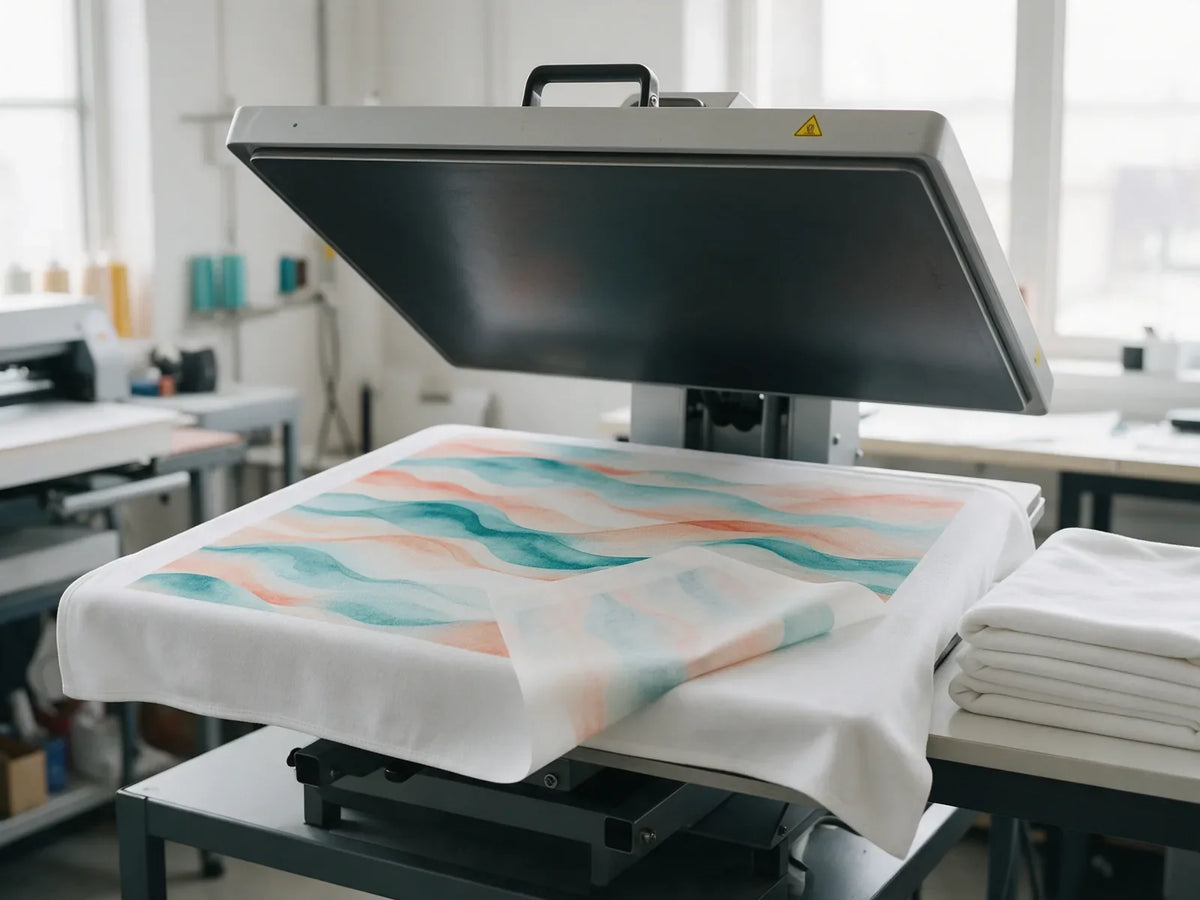
How are personalized blankets made? Most printed name and photo blankets are made with dye sublimation: the design is printed in dye-based ink, heat and pressure turn the dye into a gas that bonds with the polyester fibers, and the blanket gets a finished edge. Others are woven on a jacquard loom, embroidered, or decorated with a heat transfer.
Key takeaways
- Dye sublimation bonds the design into polyester fibers, so a printed name won't crack or peel.
- Woven, embroidered and heat-transfer blankets are made differently, and each looks and feels different.
- We sublimate eight of our nine blanket types; faux fur gets a laser-engraved patch instead.
- Most of our custom blankets are produced in 1–3 business days; shipping time comes on top.
- A sublimation blanket is a white or light polyester blank made to take sublimation dye.
In this guide
- How are personalized blankets made? Four methods
- How a printed blanket is made, step by step
- How each blanket type is printed and finished
- How personalized blankets with pictures are made
- How long does it take to get a personalized blanket?
- What is a sublimation blanket?
- From file to finished blanket
- Frequently asked questions
How are personalized blankets made? Four methods
Personalized blankets are made in four main ways, and each puts the design in a different place: dye sublimation puts it inside the fibers, jacquard weaving builds it from the yarns themselves, embroidery stitches it on with thread, and a heat transfer bonds a thin printed layer on top. That choice decides how the blanket looks, feels and washes.
| Method | How the design gets on | What you see and feel |
|---|---|---|
| Dye sublimation | Dye-based ink is printed on transfer paper or straight onto the fabric, then heat turns it into a gas that enters the polyester fibers | Full color edge to edge, photos and fine detail, nothing on the surface to feel |
| Jacquard weaving | A computer-controlled loom interlaces colored yarns, often cotton, so the image is part of the cloth | Textured and heavy; a limited set of yarn colors, so photos come out as a woven portrait |
| Embroidery | A machine stitches thread through the fabric from a digitized stitch file, with a stabilizer behind it | Raised, tactile names and monograms; suited to short text, not photos |
| Heat transfer (DTF or vinyl) | A design printed on film or cut from vinyl is pressed on with heat and an adhesive | A thin, slightly raised layer on top; suits placed graphics more than all-over prints |
Ours are dye-sublimated on eight of our nine blanket types; the fabric table further down shows each one, faux fur included.
Sublimation and DTF are both pressed with heat, but they bond in opposite ways: sublimation dye moves inside the fiber, while a DTF print stays on the surface as a thin film. Our guide to how DTF and sublimation differ covers when each one fits.
How are custom woven blankets made?
Custom woven blankets are made on computerized jacquard looms. Software turns the photo or design into a map of which colored yarn crosses where, and the loom raises and lowers each warp thread to weave that map row by row, so the picture is part of the cloth instead of printed on it. Most are heavy cotton throws, often fringed.
To tell a jacquard blanket from a printed one, turn it over: a woven picture shows on the back too, mirrored, with its colors swapped.
Our woven blanket is different: a 550 GSM throw, 85% polyester and 15% cotton, with decorative tassels, printed edge to edge by dye sublimation like our other fabrics rather than woven in.
How a printed blanket is made, step by step
A printed blanket starts as a digital file sized to the finished blanket plus bleed. The design is printed in sublimation dye, pressed into white or light polyester with heat and pressure and left to cool inside the fibers. Each fabric also gets its own finished edge, such as a hem, a whip stitch or tassels, before the blanket is packed.
- Set the design. On our personalized name blankets, you type the name or short text you want, pick a font and text color, then check the preview, and we print the name exactly as you enter it. Photo, logo and bulk blankets start from your own file, and our team checks every one.
- Size it with bleed. Quote artwork runs 1.25" past the finished size on every side, and names and faces stay at least 0.5" inside the trim line, so nothing important lands at the very edge.
- Approve the proof. On quote orders, a free proof comes first, and nothing prints until you approve it.
- Print the dye. In most sublimation shops the design is printed mirrored onto sublimation paper, though some printers put it straight onto the fabric. Sublimation printers work in RGB color, and on paper the colors often look dull until heat brings them out.
- Press it in. Heat and firm pressure turn the dye into a gas that moves into the polyester fibers. Shops that print full-size blankets typically press the whole design at once on a large-format press, so the print has no joins.
- Let it cool. The dye turns solid again inside the fibers, so there's no layer on top to crack or peel, and the surface stays soft.
- Finish the edge and pack. Each fabric gets its own edge. On our blankets, fleece, mink, chenille, twin velvet and swaddle are hemmed, sherpa is whip-stitched, woven gets decorative tassels and picnic blankets a hem with carry straps. The finished blanket then ships with tracking or waits for free local pickup in Alpharetta.
Shops don't all run the last steps in the same order: some press the design into a blank whose edge is already sewn, and others print larger pieces of fabric and finish the edge later.
From approved design to finished blanket, most of our custom blankets are produced in 1–3 business days, printed in Alpharetta, GA.

How each blanket type is printed and finished
Eight of our nine blanket types are printed edge to edge with dye sublimation, and what changes from one fabric to the next is the weight, the surface the print sits on and the edge. Faux fur is the exception: it isn't printed, and the name or logo goes on a laser-engraved patch in one corner.
| Blanket type | How the design goes on | Edge and finish |
|---|---|---|
| Economy fleece, 300 GSM | Sublimated edge to edge on anti-pill polyester | Hemmed |
| Plush mink velveteen, 300 GSM | Sublimated edge to edge on polyester plush | Hemmed |
| Premium sherpa, 480 GSM | Sublimated on the silk-touch face, with a cream sherpa back | Whip-stitched |
| Chenille, 570 GSM | Sublimated edge to edge on dense, textured chenille | Hemmed |
| Woven, 550 GSM | Sublimated edge to edge on a poly-cotton weave | Decorative tassels |
| Twin velvet, 300 GSM | Sublimated edge to edge on a soft-sheen velvet | Hemmed |
| Faux fur, 850 GSM | Not printed; a laser-engraved patch on one corner | Fur in brown, gray, hazelnut or ash |
| Baby swaddle, 220 GSM | Sublimated edge to edge on a light poly-spandex blend | Hemmed |
| Picnic, 410 GSM | Sublimated on the poly twill face, with a waterproof PE/PVC back | Hemmed, with carry straps |
Deep piles soften fine detail, so names need at least 14 pt on sherpa, chenille and mink, while fleece and twin velvet hold type down to 8 pt.
Five of these fabrics, sold in the shop as Minky Plush, Economy Fleece, Sherpa, Chenille and Twin Velvet, come on every shop design, Vintage Postage Stamp for example, in 30 × 40, 50 × 60 or 60 × 80 inches; Chenille and Twin Velvet come in 50 × 60 only.
How the fabrics differ in warmth and softness is covered in sherpa vs fleece vs minky. For what each size covers on a bed or a sofa, see the blanket size chart.
How personalized blankets with pictures are made
Photo blankets are made by the same dye-sublimation process as name blankets; the difference is in the preparation. The photo has to stay sharp at blanket size, so the file matters most: our team checks every file, sends a free proof, and prints photos, collages, names and illustrations together in full color, edge to edge.
A picture that's too small for the blanket gets stretched to fit, and the stretch shows up as soft edges and blotchy skin tones once it covers a whole throw. What a photo file needs:
- Resolution: 300 DPI at the final print size for photos and fine lines; 150 DPI is the lowest that works.
- Format and color: PNG first, TIFF fine, JPEG for simple artwork and vector files for logos, all in RGB or sRGB rather than CMYK.
- Full coverage: fill the whole canvas so the background reaches every edge.
- Safe zone: faces and names sit 0.5" inside the trim line, while the background carries on into the 1.25" bleed.
The shop designer takes text only, so photo, collage and logo blankets go through a free quote for custom photo blankets, with pricing and timing back within one business day.
Which pictures to pick and how many fit a layout is the other half of the job. Our gift guide walks through how to choose photos for a blanket, from a single portrait to a grid.
How long does it take to get a personalized blanket?
Most of our custom blankets are produced in 1–3 business days, and shipping time then depends on the option you choose at checkout and your address, while free local pickup in Alpharetta skips transit. Online photo-blanket sellers typically quote about 7 to 12 business days from order to doorstep, a few days of production plus standard shipping.
Timeline at a glance:
| Step | Shop name blanket | Photo, logo or bulk blanket |
|---|---|---|
| Ordering | Personalize online and check out | Free quote request; pricing and timing back within one business day |
| Design check | Your preview; the name prints exactly as typed | Our team checks the file and sends a free proof to approve |
| Production | Most in 1–3 business days | Most in 1–3 business days after the proof is approved |
| Getting it | The shipping option you pick at checkout, with tracking, or free local pickup | Shipping charged on top of the quote, with tracking, or free local pickup |
At checkout, Standard shipping currently takes 1–5 business days for $9.99 and is free on orders of $75+, with faster paid options listed beside it. Transit starts after production, so add it on top.
What adds time:
- The quote step: the reply and the proof come before production starts.
- Proof changes: production begins once the proof is approved, so each round of edits moves the start.
- Business days: the 1–3 count business days, not calendar days, so a weekend in between adds time.
- Transit: it depends on the shipping option and the distance, and pickup in Alpharetta removes it.
Have a birthday, a shower or another date in mind? Order early, or contact us with your date before you order; rush options are available. Blankets don't get holiday order-by dates, since the production days come first and shipping only starts after them.
Shop name blankets have set prices, from $16.85 for a 30 × 40 Economy Fleece to $46.85 for a 60 × 80 Sherpa, and photo, logo and bulk blankets are priced by free quote. What moves the price of a custom blanket is explained in how much a custom blanket costs.
What is a sublimation blanket?
A sublimation blanket is a polyester blanket made to take sublimation dye, usually sold blank in white or a light color for crafters and print shops to press their own designs onto. The term covers fleece throws, plush minky-style baby blankets and polyester-faced sherpa, and once a design is pressed in, it's simply a sublimated blanket.
What makes a blanket sublimation-ready:
- Polyester: the dye bonds with polyester, so blanks are all or mostly polyester; natural fibers such as cotton hold it poorly.
- A white or light face: the dye is see-through, so it can't cover a dark fabric.
- A smooth print side: a short, dense nap holds fine lines and a deep pile softens them, the reason behind our 14 pt rule for sherpa, chenille and mink.
- A size the press can handle: a full throw needs a large press, so owners of smaller presses work on panel or grid blankets one section at a time.
Making one yourself takes a sublimation printer and ink, sublimation paper, a polyester blank and a heat press. Few hobby presses cover a full throw, so crafters press in sections or buy panel blankets, and joins can show if a section shifts. If you'd rather skip the equipment, a print shop can print the whole blanket for you; ours start at one blanket, with no minimum.
DTF works the other way round, bonding a printed film on top of the fabric, so it also goes on cotton and dark colors. Our comparison explains where sublimation falls short, compared with DTF, and when each method fits.
Sublimation blankets near Atlanta
We print sublimation blankets at our shop in Alpharetta, GA, in metro Atlanta: shop name blankets online, and photo, logo and bulk blankets by quote, all with no minimum. Choose Local Pickup at checkout and collect your order free once we let you know it's ready, or have it shipped with tracking to any of the 50 states.
Gift shops, resellers and online sellers order finished blankets at volume pricing, or through print on demand arranged with our team. Company orders start on our custom logo blankets page.
From file to finished blanket
Most personalized blankets are sublimated: dye pressed into polyester, with a finished edge. Ours are printed in Alpharetta, GA, and most are produced in 1–3 business days. Personalize a shop design online, or send a free quote request for a photo, logo or bulk blanket, and we'll reply with pricing and timing within one business day.
Frequently asked questions
How long does it take to get a photo blanket made?
Most of our photo blankets are produced in 1–3 business days once you approve the free proof. Before that, your quote request gets pricing and timing back within one business day; after it, shipping time depends on the option and the address, or you collect the blanket free in Alpharetta. Mention your date in the quote request, and ask about rush options if it's close.
What kind of blankets can you sublimate on?
Ones with a polyester or polyester-faced surface in white or a light color: fleece, minky and other plush, velveteen, chenille, twin velvet, sherpa throws with a smooth polyester face and poly twill picnic blankets. Cotton holds the dye poorly. In our lineup, eight types are sublimated, from a 220 GSM swaddle to 570 GSM chenille, and faux fur carries a laser-engraved patch instead.
Why does blanket artwork need bleed?
Bleed is extra background that runs past the finished edge, so the design still reaches that edge even if artwork and edge line up slightly off. Our rule for quote artwork is 1.25" of bleed on every side, with names, faces and other key elements 0.5" inside the trim line. The bleed lies outside the finished size, so keep it to background.
Can you print a blanket from a phone photo?
Yes, if the file holds enough detail for the size. Send the original from your camera roll, not a screenshot or a copy sent through a messaging app, since both lose detail. Aim for 300 DPI at the final print size, with 150 DPI as the minimum; one photo stretched across a large throw asks the most of the file. Our team checks every file before your free proof.
Do sublimated blankets fade?
Not easily. Sublimation dye sits inside the polyester fibers rather than on top, so the design can't crack or peel off like a surface print, and fading usually comes from bleach and high heat rather than ordinary washing. Wash ours cold (up to 30°C / 86°F) on a gentle cycle with a mild detergent and tumble dry low. Our blanket washing guide covers each fabric.
Can a sublimation blanket have a dark background?
Yes. Sublimation needs a white or light blank, but a dark color can be printed as part of the design, edge to edge, so a navy blanket is usually a light blank printed navy. Because sublimation has no white ink, any white in the design, such as white lettering on that navy, is the bare fabric showing through, so fill the whole canvas with color.
Can I see my blanket before it's printed?
Yes. On a shop name blanket, the preview shows your text, font and color on the design before you add it to the cart, and we print the name exactly as you type it, so check the spelling there. For a photo, logo or bulk blanket, we send a free proof first, and nothing prints until you approve it.


