


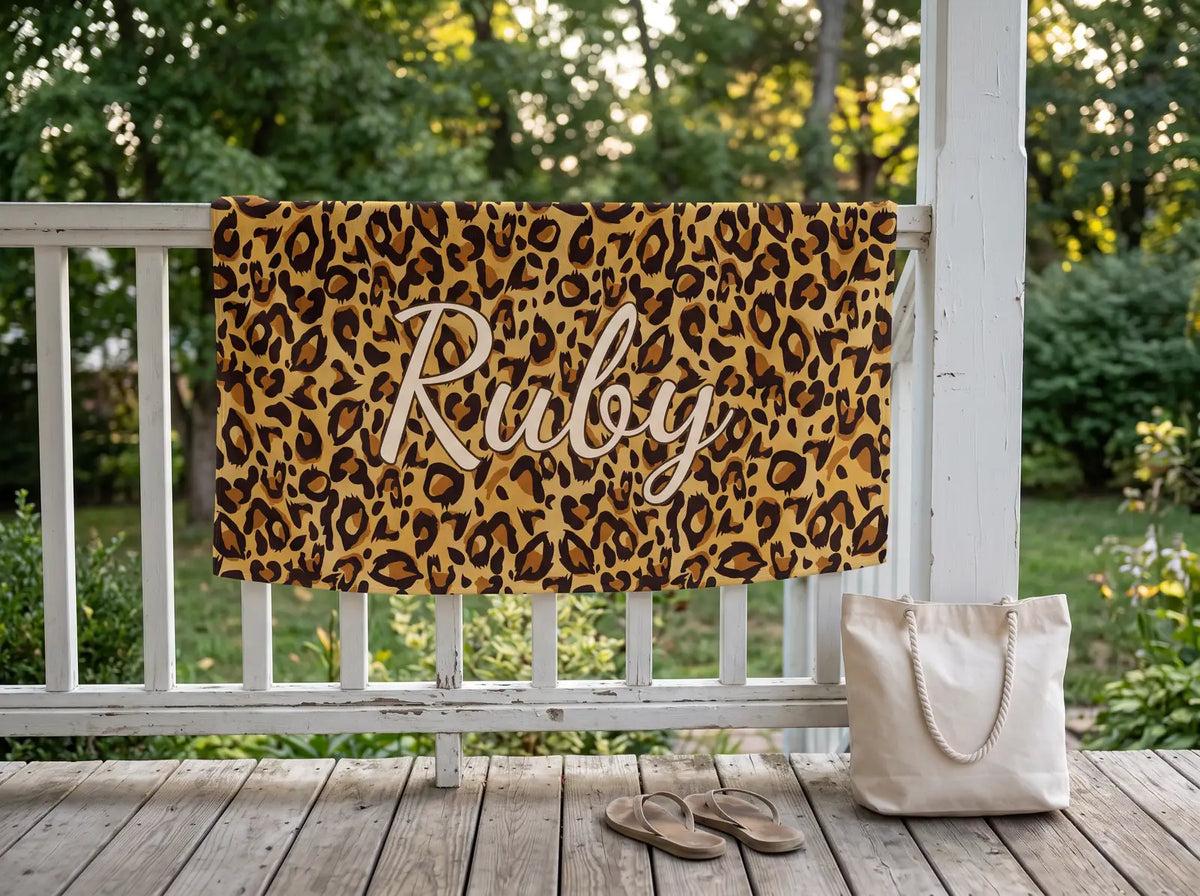
Here's how to wash beach towels so they stay soft: let them dry, shake the sand out, then wash them in their own load in cool or warm water with a little detergent and no fabric softener. Dry them all the way through before you fold them. On a printed towel, ours included, the care label comes first.
Key takeaways
- Let a sandy towel dry first, then shake it outside: dry sand falls out, wet sand clings.
- Wash beach towels in their own load, with less detergent than usual and no fabric softener.
- Cool or warm water and a low or medium dryer keep colors bright and loops soft.
- A musty smell means the towel stayed damp too long; dry it completely before folding.
- Microfiber and Turkish towels need a gentler wash, and printed towels follow their care label.
In this guide
- How to wash beach towels, step by step
- How to wash beach towels for the first time
- How to get sand out of beach towels
- After the beach or pool: salt, chlorine and sunscreen
- How to keep beach towels soft and absorbent
- Why do my beach towels smell musty?
- How to dry beach towels
- Cotton, microfiber and Turkish towels: care by type
- A simple beach towel care routine
- Frequently asked questions
How to wash beach towels, step by step
Yes, beach towels go in the washing machine. Get the sand out first, wash them on their own in cool or warm water with a small amount of detergent, skip the fabric softener and add an extra rinse, then dry them completely. Always check the care label before any of it.
The steps below are the routine most care guides share for a cotton beach towel. Wherever a tip here and the label on your towel disagree, the label wins.
- Read the care label. It's written for that towel's fibers and finish, and it outranks every tip on this page.
- Get the sand out while the towel is dry. Shake it outdoors; the full method is in the sand section below.
- Pre-treat sunscreen and oil marks. Rub a little liquid detergent into each mark before the towel goes in.
- Give beach towels a load of their own. Sort them by color and leave them room to tumble.
- Choose cool or warm water. A normal cycle is fine, and a bulky setting adds water that flushes out leftover sand and salt.
- Go light on detergent. Leave the fabric softener out and run an extra rinse.
- Dry them all the way through. Low to medium heat in the dryer works, and so does a line in the shade.
Printed towels are a two-material product. Our personalized beach towels have a polyester print face and a 100% cotton back, printed on one side, in Standard 360 GSM or Premium 450 GSM. Each one comes with a care label, so follow the care label: how a towel should be washed and dried depends on its material and print finish.
If the label on one of ours is unclear or has gone missing, ask our team before the towel goes in the machine.
Want towels the whole family can tell apart? Every design in our shop takes a name: type it, pick one of 30 fonts and 10 text colors, then check the preview.
How to wash beach towels for the first time
Wash new beach towels once before the first beach day. Most towel makers say a first wash rinses out finishing residue and loose fibers and helps a new cotton towel start absorbing. Wash them on their own, sorted by color, in cool or warm water with a little detergent and no softener.
- Sort by color. A bright new cotton towel can let go of some dye in its first few washes, so keep it away from whites and pale colors.
- Use less detergent and no softener. Many new towels already carry a softening finish, which is why they can feel almost water-repellent straight out of the packaging.
- Add an extra rinse. It carries away whatever the first wash has loosened.
- Consider white vinegar in the rinse. Care guides often list it as a first-wash step; never add it to a load that contains bleach.
Why does a brand-new towel push water around instead of soaking it up? The finish that makes it feel silky on the store shelf usually coats the outside of the fibers. It wears away over the first few washes, and the cotton loops open up and start to drink.
For our towels, follow the care label, including anything it says about washing before first use.
How to get sand out of beach towels
Let the towel dry completely, then shake it hard outside. Dry sand drops out of the fibers on its own, while wet sand clings to them. Snap it from two corners, turn it and snap it from the other end, and check the hems and folds before it goes into the washer.
- Hang it in sun and breeze, over a railing, a chair back or a line, until it's dry right through.
- Hold two corners and snap it hard, standing downwind, then switch ends and do it again.
- Check the hems, fringe, tassels and folds, where grit likes to hide.
- If your dryer has an air-only or no-heat setting, a short tumble knocks the last grains loose into the lint trap; empty the trap when it's done.
- Wash it in a roomy load with plenty of water, so leftover sand rinses away instead of settling back into the loops.

How to get sand out without washing
Drying and shaking is the whole method, and it needs no washer at all. At the beach, shake the towel before you fold it and fold the sandy side in, so the grit stays inside the towel instead of spilling into the bag. At home, a soft clothes brush lifts stubborn grains off a smooth surface.
Some fabrics make the job easier than others: smooth, tightly woven towels let go of sand more readily than looped terry. Our guide to which towel fabrics sand doesn't stick to compares them.
Keep sand out of your washing machine
Sand that goes into the washer settles in the drum, the filter and the door seal, and that grit then rubs against every load that follows. Shake towels outdoors first. After a sandy load, wipe the drum and the seal, and clean the filter the way the machine's manual describes.
And if you've wondered how to sterilize sand from the beach: sand on a towel doesn't need it, since shaking it out and a normal wash take care of it.
After the beach or pool: salt, chlorine and sunscreen
Salt water and pool chlorine stiffen towel fibers and wear them faster when they dry into the fabric, so rinse a towel in fresh water when you get home and hang it open if it can't be washed that day. Sunscreen and body oil leave greasy marks that need a pre-treat before the wash.
- Salt water. Rinse the towel, hang it up to dry and wash it within a use or two. Salt left to dry in the loops is what makes cotton feel crunchy.
- Pool chlorine. Rinse soon after swimming. Chlorine that stays in the fibers keeps working on the color and on the fibers themselves.
- Sunscreen and oil marks. Work a little liquid detergent or an enzyme stain remover into the mark, give it as long as the remover's directions say, then wash. Check that the mark has gone before the towel goes into the dryer, since heat can set an oily stain.
Chlorine bleach is usually the wrong fix on a colored or printed towel, because it lightens the color along with the stain. Check the label before you reach for it, and give a stubborn mark a second pre-treat and wash instead.
How to keep beach towels soft and absorbent
Beach towels usually go stiff and stop absorbing because of buildup: too much detergent, fabric softener or dryer sheets coat the fibers, and salt or hard water adds to the film. Use less detergent, leave out the softener, add an extra rinse and dry them with wool dryer balls instead of dryer sheets.
Most stiff towels come back with a few small swaps. These are general habits from towel care guides:
| Skip this | Do this instead |
|---|---|
| Fabric softener and dryer sheets | A few wool dryer balls in the dryer |
| A full dose of detergent | A smaller dose and an extra rinse |
| A packed drum | A load with room to move |
| Hot water and high dryer heat | Cool or warm water, then low to medium heat |
| Leaving towels on a line in full sun until they're crisp | Shade, then a good shake or a short tumble |
Is it better to wash towels with vinegar or baking soda?
They do different jobs, so neither one is better. White vinegar in the rinse helps dissolve the detergent and mineral film that leaves towels stiff, while baking soda in the wash helps lift odors. Many care guides use them in separate washes rather than together.
Mixed in one load, the two cancel each other out, so you get the fizz and lose most of the benefit. Never combine vinegar with bleach. Check the label before adding either one, especially on a printed or microfiber towel.
Why do my beach towels smell musty?
A musty smell means the towel stayed damp long enough for mildew and bacteria to grow: in a beach bag, in the car, in a heap on the floor or in the washer after the cycle ended. One normal wash doesn't always clear it, because the smell can cling to detergent buildup.
- Rewash it soon, as warm as its label allows.
- Add white vinegar to the rinse or baking soda to the wash, in separate washes as described above.
- Dry it completely straight away, in the sun or in the dryer.
- Clean the washer too: the door seal, the drum and the detergent drawer, as its manual describes. A musty machine passes its smell to every load.
- Never fold or bag a towel that's still damp.
Prevention is easier than the fix. Hang towels open for the ride home, and empty the beach bag the same day, wet swimsuits included.
How to dry beach towels
Tumble dry beach towels on low or medium heat with a few wool dryer balls, or hang them in the shade with air around them, and keep going until they're dry right through, hems included. If the care label says not to tumble dry, line dry them.
Move towels out of the washer as soon as the cycle finishes, and give each one a shake on the way to the dryer or the line so the loops aren't pressed flat. Thick terry holds water longest in its hems and folds, so feel those spots before you decide a towel is done.
How to dry towels outside without them going hard
A line costs nothing and is easy on the fibers, but a towel left to bake can come down stiff as cardboard. Four habits keep it soft:
- Snap it before you hang it. A few hard shakes fluff up the loops.
- Pick shade or part shade with a breeze. Strong sun bakes cotton stiff and fades bright colors.
- Bring it in as soon as it's dry. Hours of extra sun only make it crisper.
- Finish it in the dryer if the label allows. A short tumble on low or air-only softens a line-dried towel.
Store beach towels only once they're fully dry. Rolled towels pack tighter in a beach bag and crease less than folded ones, and the same roll keeps a stack of hand towels tidy on a shelf. An airy cupboard or an open basket beats a sealed bin, where any leftover damp turns musty.
Cotton, microfiber and Turkish towels: care by type
The routine above suits most cotton terry and velour beach towels. Microfiber and flat-woven Turkish towels are lighter and want a gentler wash, and a printed towel follows its own care label first.
| Towel | How most care guides wash it | Watch out for |
|---|---|---|
| Cotton terry or velour | Cool or warm water, a normal or bulky cycle, a low to medium dryer | Softener film, a packed drum, folding it damp |
| Microfiber | Cool water on a gentle cycle, alone or with other synthetics; air dry or low heat | High heat, fabric softener, lint from cotton loads |
| Turkish flatweave | Cool water on a gentle cycle; line dry or low heat. It softens with washing | Fringe tangling (a large mesh bag helps), high heat |
| Printed: polyester face, cotton back (like ours) | Follow the care label supplied with the towel | Anything the label rules out |
Lost the label on a towel from somewhere else? The gentlest routine in the table is the safe default until you know what it's made of.
What ruins microfiber towels?
Heat, fabric softener and lint. High dryer heat can melt or flatten microfiber's very fine synthetic fibers, softener and dryer sheets clog the tiny gaps that hold water, and a load of cotton towels leaves lint that clings to it. Bleach and a hot iron should stay away too.
Which material dries fastest, sheds sand or feels plushest is a buying question, and our guide to microfiber vs cotton beach towels answers it. This section only keeps each one clean.
A simple beach towel care routine
Most beach towel care happens before the washer: shake, rinse and dry the towel the day you use it, and wash day gets easy.
After every beach day:
- Shake it out once it's dry.
- Rinse off salt or chlorine.
- Hang it open, never in a heap.
On wash day:
- Label first.
- A load of its own, a light dose of detergent, no softener.
- Cool or warm water.
- Dry it right through before it's folded.
Ordering towels for a team, a club or an event? We print custom beach towels with names or a logo by quote, and the quote is free. Blanket care has its own page: our blanket washing guide.
Frequently asked questions
Can I wash beach towels with regular towels?
Yes, once the sand is out: towels of a similar color and weight wash well together. Keep them apart from clothes, though. Zippers, hooks and buttons snag towel loops, and clothes pick up the lint and leftover sand that beach towels bring with them.
Can you wash beach towels in hot water?
Most care guides say no. Cool or warm water is enough to clean a beach towel, while hot water fades bright colors and prints and wears cotton loops faster. Even where a label allows hot water, it's the label that decides. For our printed towels, follow the care label supplied with the towel.
How often should you wash beach towels?
Every couple of uses, and right away after a day in salt water, chlorine, sunscreen or wet sand. Between lighter uses, shake the towel out and let it dry completely before it goes back in the bag. A towel that smells even slightly musty is due for a wash now.
Can you wash beach towels with swimwear?
It's better not to. Swimsuits need a gentle wash, often by hand, while beach towels are heavy, rough and full of lint, and swimsuit clasps and hooks catch towel loops. Rinse both after the pool or the beach, then wash them separately, each the way its label asks.
How do you wash swim towels?
Like beach towels, with chlorine as the first job: rinse the towel in fresh water after practice, hang it open and wash it within a use or two. Compact chamois-style swim towels are a different material with their own instructions. Ordering a towel for every swimmer? See our swim team towels with names.
Is there a difference between beach towels and regular towels?
Yes. Beach towels are usually larger, often lighter and printed or brightly colored, and made to lie on as well as dry off with; bath towels are made for drying off indoors. Beach towels also meet sand, salt, chlorine and sunscreen, which is why they get shaken and rinsed first and washed on their own. Sizes are compared in our beach towel size guide.
How do you get sand out of clothes in the washing machine?
Shake or brush the clothes while they're dry, before they go in, and turn out pockets and cuffs. If sand has already reached the machine, run an empty rinse cycle, wipe the drum and the door seal, and clean the filter as the manual describes, so the grit doesn't end up in the next load.


