


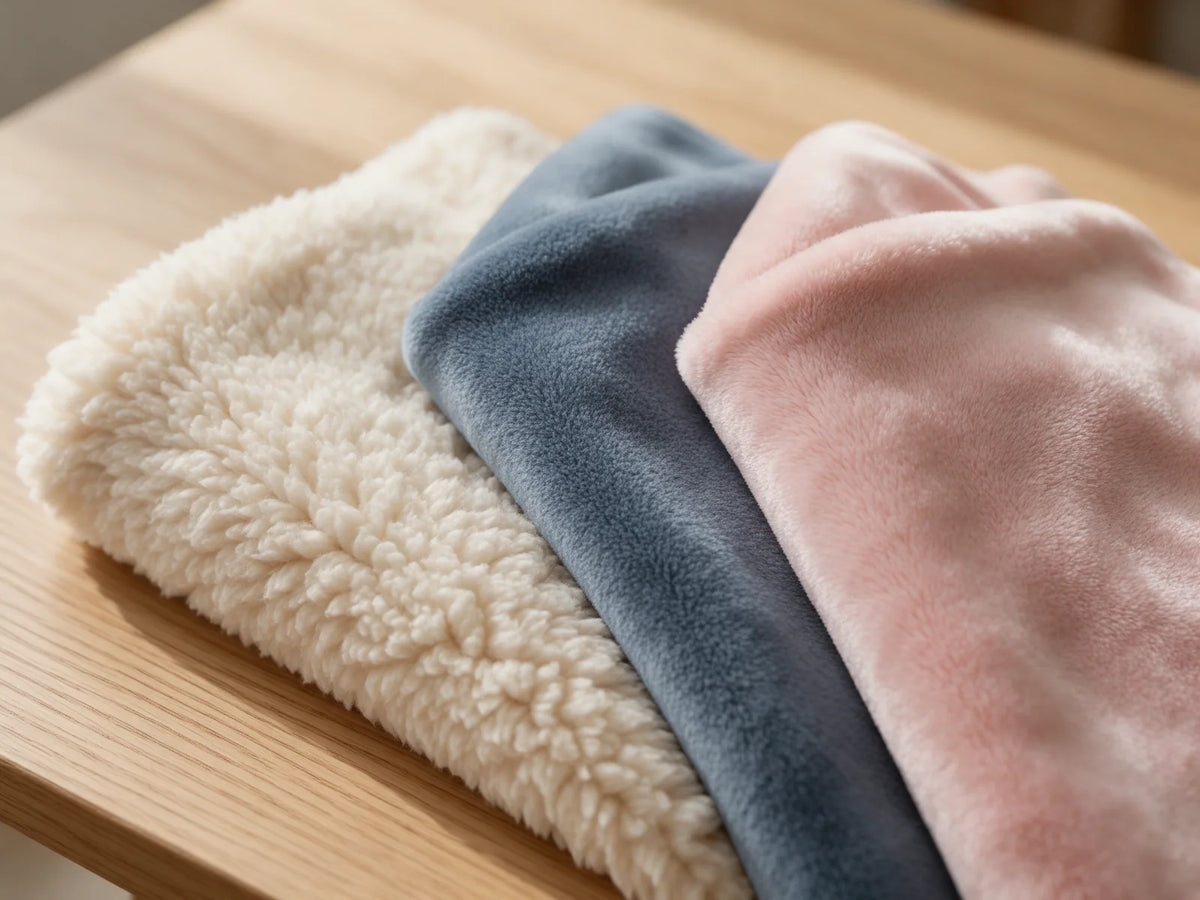
In a sherpa vs fleece blanket match-up, sherpa is warmer: its thick, fluffy pile traps more heat, which makes it the pick for cold nights on the couch. Fleece is lighter, smoother and more breathable, so it works year-round. Minky sits between them: a dense, velvety plush and the silkiest of the three to the touch.
Key takeaways
- Sherpa is the warmest of the three; ours weighs 480 GSM, against 300 GSM for our Fleece and Minky.
- Fleece breathes most freely and dries fastest; our Economy Fleece is anti-pill and our most affordable.
- Minky feels the silkiest: a dense, velvety plush for lap blankets, kids and anyone who wants softness first.
- Chenille (570 GSM) is our heaviest shop fabric and Twin Velvet has a sheen; both are 50 × 60 only.
- Every fabric takes a printed name the same way: the ink is dyed in, so it won't crack or peel.
In this guide
- Sherpa vs fleece vs minky at a glance
- Sherpa vs fleece blanket: the real differences
- Is sherpa warmer than fleece?
- Minky vs fleece blanket: what's the difference?
- Which is softer: minky, sherpa or fleece?
- How chenille and twin velvet compare
- Is fleece, minky or sherpa better for a baby?
- Which is better, a sherpa or fleece blanket?
- Sherpa, fleece or minky for a personalized blanket?
- Which lasts longest: pilling, matting and wear
- Sherpa, fleece or minky: how to choose
- Frequently asked questions
Sherpa vs fleece vs minky at a glance
Sherpa is the warmest and heaviest, fleece the lightest in feel and the easiest to live with, and minky the silkiest. Our shop prints all three, plus Chenille and Twin Velvet, and GSM, the fabric's weight in grams per square meter, helps you compare them: 300 for Fleece, Minky and Twin Velvet, 480 for Sherpa, 570 for Chenille.
| Fabric and weight | Feel and build | Warmth | Good for |
|---|---|---|---|
| Economy Fleece, 300 GSM | Smooth and light; anti-pill polyester fleece | Light to medium; breathes well | Everyday use, the car, layering, a smaller budget |
| Minky Plush, 300 GSM | Soft, velvety polyester plush with a short, dense pile | Medium; holds warmth close | Lap blankets, kids, softness first |
| Sherpa, 480 GSM | Two sides: the printed face feels silky, the sherpa back is fluffy; whip-stitched edge | High; the warmest of the three | Cold nights, the couch, anyone who runs cold |
| Chenille, 570 GSM | Our heaviest shop fabric: dense, textured polyester | Heavy and substantial | A statement throw; 50 × 60 only |
| Twin Velvet, 300 GSM | Smooth with a soft sheen; 95% polyester, 5% spandex | Light to medium | A polished sofa throw; 50 × 60 only |
Read GSM as a guide rather than a verdict. Two blankets of the same weight can feel very different, because the height of the pile and the way the fabric is knit shape warmth and softness as much as the number does. Our Minky Plush and Economy Fleece are both 300 GSM, yet the minky feels denser and silkier in the hand.
Many guides put fleece blankets at about 150–250 GSM and sherpa blankets at about 280–350 GSM. Ours run heavier: 300 GSM for Economy Fleece and 480 GSM for Sherpa.
Custom orders widen the choice to nine blanket types from 220 to 850 GSM, including woven, faux fur, a polyester baby swaddle and a picnic blanket; see the fabrics we make by quote.
Sherpa vs fleece blanket: the real differences
Sherpa is a kind of fleece. Most sherpa is polyester, knit and brushed into a long, curly pile that imitates sheepskin, so the difference is how it's built, not what it's made of. A fleece blanket has a short, even nap on both sides; a sherpa blanket pairs a smooth face with a thick, fluffy back, which makes it heavier and warmer.
- Build. Fleece has one texture on both sides; sherpa has two. Ours combines a silky printed face, where the design and the name go, with a fluffy sherpa back, and the edge is whip-stitched.
- Weight. Our Sherpa is 480 GSM and our Economy Fleece 300 GSM, so the sherpa feels like a heavier hug and takes up more of a closet shelf or a tote bag.

- Warmth. Sherpa's deep pile holds a thicker layer of still air, so it keeps you warmer while you sit still. The next section explains when that matters and when fleece is the smarter pick.
- Breathing and drying. Fleece lets body heat and moisture escape and dries quickly after a wash. Sherpa holds heat in, which is the point of it, and its thick back takes longer to dry.
- Look and print. Fleece drapes flat and folds small; sherpa looks plush and shows its thickness at the edges. Both carry the full printed design, name included, on the face.
For what sherpa is made of, how its pile is produced and whether it pills or sheds, read our guide to what sherpa fabric is and how it's made.
Is sherpa warmer than fleece?
Yes. Sherpa's deep, curly pile traps more still air next to your body than fleece's short nap, and a sherpa blanket is usually heavier too: ours is 480 GSM, against 300 GSM for our Economy Fleece. Fleece wins when you'd rather not overheat, because it breathes better and lets moisture escape.
So the real question is what kind of warm you want. Sherpa is the one for sitting still: a cold living room, a drafty house, a long movie, anyone who runs cold. Fleece is the one for moving around, for a warm sleeper, for layering on a bed and for outdoor use where the blanket may get damp.
Climate plays a part too. Where winters are short, as in metro Atlanta, a fleece or minky throw covers most of the season, and a sherpa earns its place in the coldest weeks. The same logic holds for clothing: a sherpa-lined jacket suits standing still in the cold, a fleece jacket staying active.
Is sherpa the warmest blanket?
Not always. Warmth comes from trapped air, weight and how much of you the blanket covers, so a double-layer blanket, a wool blanket or a down comforter can be warmer than any single sherpa throw. Sherpa is still one of the warmest fabrics you'll find in an everyday printed blanket.
Fabrics warmer than plain fleece include sherpa, wool, down and minky, which usually runs a little warmer at a similar weight because its pile is denser. Among our five, Sherpa has the deepest pile and Chenille the most weight. For the warmest wrap in our shop, choose a 60 × 80 Sherpa: the deepest pile in the largest size, since Chenille comes in 50 × 60 only.
Minky vs fleece blanket: what's the difference?
Minky and fleece are both polyester, but minky is knit into a dense, short, velvety pile that feels silky and drapes smoothly, while fleece is brushed into a lighter, springier nap. Minky usually feels softer and holds warmth closer; fleece breathes better, dries faster and costs less.
| Trait | Minky | Fleece |
|---|---|---|
| Feel | Silky, velvety, smooth | Softly brushed, more casual |
| Pile | Dense and short | A light, springy nap |
| Warmth | Holds warmth close | Breathes and lets heat out |
| Pilling | The dense knit resists pilling | Standard fleece can pill; ours is anti-pill |
| Weight in our shop | 300 GSM | 300 GSM |
| Price in our shop (30 × 40 / 50 × 60 / 60 × 80) | $19.85 / $27.85 / $37.85 | $16.85 / $19.85 / $29.85 |
Here's the honest catch: in our shop both weigh 300 GSM, so the gap between our Minky Plush and Economy Fleece lies in the pile and the feel, not the weight. Choose minky when softness and a cozy drape matter, as on a lap blanket or a child's blanket. Choose fleece for a light everyday blanket you'll wash often, keep in the car or buy on a smaller budget.
You'll also see "mink" and "plush" blankets on sale. Shops use mink, minky and plush for the same family of soft polyester plush, and despite the name, no animal is involved: a minky blanket contains no real mink fur.
Minky usually costs more than fleece; at 50 × 60, ours is $27.85 against $19.85. Why, and how the fabric is made, is covered in our guide to what minky fabric is and why it costs more.
Which is softer: minky, sherpa or fleece?
Minky feels the softest to most hands: its short, dense pile is smooth and silky. Sherpa is soft in another way, fluffy and springy like a lamb's coat, and fleece feels softly brushed but more casual. Our Sherpa adds a silky printed face, so you get two textures in one blanket.
Softness isn't one thing, which is why people disagree about it. Silky softness comes from a short, dense pile you can stroke in one direction, as on minky. Fluffy softness comes from a deep, loose pile that gives under your hand, as on a sherpa back. Brushed softness is the even, slightly fuzzy surface of fleece.
Chenille adds a fourth kind: a nubby, textured feel, closer to a chunky sweater than a plush toy. Many "mink sherpa" blankets pair a plush face with a sherpa back; ours pairs a silky printed face with a fluffy sherpa back.
Minky vs sherpa blanket
Minky is smooth, drapey and lighter, at 300 GSM: the lap blanket and the kids' blanket. Sherpa is thicker and warmer, at 480 GSM: the blanket for a cold night on the couch.
At 50 × 60, our Minky Plush is $27.85 and our Sherpa $36.85. If the softer touch matters most, pick minky; if you want something fluffier and cozier to sink into, pick sherpa.
How chenille and twin velvet compare
Chenille and Twin Velvet sit outside the sherpa, fleece and minky trio. Chenille is our heaviest shop fabric at 570 GSM, dense and textured, a rival to sherpa when you want a substantial throw. Twin Velvet, at 300 GSM, is smooth with a soft sheen, closer to minky in feel but with a more polished look.
- Chenille vs sherpa: both feel substantial, in different ways. Chenille gets there with weight and a textured surface, sherpa with loft and a fluffy back. At 50 × 60, Chenille is $37.85 and Sherpa $36.85, and only Sherpa also comes in 60 × 80.
- Twin Velvet vs minky: a sheen against a plush. Twin Velvet is 95% polyester and 5% spandex, with a smooth surface that catches the light, while minky has the deeper, cuddlier pile. At 50 × 60, Twin Velvet is $33.85 and Minky Plush $27.85.
Both come in 50 × 60 only, so a 30 × 40 baby blanket or a 60 × 80 throw to share means Fleece, Minky or Sherpa. For washing and drying each fabric, see our guide on how to wash chenille, minky and sherpa blankets.
Is fleece, minky or sherpa better for a baby?
For a baby, minky or fleece usually fits better than sherpa. Minky makes a soft blanket for cuddles and tummy time while the baby is awake, and light fleece suits warmer days and the diaper bag. Sherpa is thicker and warmer than most babies need; it shines later as a toddler's couch blanket.
Think about where the blanket will spend its days. Over the stroller on a mild afternoon, light fleece is enough; on the play mat or the nursery armchair, minky is the softer choice. Once the child is older, a sherpa turns into the cozy blanket for the couch and story time.
No fabric makes a loose blanket right for an infant's crib: pediatric safe-sleep guidance, including the AAP's, keeps blankets out of a baby's sleep space. Our guide to whether minky blankets are safe for babies has the full answer.
Our smallest size, 30 × 40 inches, comes in all three fabrics, and a 42 × 42 polyester baby swaddle is available by quote. For what to print and how to give it, see our personalized baby blanket gift guide, or browse our baby and kids name blankets.
Which is better, a sherpa or fleece blanket?
Neither wins everywhere: choose sherpa for warmth on the couch or as the top layer on a cold bed, and fleece for a light, breathable blanket you'll use year-round, take in the car or wash often. If you can own only one throw and your winters are mild, fleece or minky covers more of the year.
- Couch and movie nights: sherpa, and a 60 × 80 if two people share it.
- Top layer on the bed: sherpa in winter, fleece in spring and fall.
- Warm sleepers: fleece, or a sherpa you can push off when you heat up.
- The car, a dorm room or the bleachers: fleece, because it folds small and dries fast.
- A throw that dresses up the living room: Chenille for weight and texture, Twin Velvet for a soft sheen.
A "throw" is a size, not a fabric: in our shop that's 50 × 60, with 60 × 80 as our largest shop size and 96 × 120 available on select fleece and mink by quote. To match a blanket to a bed or a person, use our blanket size chart.
What is the healthiest blanket to sleep with?
There's no single healthiest blanket, but for bedding most people mean one that breathes and washes easily. Natural fibers such as cotton, linen and wool breathe most freely. Sherpa, fleece and minky are synthetic: they hold more heat and don't absorb moisture the way cotton does.
That's why warm sleepers tend to use a sherpa, fleece or minky blanket as a throw or a top layer they can pull off, rather than the only cover on the bed. What goes into minky and sherpa is explained in the two fabric guides linked above.
Sherpa, fleece or minky for a personalized blanket?
All five fabrics take a printed name, because the design is dyed into the fabric with dye sublimation. Pick the fabric for the person and the budget: smooth, short-pile fabrics hold the finest detail, while deep-pile Sherpa, Chenille and Minky suit a bold name in a larger font.
Our file rules for custom orders show why. We ask for photos at 300 DPI and for text at least 14 pt on sherpa, chenille and mink, while 8 pt is fine on fleece and twin velvet. A deep pile softens fine lines, so bold lettering reads clearly on a thick fabric and a detailed photo suits a flatter face. Our team checks every file and sends a free proof before printing.
Matching the fabric to the person:
- Someone who's always cold: a Sherpa throw; there are more ideas in our guide to personalized blankets for grandma.
- A new baby: Minky Plush in 30 × 40, with the name spelled the way the parents chose it.
- A Christmas gift: any of the five in a holiday design; start with our Christmas blanket gift ideas.
- A dorm room or the car: Economy Fleece, light and our most affordable fabric.
- A team, a company or an event: one logo on every blanket, made by quote as custom logo blankets.
Prices by fabric and size
Shop prices run from $16.85 to $46.85 and are the same for every design, so only the fabric and the size change what you pay.
| Fabric | 30 × 40 | 50 × 60 | 60 × 80 |
|---|---|---|---|
| Economy Fleece | $16.85 | $19.85 | $29.85 |
| Minky Plush | $19.85 | $27.85 | $37.85 |
| Sherpa | $21.85 | $36.85 | $46.85 |
| Twin Velvet | – | $33.85 | – |
| Chenille | – | $37.85 | – |
To order, open a design, choose the fabric and size, type the name or short text you want, pick a font and text color, and check the preview: the name is printed exactly as you type it. Photos, collages, logos and your own artwork go through a free quote with no setup fees or minimum; we reply within one business day. Most custom blankets are produced in 1–3 business days and printed in Alpharetta, GA.
Which lasts longest: pilling, matting and wear
With the same gentle care, all five hold up well; the differences show in the pile. Minky's dense knit resists pilling, standard fleece can pill with friction (ours is an anti-pill fleece), and a sherpa back can mat if it's washed hot or dried on high heat. The printed name won't crack or peel.
One care rule covers all five of our fabrics: machine wash cold (up to 30°C / 86°F) on a gentle cycle with a mild detergent, tumble dry low, and skip bleach and high heat. Sizes have a ±1" manufacturing tolerance, and a blanket can shrink 2–8% after its first wash.
Chenille's loops, a flattened sherpa back and fleece that's starting to pill each call for a slightly different touch. Our washing guide for minky, sherpa and fleece goes fabric by fabric, from drying to fluffing a tired pile back up.
Sherpa, fleece or minky: how to choose
Pick Sherpa for cold nights and the couch, Fleece for a light blanket you'll use and wash all year, and Minky when softness comes first. Chenille is the heavy statement throw, Twin Velvet the polished one with a sheen. Whichever you choose, the name goes on the same way, dyed into the fabric.
Frequently asked questions
Can you sublimate on a fleece blanket?
Yes. Polyester fleece is one of the fabrics sublimation suits, because the dye bonds with polyester fibers instead of sitting on top of them; cotton won't hold it. Our blankets are printed this way, so the design becomes part of the fabric. To see when sublimation or DTF fits a job, read our comparison of sublimation and DTF printing.
Are minky blankets worth the hype?
For a blanket people touch every day, often yes: the silky, dense pile is what most people picture when they say "soft blanket", and it resists pilling. It isn't the pick for the lightest, most breathable blanket or the smallest budget, where fleece wins. In our shop a 50 × 60 Minky Plush is $27.85 and an Economy Fleece $19.85.
What blanket is comparable to Minky Couture?
Compare fabric traits rather than labels: a dense, short, velvety polyester plush, a weight you can feel (check the GSM), the size you need and a care label that allows machine washing. A minky blanket with those traits should feel much the same in the hand. Ours is Minky Plush, 300 GSM, in 30 × 40, 50 × 60 and 60 × 80 with a printed name, from $19.85.
Is minky warmer than fleece?
Usually a little, at a similar weight: minky's dense pile holds warmth close to you, while fleece breathes and lets heat escape. Our two weigh the same, 300 GSM, so the difference you notice is mostly in the feel. For clearly more warmth than either, choose Sherpa at 480 GSM, or layer a fleece under a minky throw.
Does sherpa make you sweat?
It can if you sleep warm. The thick pile that makes sherpa cozy also slows heat and moisture on their way out, and polyester doesn't soak up sweat the way cotton does. Use sherpa as a throw or a top layer you can push off during the night, and reach for fleece on mild nights.
Can you use a minky or fleece blanket in summer?
Fleece, yes: it's light and breathable enough for air-conditioned rooms, the car and cool evenings on the porch. Minky works as a light lap blanket but feels warmer, and sherpa is usually too warm for summer. A 50 × 60 Economy Fleece at $19.85 is the easy year-round choice.
Is fleece or sherpa better for camping?
Fleece, for most trips: it's lighter, packs smaller, dries faster and still keeps some warmth when a little damp. Sherpa is warmer around the fire or in the tent, but bulky and slow to dry. For a blanket on the ground, ask about our picnic blanket by quote, which has a waterproof back and carry straps and is spot clean only.
Is sherpa or fleece better for a dog?
Fleece is usually easier with pets: hair shakes off its short nap, and it washes and dries quickly. Sherpa is cozier for a dog that curls up in the cold, but its fluffy pile tends to hold on to fur. Either fabric can carry your pet's name; type it in the designer like any other name.
Can you put a name on a sherpa blanket?
Yes: every shop design comes in Sherpa. Choose the size, type the name or short text, pick a font and text color, and check the preview; the name prints on the silky face exactly as you type it and won't crack or peel. A Sherpa Checkered Hearts name blanket, like every design, costs $21.85, $36.85 or $46.85 by size.


