


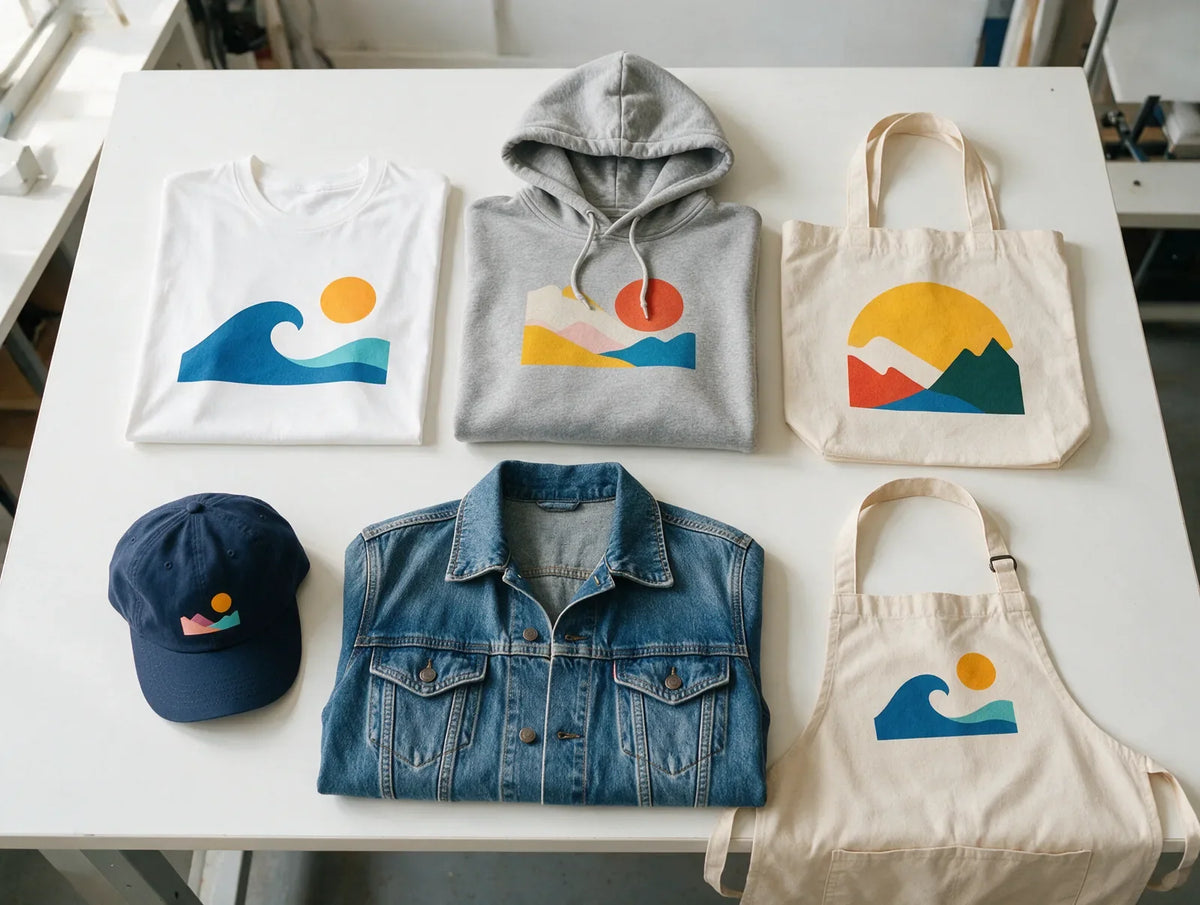
What can DTF transfers be applied to? Most fabric items that can lie flat under a heat press: t-shirts, hoodies, hats, tote bags, jackets, denim and aprons. Our transfers adhere to cotton, polyester, blends, tri-blends, canvas, denim, leather and nylon. Mugs, tumblers, glass and other hard surfaces need UV DTF instead, which we don't offer.
Key takeaways
- Standard DTF is made for fabric items that can lie flat under a heat press.
- Our transfers adhere to cotton, polyester, blends, tri-blends, canvas, denim, leather and nylon.
- Test nylon, leather, coated fabrics and non-woven bags on a spare before a batch.
- Mugs, tumblers, glass, metal and wood need UV DTF, which we don't offer.
- With our transfers, every item uses the same press settings; what changes is how you support it.
In this guide
- What can DTF transfers be applied to?
- What surfaces can you put DTF on?
- Can DTF go on any shirt?
- Hoodies and sweatshirts
- Hats and caps
- DTF on canvas bags and tote bags
- DTF on polyester, jackets and activewear
- Denim, aprons and workwear
- Leather and nylon goods
- Can DTF go on mugs, tumblers, glass or metal?
- How to press DTF on different items
- DTF transfer ideas beyond t-shirts
- Frequently asked questions
- Pick the item, test it, then press

What can DTF transfers be applied to?
DTF transfers can be applied to almost any fabric that takes a heat press, because heat and pressure melt the transfer's adhesive into the fibers. That's why one transfer can go on a cotton tee, a polyester jersey or a canvas bag. Here's how the common fabrics compare:
- Cotton. The everyday choice for tees and hoodies. Pre-press it first, because cotton holds moisture.
- Polyester and blends. Jerseys, performance shirts, poly-cotton blends and tri-blends all take DTF well.
- Canvas and denim. Heavy, sturdy fabrics that need firm, even pressure across the weave.
- Nylon and leather. Our transfers adhere to both, but finishes vary, so always test first.
Garment color isn't a limit either. Transfers include a white underbase, so designs stay bright on black, navy and other dark fabrics.
That's a real difference from sublimation, which needs polyester and works best on white or light fabric (see how DTF and sublimation compare). With DTF, the item's shape matters as much as its fiber: the whole design has to sit flat under the press, so seams, zippers, pockets and curves decide whether an item is easy or tricky. The sections below take them one at a time.
Standard DTF is made for fabric, so hard surfaces such as mugs and glass get their own section further down. Curious what's inside a transfer? Read how DTF printing works. If you're new to the process, start with our custom DTF transfers page.
What surfaces can you put DTF on?
Standard DTF goes on fabric. Cotton, polyester, blends, tri-blends, canvas and denim press well, nylon and leather need a test first, and hard surfaces such as mugs, glass, metal and wood need a different product, UV DTF, which we don't offer. The table below sorts common materials into three groups.
| Material | Standard DTF? | What to know |
|---|---|---|
| Cotton (tees, hoodies, totes) | Yes | A quick pre-press helps, because cotton holds moisture. |
| Polyester and performance fabrics | Yes | A cover sheet helps prevent shine; test dyed polyester for dye migration. |
| Cotton-poly blends and tri-blends | Yes | Same press settings as cotton and polyester. |
| Canvas | Yes | Firm, even pressure across the weave. |
| Denim | Yes | Keep rivets, pockets and thick seams out from under the design. |
| Nylon | Test first | Often thin, slick or coated; one jacket bonds, a similar one may not. |
| Leather | Test first | Finish and thickness vary; test a scrap or a hidden spot. |
| Water-repellent, silicone or coated finishes | Test first, often no | Coatings can stop any heat transfer from bonding. |
| Non-woven bags | Test first | A different, more heat-sensitive material. |
| Paper bags and cardboard | No | Not fabric; outside what our transfers are made for. |
| Vinyl, plastic and acrylic | No | Heat can soften or warp them; hard plastics use UV DTF. |
| Mugs, tumblers, ceramic, glass, metal and wood | No | Hard surfaces need UV DTF, which we don't offer. |
"Yes" means the material is on our fabric list and presses at our standard settings. "Test first" means the result depends on the finish of the item in front of you, so one spare tells you more than any chart. "No" means the material isn't fabric or can't take the heat.
Not listed? Check the fabric label: if it's one of the fabrics above and the item lies flat under a press, it's a candidate. Anything coated or heat-sensitive gets a test press on a spare first.
Which fabric works best with DTF?
Cotton and cotton-rich blends are the easiest: they take heat well, rarely shine and don't bleed dye into light inks. Polyester works just as well; a cover sheet helps prevent shine, and dyed polyester needs a quick test. Canvas and denim need firm, even pressure, and nylon and leather depend on the finish.
Every fabric on our list takes the same settings with our transfers, so choose the blank for its feel, fit and use. Our guide to the best blank t-shirts for printing compares popular options, and our fabric-by-fabric pressing tips cover the prep that changes from one fabric to the next.
Can DTF go on any shirt?
Almost any shirt made of cotton, polyester or a blend can take DTF, in any color. The exceptions are shirts with water-repellent or silicone finishes, very textured knits that keep the film from touching everywhere, and fabrics whose care label warns against heat.
T-shirts are the most common home for DTF. The design is printed on film first and heat pressed onto the shirt afterward, so one transfer works on light and dark shirts alike.
Cotton, polyester, blends and tri-blends all work, so you can choose a blank for its feel and fit rather than its fabric. Start with a clean, dry, wrinkle-free shirt (a quick pre-press helps), then press it on a flat, firm surface. Youth and toddler tees work the same way with a smaller design; our DTF size guide lists common widths.
Popular placements are a full front, a left chest logo, a full back and a sleeve print. On long sleeves, lay the sleeve flat with the seam folded out of the print area, or slip a small pressing pad inside it so the pressure lands on the design.
- Dark shirts. The white underbase keeps colors bright. On black, charcoal or deep heather shirts, Black Knockout DTF prints no black ink and lets the shirt itself show through.
- Performance shirts. Polyester takes DTF well. The polyester section below covers the extra care, and shirts with a coated finish need a test first.
- What a DTF shirt costs. A 12" × 12" transfer ordered by size is $4.51; the blank and your pressing time come on top. See DTF transfer prices for other sizes, and what to charge for a DTF shirt if you sell them.
Prefer finished shirts? Our custom t-shirts are printed for you, with no minimum order.
Hoodies and sweatshirts
Hoodies and crewneck sweatshirts take DTF well, whether they're cotton, polyester or a fleece blend. The challenge is thickness and hardware, not the fabric. Seams, a pouch pocket, zippers and drawcords can hold the press off parts of the design, so plan around them:
- Raise the print area. A pressing pillow under the front lifts it above pocket seams, so the pressure lands on the design.
- Mind the pocket. On pullovers, keep a full-front design above the front pocket, or plan a smaller chest print.
- Keep zippers and drawcords clear. On zip-ups, a left chest logo plus a full back design avoids the zipper entirely.
- Check your pressure. Thick fabric tightens the press, so ease it back a little when you switch from tees. The goal is still medium pressure.
Standard sweatshirt fleece presses well, because the print goes on the smooth outer face; polar fleece, brushed on both sides, is a test-first fabric. Hoods and sleeves can take a print too, as long as you can lay that panel flat with the seam off the platen. Browse our hoodies to compare styles and fabrics.
Hats and caps
DTF works best on caps with a flat or soft front panel. Those are the styles we decorate with DTF on our custom hats: flat-front and unstructured caps. Structured caps with a stiff, curved front and a center seam are harder, because the seam and curve keep parts of the design from getting full pressure.
Secure the transfer with heat tape so it can't slide on the curved front, and support the panel from inside with a hat pillow or pressing form. On trucker hats, keep the design on the solid front panel and off the mesh. The settings for our transfers don't change for caps; the tape and the support do.
Our guide to applying DTF transfers on hats covers sizes, beanies and a step-by-step routine. Prefer stitching? We embroider hats too, and our comparison of embroidered vs printed hats helps you choose.
DTF on canvas bags and tote bags
Canvas is one of the easiest materials for DTF: it's flat, sturdy and holds a crisp print, which makes DTF on canvas bags a popular choice for events, merch tables and everyday totes. To press one, slip a pressing pillow or a sheet of cardboard inside and keep the handles off the platen.
- Press it flat. Slide a pressing pillow inside the bag so the front panel sits level.
- Keep handles off the platen. Let the straps and bottom seam hang over the edge of the lower platen.
- Pick the right bag. Cotton and canvas totes are ideal. Non-woven bags are a different, more heat-sensitive material, so test one first.
- Skip coated canvas, or test it. Waxed, waterproofed or laminated canvas may not bond, so press a spare before a batch.

On a gusseted tote, press only the flat front panel and fold the side gussets back, so their seams stay outside the design. Zippered canvas pouches work the same way, with the zipper off the platen. The front of a standard tote typically fits a design about 8–10" wide. For every other placement, from a left chest logo to a full back, our DTF size guide lists common widths.
Need bags to press? Browse our tote bags and check each bag's fabric before you order.
A printed tote is washed like a printed shirt: inside out, in cold water, then air dried. For how long prints hold up on bags and hoodies, see how long DTF transfers last.
What about canvas boards and art canvases?
Canvas fabric is on our list, but an art canvas is stretched over a wooden frame or glued to a board, so a press can't reach it evenly and the frame or board can scorch or warp. Treat it as a test-first job. The easier route is to press unframed canvas flat and mount it afterward.
If you test one anyway, support the canvas from behind with a firm block that fits inside the frame, so it can't sag under the press.
DTF on polyester, jackets and activewear
Yes, DTF works on polyester, which makes it a strong fit for jerseys, performance tees, warm-up jackets and other athletic wear. That includes 100% polyester; DTF on polyester just needs a little more care than cotton:
- Use a cover sheet. Parchment paper or a Teflon sheet helps prevent shiny press marks on synthetic fabric.
- Watch for dye migration. On some dyed polyester, heat can draw the garment dye into light-colored ink. A test press on a spare shows you before it matters.
- Read the care label. If it warns against ironing or high heat, choose a different garment.
Moisture-wicking shirts are usually polyester with a finish that moves sweat away from the skin. Many take DTF like any polyester, but some finishes resist the adhesive, so press one shirt from each new style before the rest. Jerseys with open mesh or a heavily textured knit are trickier, because the film only touches the raised parts, so put the design on a smooth panel.
Jackets add seams, zippers, linings and sometimes a water-repellent coating. Choose a flat area for the design, such as the left chest or upper back, keep hardware off the platen and test coated shells first. Many windbreakers are nylon, so read the leather and nylon section below as well.
Pressing team jerseys with names and numbers? Lay them out player by player on a names-and-numbers gang sheet. Fully sublimated uniforms are a separate service; see our sublimated team uniforms.
You may see lower temperatures suggested for polyester elsewhere. With our transfers, use the one setting in our DTF application guide on polyester too; our DTF heat press settings guide covers temperatures and press times fabric by fabric.
Denim, aprons and workwear
Denim jackets, work shirts and aprons are sturdy, so they handle heat well. They just need firm, even pressure across a thick weave.
- Denim. Pre-press to flatten the print area, and keep rivets, pockets and heavy seams out from under the design. The back of a denim jacket is a classic spot for a large print.
- Aprons. The bib is the natural print area. Lay it flat, keep straps and pockets off the platen and size the design to fit between them. Our aprons collection has blanks to start with.
- Work shirts. Left chest and full back placements avoid button plackets and pocket flaps.
On jeans, slide a pad inside the leg so the print area sits above the side seams, and keep the design small enough to stay on the flat part. Many work shirts and aprons are cotton or poly-cotton twill, both covered by our fabric list, so they press like a tee once the hardware is out of the way. Prefer a stitched logo? We also offer custom embroidery on workwear.
Leather and nylon goods
Our transfers adhere to leather and nylon, but these two vary more than anything else on this list. Leather changes with its finish and thickness. Nylon on windbreakers, drawstring bags and backpacks is often thin, slick or coated, so one item can bond well while a similar one from another maker doesn't.
That's why a test press comes first. Follow the settings in our DTF application guide, use a cover sheet and press a scrap, a hidden spot or a spare item before you commit to a batch. Once it has cooled and been peeled, check that the edges hold and the material shows no marks or shine.
If the test doesn't pass, choose a different item rather than guessing at new settings.
Faux leather is a different case: it's usually a plastic coating on a fabric backing, so treat it like any coated material and expect some pieces to fail the test. Suede and other napped leathers are harder still, because the raised surface keeps the film from touching evenly.
Another way around a fussy bag or jacket: press the design onto a flat cotton or canvas patch, then stitch the patch on.
Can DTF go on mugs, tumblers, glass or metal?
Not standard DTF. It's made for fabric: the adhesive needs fibers to grip, and the item has to lie flat under a heat press. Mugs, tumblers, cups, ceramic, glass, metal and wood call for UV DTF instead, a cold-applied decal, and we don't offer UV DTF.
Pressed onto a mug, a glass or a metal tag, a regular transfer has nothing to sink into, and a flat press can't reach a curved surface evenly, so the print won't hold the way it does on a shirt. Wood is rigid and can scorch, so it's no better. Coated mugs are also commonly sublimated; our own sublimation work covers blankets, towels and team uniforms.
What is UV DTF?
UV DTF is a decal printed with UV-cured inks onto a film with an adhesive layer. You press it onto the item by hand like a sticker, then peel away the top film, with no heat press. It's made for smooth, hard surfaces, not clothing.
The "DTF" cup wraps and tumbler decals you see for sale are usually UV DTF, not heat-press transfers like ours. UV DTF isn't a shortcut for clothing either: the decal is stiff and isn't made to flex or go through the wash with fabric. We don't offer UV DTF. For fabric, standard DTF is the right product, and that's what we print.
Can DTF go on vinyl or plastic?
Not standard DTF. Vinyl (PVC) and most plastics soften or warp under a heat press, and they have no fibers for the adhesive to grip, so the print won't bond the way it does on fabric. Hard plastic items such as phone cases and signs are a job for UV DTF.
If you meant DTF versus heat transfer vinyl on shirts, our guide to DTF vs vinyl on shirts compares the two.
Paper bags, boxes and DTF transfer paper
Paper and cardboard aren't on our fabric list, and they can scorch under a press, so we don't recommend them for our transfers. Searching for "DTF transfer paper" to run through a cutting machine? Our transfers aren't paper: they arrive printed on clear film, ready to press, with no cutting machine needed.
Trim around each design with scissors and press it with a heat press, or with a household iron in a pinch. Our guide to pressing at home with an iron or a small press walks through both.
How to press DTF on different items
The settings for our transfers stay the same from item to item: 320°F (160°C), medium pressure, 15 seconds, a cold peel and a 5-second finishing press under parchment or a Teflon sheet. What changes is how you support each item so the whole design gets even pressure.
The first press needs no cover sheet, though one helps prevent shine on synthetic fabric, and a quick pre-press is optional. Support matters because a seam, zipper or pocket edge holds the platen up around it, which can leave part of the design under-pressed and likely to lift later.
| Item | Support it with | Keep off the platen or watch for |
|---|---|---|
| T-shirts and long sleeves | The flat platen; a pad inside sleeves | Side and sleeve seams |
| Hoodies and sweatshirts | A pressing pillow under the print area | Pocket seams, zippers, drawcords |
| Hats | A hat pillow or pressing form; heat tape on the transfer | The center seam and the bill |
| Tote bags | A pillow or cardboard inside | Handles and the bottom seam |
| Denim jackets | A pillow under the print area | Rivets, pockets, thick seams |
| Aprons | The flat platen | Straps and pockets |
| Jackets and bags | A pillow under a flat area, such as the left chest or upper back | Zippers, linings, coated shells (test first) |
| Leather and nylon goods | A cover sheet, after a test on a scrap or hidden spot | Marks, shine or lifting edges on the test piece |
For the full routine, step by step, follow our DTF application guide. If a print lifts or won't stick, our DTF troubleshooting guide covers the usual causes.
Pressing tees, hats and totes with the same logo? Put each size on one sheet in the free Gang Sheet Builder, where small hat and chest prints fit into the gaps around larger designs.
DTF transfer ideas beyond t-shirts
Anything on the fabric list that can lie flat under a press is fair game, so good ideas start with who will use the item. Here are items that work well with DTF, grouped by occasion:
- Events and fundraisers. Canvas totes and tees for walks, festivals and merch tables, with the date or a sponsor list on the back.
- Cafes and makers. Aprons with a logo on the bib, plus flat-woven cotton tea towels for the counter or a market stall.
- Teams and clubs. Polyester jerseys, warm-up jackets and drawstring bags; test coated bags and shells first.
- Businesses and crews. Work shirts with a left chest logo, hats for the whole crew and a large print across the back of a denim jacket.
- Family events. Matching tees with a different name on each; our family reunion shirt ideas have more.
- Home and pets. Cotton or canvas pillow covers and cotton pet bandanas, pressed flat before the insert goes in or the bandana is tied.
With no setup fees and no minimums on DTF transfers, you can try a small run of any idea before you commit to a bigger order.
Selling what you make? Our guides to DTF ideas to sell on Etsy and starting a t-shirt business with DTF cover niches, pricing and the first steps. Blankets and beach towels printed edge to edge are a different process: we make those with dye sublimation, so see our custom blankets instead.
Frequently asked questions
Will DTF stick to a canvas bag?
Yes. Canvas is on our fabric list, and its dense weave gives the adhesive plenty to grip, so a tote holds a crisp print. Check the bag first: waxed, waterproofed or laminated canvas and non-woven totes may not bond, so test one before a batch. Plain cotton canvas is the easiest kind to press.
What temperature do you press DTF on a canvas bag?
The same as any item with our transfers: 320°F (160°C), medium pressure, 15 seconds. Let the film cool completely, peel, then press 5 seconds under parchment or a Teflon sheet. Some guides suggest a hotter press for thick canvas; follow the settings for the transfers you're using, with a pillow inside and the handles off the platen.
Can you put DTF on polyester or nylon tote bags?
Yes. Polyester and nylon are both on our fabric list, so our transfers work on those totes too. Nylon is often thin, slick or coated, so press a corner or a spare bag first, with a cover sheet over the design. For a white polyester tote with an edge-to-edge design, sublimation is the other option; our DTF vs sublimation guide compares the two.
Is DTF better on cotton or polyester?
Both work with our transfers at the same settings, so pick the fabric for the garment, not the print. Cotton is the most forgiving, with little risk of shine marks and no dye bleeding into light inks. Polyester suits sportswear; a cover sheet helps prevent shine, and dyed polyester should get a test press for dye migration first.
Does DTF work on spandex or other stretchy fabric?
Yes, on blends where the main fiber is cotton or polyester, such as poly-spandex performance wear. The print stretches with the fabric, but large solid areas on very stretchy garments flex the most and are more likely to crack over time, so open designs hold up better. Don't stretch the print while it's still warm.
Can you put DTF on a backpack?
Yes, on a flat fabric panel such as the front pocket, if it's polyester or nylon without a heavy coating. Empty the bag, support the panel from inside so it lies flat, and keep zippers and straps off the platen. Test nylon, coated or padded areas first; small designs are the easiest. Browse our backpacks and check the fabric before you order.
Can you put DTF transfers on towels?
Flat-woven cotton towels, such as tea and kitchen towels, press like any cotton item. Looped terry, the fluffy weave on most bath towels, can leave gaps under the film, so test one first or choose another method. Our printed beach towels are dye sublimated, and we embroider cotton towels.
Can I put a DTF transfer on top of another DTF transfer?
It can be done, but it's rarely the cleanest option. The top transfer bonds to the print underneath instead of the fabric, so the stack is thicker and stiffer, and its edges are more likely to lift. Merge both elements into one design or place them side by side. If you must layer, or press over vinyl, test on a spare first.
Can I apply DTF to acrylic?
Not standard DTF. Acrylic is a hard plastic with no fibers for the adhesive to grip, and a heat press can warp it. For acrylic signs, keychains and displays, the decal-style option is UV DTF, which we don't offer. Standard DTF, the kind we print, is made for fabric.
Can DTF be put on with an iron?
In a pinch, yes. A household iron works if you press firmly over every part of the design, but a heat press gives the most even results. Flat cotton items such as tees and totes are the easiest to iron; curved hat fronts, thick hoodies and designs that cross seams are much harder. Our guide to applying DTF transfers with an iron goes step by step.
Pick the item, test it, then press
DTF covers most of what people want to decorate. Stick to fabric, support the print area so the pressure is even, and test anything unusual, like leather, nylon or coated materials, before a full batch.
The free DTF transfer sample pack is an easy way to run that test on your own items. You pay $4.99 for shipping and get it back as $4.99 store credit, or pick it up free in Alpharetta.


